
In Mannheim, Germany, on June 12, 1817, an inventive local named Karl von Drais introduced an innovative creation to the public. This invention, known as a laufmaschine or "running machine" in German, can be considered the world's first bicycle. Unlike modern bicycles, it lacked pedals, a seat, and a chain connecting the wheels. Instead, riders propelled the laufmaschine with their feet and relied on balance once they gained sufficient momentum. While rudimentary, the contraption proved functional. On that summer day, von Drais showcased his machine by covering approximately 7 kilometers in about an hour.
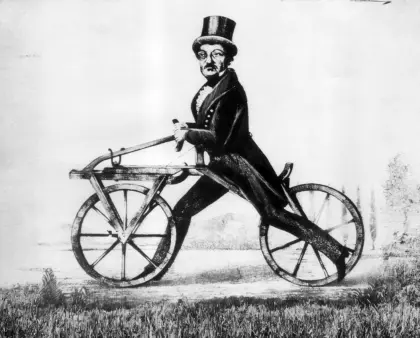
Opinions regarding the laufmaschine varied widely. Some enthusiasts considered it on par with the groundbreaking invention of the wheel by early humans, envisioning a future where bicycles would reign supreme in transportation. Others, however, dismissed it as a frivolous and hazardous creation. The press often ridiculed Karl von Drais's invention, derogatorily labeling it a "dandy horse." In fact, several governments, including those in the United Kingdom, the United States, and Germany, banned its use due to concerns about endangering pedestrians.
Government ban cannot stop an idea
Despite the initial criticisms and restrictions, the evolution of the bicycle persisted over the following decades, capturing public interest. By the early 1880s, cycling had gained immense popularity. Even the Queen of England embraced the trend, owning her own bicycle and making it highly fashionable among the British elite.
During that time, the most advanced bicycle design in the world was known as the 'penny-farthing,' which you might have seen in old photographs. It featured an exceedingly large front wheel paired with a small rear wheel. The penny-farthing offered remarkable speed, but it was also incredibly unstable. Cyclists zooming along at high speeds often found themselves unexpectedly somersaulting over the handlebars after encountering one of London's numerous potholes—a mishap humorously referred to as "taking a header."

The burgeoning popularity of bicycles spurred inventors and engineers throughout Europe to dedicate themselves tirelessly to developing new and safer designs. Such was the concentration of brainpower on cycling that, by 1896, a remarkable 15% of British patents were granted for bicycle innovations.
The entire industry experienced explosive growth. Bicycle factories, tire manufacturers, repair shops, and sales outlets appeared everywhere. In the city of Birmingham alone, the number of bicycle manufacturers skyrocketed from nearly nonexistent in the early 1880s to 177 by the mid-1890s.
The British Bicycle Bubble
'Bicycle mania' was sweeping across the nation, and it didn't take long for the financial sector to take notice. In 1895, 70 bicycle-related companies were listed on stock exchanges in the United Kingdom. By 1896, that number had surged to 363, and within the first half of 1897, an additional 238 companies joined the list.
Most of these companies lacked substantial assets. They lacked valuable intellectual property, revenue-generating plans, professional management, engineering expertise, and profitability prospects. Yet, by simply associating themselves with the bicycle business, their stock prices soared.
Bicycle stocks became so popular and appreciated so rapidly that the Financial Times dedicated a section of its daily newspaper to the industry, while Cycling magazine included a financial section discussing stock prices in the field.
However, the bicycle sector experienced a significant downturn in the middle of 1897, with the 'Bicycle Index' plunging over 70% from its peak by the end of 1898. By 1900, approximately half of the bicycle companies that had gone public were no longer operational.
Throughout this period, skeptics in the media viewed bicycle mania as a scam or dismissed the technology as nonsense. After the late 1890s bust, these skeptics reveled in the downfall of the collapsed companies, believing they had been proven right.
However, the skeptics were ultimately proven wrong. When the bicycle bubble burst, subpar companies and flawed designs were washed away, but resilient businesses and exceptional designs endured. Dunlop Tires serves as an excellent example, as it remains one of the world's largest tire brands today, with its origins tracing back to Bicycle Mania in 1890.
Moreover, the fundamental technology of bicycles has proven to be remarkably robust. Bicycles have become a ubiquitous mode of transportation worldwide and played a significant role in influencing the development of automobiles.
Riding the Boom and Bust
Similar to historical financial bubbles triggered by emerging trends and technologies, the dot-com boom of the 1990s serves as a prime example. During that period, numerous impractical ideas and futile companies went public. When the bubble eventually burst, many of them disappeared forever. However, amidst the chaos, several successful businesses emerged and continue to dominate today, including Amazon, Google, and Nvidia, which were founded during the frenzy of the 1990s.
Importantly, the bursting of the dot-com bubble did not negate the transformative potential of the Internet and its profound impact on our lives.
Bitcoin's Resilience: Thriving Amidst Market Challenges and FUD
Drawing parallels to the present, Bitcoin is the latest technology experiencing this boom-and-bust cycle. The cryptocurrency has undergone multiple cycles of euphoria and collapse within its relatively short existence. In the last cycle, the price of Bitcoin plummeted by 70% from its peak, prompting some critics to claim vindication in predicting its demise. However, history has shown that such declarations are often misguided.
Throughout this journey, skeptics have labeled Bitcoin as a "scam" and deemed it "dangerous." However, it is worth remembering that bicycles faced similar opposition in the early 1800s, with multiple governments even outlawing them due to concerns about their perceived dangers.
The fact that a technology attracts speculative boom-and-bust capital does not inherently reflect its intrinsic value. Rather, it demonstrates the market's tendency towards irrationality. This pattern was observed with bicycles, the Internet, and is likely to persist with Bitcoin too. The temporary market downturn that Bitcoin is currently experiencing holds no bearing on its underlying value. History has consistently favored innovation, even if some governments decide to ban themselves from it.
I kindly invite you to share your thoughts in the comments section regarding what you enjoyed or found lacking in this piece. As a novice writer, I highly value any constructive criticism that can help me improve my skills and deliver better content in the future. Your feedback is greatly appreciated.
Thank you all.






