
Bill Ackman’s Pershing Square Capital Management continues to operate with uncompromising focus, a strategy that commands significant attention in volatile markets. Analysis of the latest Bill Ackman portfolio reveals a profound strategic evolution: an increased reliance on high-growth infrastructure and the structural use of hedges to protect concentrated capital. The extreme concentration means any portfolio adjustment signals a high-conviction thesis shift.
The Strategic Shift: UBER and BN Domination
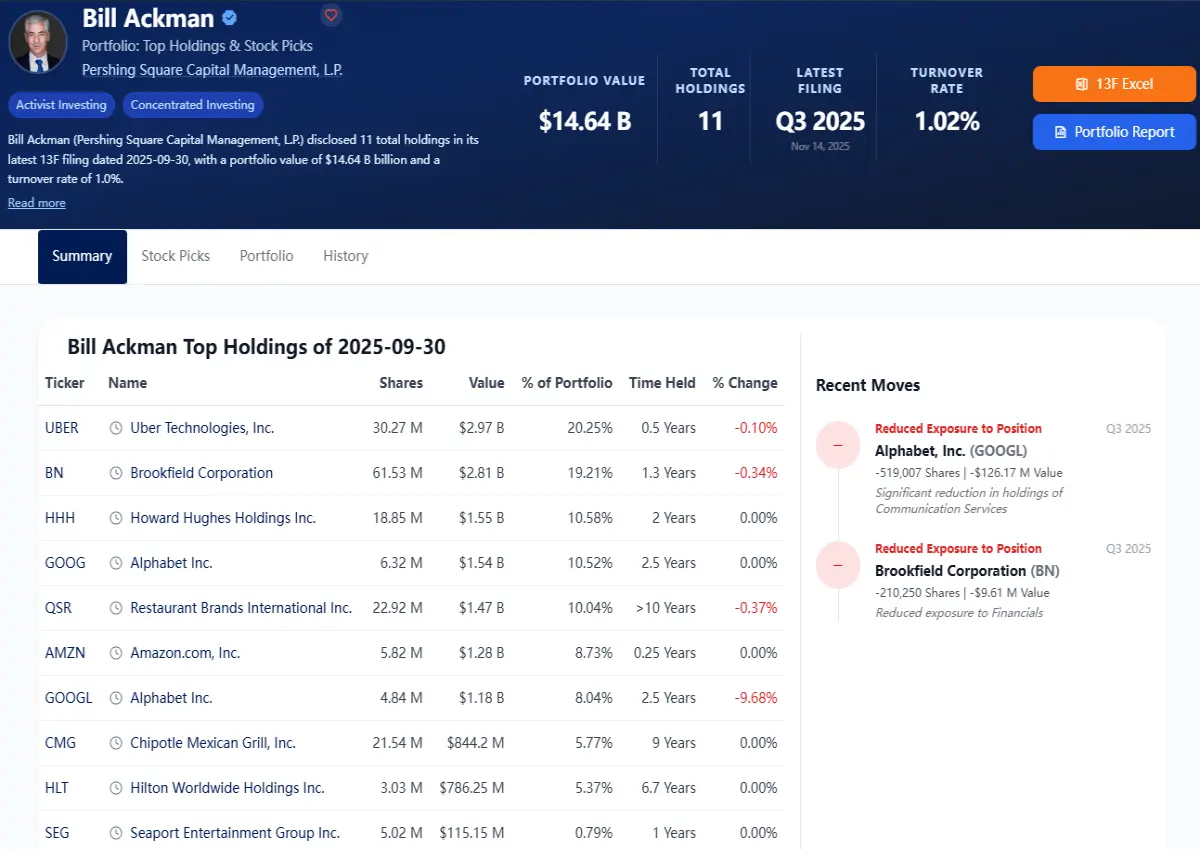
While the firm's total public equity holdings stand at 11 unique positions, the portfolio is defined by the massive capital allocated to its top names. The two largest holdings, Uber Technologies ($UBER) and Brookfield Corporation ($BN), combine to account for over 39% of the portfolio's total market value. This concentration signals a strategic evolution from purely domestic consumer staples to global infrastructure and logistics platforms, where growth is secured by network effects and real assets.
High-Impact Macro Hedges: The True Defense
Pershing Square famously utilizes complex financial derivatives to manage systemic risk that is not captured by stock diversification. Ackman frequently employs instruments, such as interest rate swaps, to hedge against unforeseen macro risks like sudden inflation spikes or interest rate volatility. This highly sophisticated defense layer mirrors the firm's historical use of successful hedges during periods of market dislocation, designed to buffer the concentrated stock bets from sudden, high-impact systematic volatility.
Ultra-Low Turnover and Tactical Opportunities
The Bill Ackman portfolio is characterized by ultra-low turnover, with annual rates often under 20%. This confirms the commitment to multi-year, activist investment mandates. Furthermore, the inclusion of smaller, tactical holdings like Hertz Global Holdings ($HTZ) and Seaport Entertainment Group ($SEG), which account for less than 1.5% of the portfolio combined, shows tactical flexibility in pursuing special situation value that requires minimal capital allocation.






