
The past week has been a brutal reminder of the fragility of narrative-driven markets. As the "AI Efficiency" shockwave—triggered by the DeepSeek revelations—tears through the semiconductor sector, retail investors are panic-selling Nvidia and AMD at alarming rates. Yet, amidst this sea of red, the quantitative giants remain stoic. A closer look at the market behavior suggests that sophisticated algorithms are not fleeing; they are re-calibrating.
For those tracking the renaissance technologies stock positions, the current volatility is likely viewed less as a crisis and more as a data point. Unlike human traders who suffer from recency bias, the firm's legendary Medallion-style models rely on historical probability and mean reversion. The 13F trends indicate a portfolio that is structurally immune to the collapse of any single sector, thanks to a strategy that prioritizes extreme diversification over concentrated bets.
1. The Pivot to "Application Layer" Stability
While the hardware infrastructure trade (chips) is seeing a violent multiple compression, the "application layer" of technology remains resilient. Recent filings suggest a sustained interest in software companies that have embedded moats. Positions in data analytics firms like Palantir (PLTR) and cybersecurity leaders indicate a preference for "sticky" revenue. The logic is clear: even if AI models become cheaper to run, companies will still need security and data integration. This is the classic "picks and shovels" play, but shifted away from the crowded hardware manufacturing space.
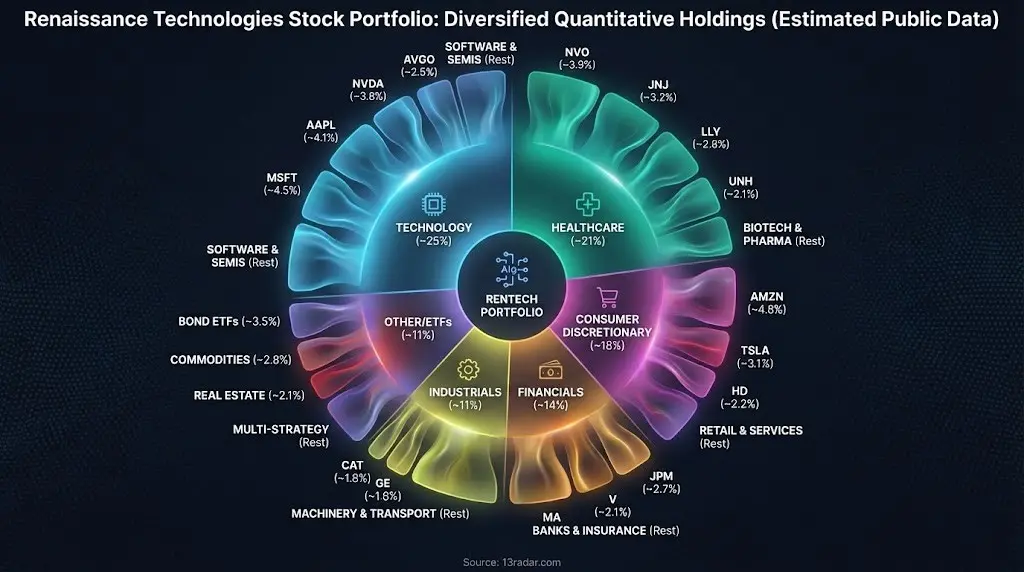
>>> QUANT INSIGHT: The "Anti-Fragile" Approach
How does a black box survive a crash?
- 📉 Short-Term Arbitrage: High-frequency models often act as liquidity providers, buying the dip when spreads widen due to panic.
- ⚖️ Market Neutrality: By holding thousands of long positions against short hedges, the net exposure to "market beta" is minimized.
- 🔄 Rapid Rebalancing: An algorithm doesn't "hope" a stock comes back; it cuts exposure the millisecond momentum signals turn negative.
2. The "Long Tail" of Small Caps
The most dangerous place to be in 2026 is in the "crowded trade." For years, capital has clustered in the Magnificent Seven. However, quantitative funds have consistently maintained exposure to the "long tail"—the thousands of mid-cap and small-cap stocks that index funds ignore. As liquidity drains from the mega-caps, it often seeks refuge in these undervalued pockets. The portfolio's vast array of industrial and consumer service holdings provides a natural buffer against the tech-heavy Nasdaq correction.
3. Volatility is the Fuel
It is a common misconception that funds hate volatility. For market-neutral strategies, volatility creates price dispersion—the raw material for generating alpha. As correlations between stocks break down (e.g., Nvidia falls while Walmart rises), the opportunities for statistical arbitrage increase. While the average investor sees risk, the algorithm sees a target-rich environment for pair trades.






