
Oscar Health occupies a unique and often volatile space at the intersection of Silicon Valley technology and traditional health insurance. Because it is priced partly as a tech platform and partly as an Affordable Care Act (ACA) provider, its valuation can swing dramatically based on retail momentum and forward-looking guidance. However, when the stock experiences a massive run-up, investors must ask a critical question: is the rally sustainable? To find the answer, one must look directly at the behavior of Oscar Health’s core leadership team and their personal portfolio decisions.
Contextualizing Oscar Health's Market Premium
Unlike legacy insurers, Oscar Health relies heavily on rapid membership growth and its proprietary technology stack to justify its market premium. When macroeconomic conditions favor growth stocks, retail capital floods into the ticker. Yet, corporate leaders have a much more sobering view of the actual balance sheet. Recent Form 4 filings show a noticeable increase in executive sales across major tech-enabled healthcare platforms following extended market rallies. When the architects of a company begin liquidating significant tranches of shares, it serves as a crucial warning that the stock’s current price may have fully baked in all near-term operational successes. They are locking in multi-million dollar gains before the next earnings cycle potentially resets expectations.
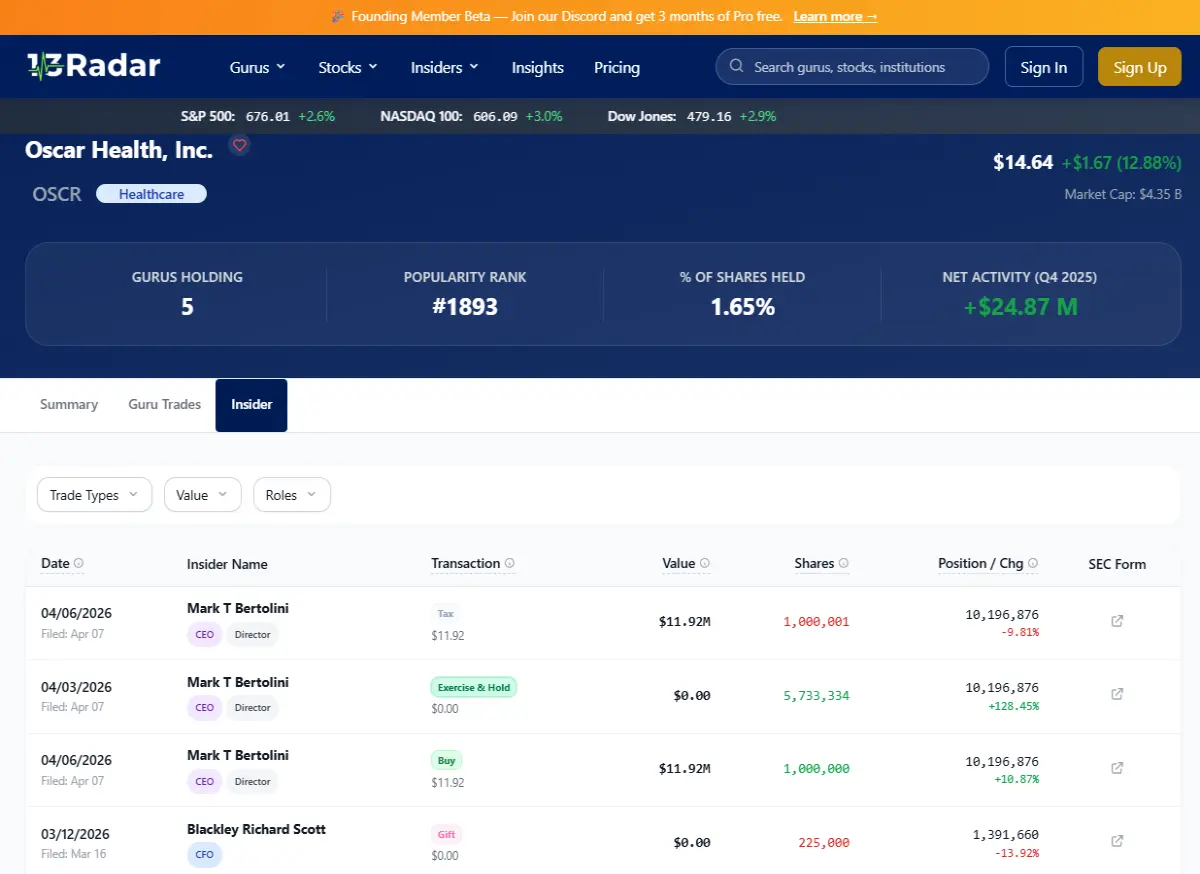
Deciphering the Oscar Health Distribution Cycle
Understanding the exact timing of these executive maneuvers is what separates institutional alpha from retail losses. Tracking the precise velocity of OSCR insider selling allows traders to contextualize the prevailing market sentiment against the cold, hard reality of the C-suite's actions. If the Chief Financial Officer or key board members are actively trimming their exposure while public analysts are projecting endless growth, it creates a glaring fundamental divergence. Management knows precisely where their medical loss ratios (MLR) are trending and whether their pricing strategies will hold up in the upcoming enrollment season. Ignoring their exit signals is a dangerous game for any investor holding a long position.
⚠️ Key Triggers for Insurtech Insider Liquidations ⚠️
When assessing why Oscar Health insiders might be hitting the bid, savvy investors must evaluate specific company-centric catalysts rather than just broad market trends. A sudden spike in executive offloading is frequently driven by internal data points that the public has not yet fully digested:
- Medical Cost Inflation: Insiders sell when internal dashboards show rising claims costs threatening to compress profit margins before the public quarterly reveal.
- Regulatory Pressures: Approaching changes to Medicare Advantage or ACA reimbursement rates often prompt risk-averse executives to cash out early to protect their personal net worth.
- Valuation Reality Checks: When a stock's multiple expands purely on software-centric hype rather than actual premium revenue, leadership will systematically distribute shares to capitalize on the retail exuberance.






