For years, Michael Saylor's message was simple.
Buy Bitcoin. Hold Bitcoin. Never sell Bitcoin.
That philosophy transformed Strategy from a traditional software company into the world's most famous corporate Bitcoin treasury. It also helped create one of the strongest narratives in the entire crypto industry.
But now, something has changed.
And while the amount involved may seem insignificant, the implications could be much larger than most investors realize.
Strategy Sells Bitcoin For The First Time
Strategy has officially sold a portion of its Bitcoin holdings for the first time in its history.
According to the company's disclosure, 32 BTC were sold at an average price of roughly $77,000 per coin.
Financially speaking, the transaction is almost irrelevant.
Strategy still controls one of the largest Bitcoin reserves on Earth, and the sale represents only a microscopic fraction of its total holdings.
Yet markets are not reacting to the amount sold.
They're reacting to what the sale represents.
For years, Saylor built the Strategy brand around the idea that Bitcoin should never be sold. That principle became almost sacred among Bitcoin supporters.
The moment a company known for "never sell" starts selling—even a tiny amount—the narrative changes.
Why Sell Only $2.5 Million Worth Of BTC?
The interesting part is that Strategy wasn't exactly desperate for cash.
The company reportedly still has close to $900 million in cash reserves.
That raises an obvious question:
Why sell Bitcoin at all?
The most likely explanation is that Strategy is testing a more flexible financial model.
Saylor has previously hinted that selective Bitcoin sales could eventually be used to cover dividend obligations instead of relying exclusively on new stock issuances or preferred share offerings.
In other words, Strategy is not abandoning Bitcoin.
It's simply giving itself more options.
And that's where things get interesting.
Because if Bitcoin can be sold today to fund dividends, investors must also consider the possibility that Bitcoin could be sold again in the future whenever market conditions become less favorable.
A small sale today could establish a precedent that becomes much more important later.
Meanwhile, BitMine Is Doing The Exact Opposite
While Strategy introduces flexibility into its Bitcoin strategy, BitMine is doubling down on Ethereum accumulation.
The company, chaired by Tom Lee, purchased another 26,497 ETH during the past week, spending approximately $52 million.
That brings BitMine's total Ethereum holdings to an astonishing 5,416,901 ETH.
To put that into perspective, the company now controls roughly 4.49% of Ethereum's entire circulating supply.
Even more remarkable?
BitMine has already achieved about 90% of its publicly stated goal of owning 5% of all ETH in circulation by 2026.
Tom Lee's Massive Ethereum Bet
Tom Lee believes the market is still underestimating Ethereum.
His thesis rests on two major trends.
The first is Wall Street's growing interest in tokenized assets.
Banks, asset managers, and financial institutions are increasingly exploring tokenization, and Ethereum remains the dominant infrastructure layer for much of that activity.
The second driver is artificial intelligence.
Lee argues that AI-powered systems may eventually require neutral, public blockchain networks to handle verification, ownership, settlement, and coordination functions.
If that vision becomes reality, Ethereum could become one of the most important digital infrastructures on the planet.
At least, that's the bet BitMine is making.
Bitcoin Flexibility vs Ethereum Accumulation
What makes this story fascinating is the contrast.
Strategy is showing that even the strongest Bitcoin treasury may eventually need operational flexibility.
BitMine, on the other hand, is still in full accumulation mode and appears determined to acquire as much ETH as possible.
One company is slightly softening its stance.
The other is becoming even more aggressive.
Neither move guarantees success.
But together, they reveal something important about where institutional crypto investing may be heading next.
The era of simply buying and holding might be evolving into something much more complex.
And investors are watching every move.
What do you think?
Is Strategy's Bitcoin sale a non-event, or does it break one of the most important unwritten rules in corporate Bitcoin investing?
🔥 MY PASSIVE EARNINGS: What I’m farming right now🔥
1. GRASS — (DePIN/AI)
Grass is a decentralized network that lets you turn your unused internet bandwidth into crypto rewards!
Just install the browser extension, desktop app (2× rewards) or mobile app (3× rewards) — and start farming Grass Points automatically while you browse.
🔥 At the end of each season, your Grass Points are converted into $GRASS tokens — and Season 1 has already rewarded thousands of users (including me!).
👉 Farm Grass airdrop now: https://app.grass.io/register?referralCode=lNAoYuHQUPN22mF

2. UPROCK — (DePIN/AI)
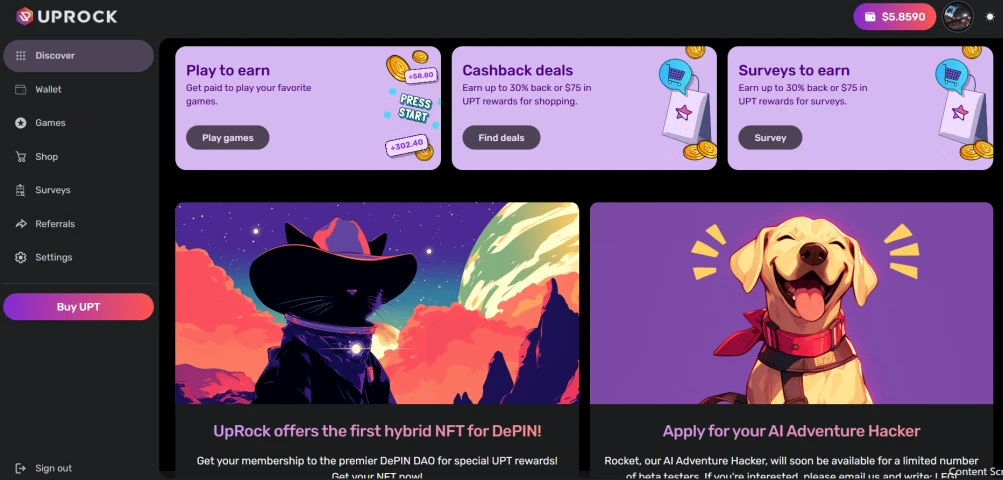
Earn $UPT in multiple ways: share your unused internet (desktop & mobile), watch videos (mobile only), play games, answer surveys and complete simple tasks.
👉 Start earning $UPT now: https://link.uprock.com/i/f38853d4