
In a previous article I reviewed a few factors that affected bitcoin valuations in 2025. Now I want to take a closer look at the first of those factors; the 2024 Halving.
First of all, let’s talk about the bitcoin blockchain. Every bitcoin transaction block must be verified and entered into the ledger (blockchain). That requires computational power, so the people providing that service must be rewarded or the system would collapse. These are the so-called Miners, and they receive rewards in the form of newly minted bitcoin for every block that is added to the blockchain.
These miner rewards are the only new bitcoins that can be created, so the total number of existing bitcoins grows with every block reward that is awarded. Now, as with any traditional currency, if you increase the supply of the currency it will tend to reduce its value, that is the basis of inflation. It stands to reason to assume then that reducing the rate at which new bitcoins are created would lower the inflationary pressure created by this new supply.
There have been four Miner Reward Halving since the bitcoin blockchain was created
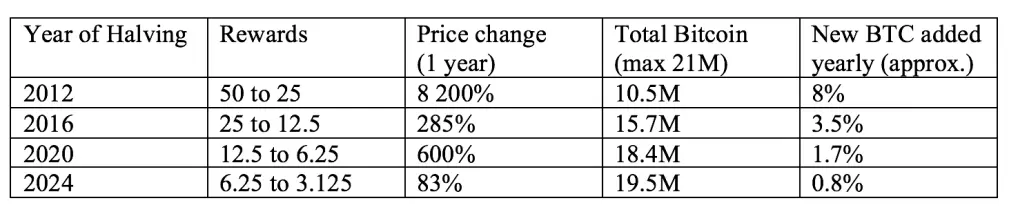
As can be seen in this table, the percentage weight of the new bitcoins mined yearly keeps going down with every halving event. Now, it must be noted that before the first halving new BTC were being added at an astonishing 25% yearly rate.
It is easy to see how halving affects bitcoin valuations by the simple laws of supply and demand. But it must be noted that the effect is proportional to the weight of the new bitcoin supply relative to the volume of bitcoins already in the market. The fact that new bitcoin account for only 0.8% of the total volume suggests that the effect of halving is reaching the point where it could soon be dismissed.
But that is not the case yet, there has been an increase in the price of bitcoin, from around USD 63K at the time of the halving to USD 87K at the present time. There have been other factors at play, but the historical record remains.
One of the other factors that moved bitcoin valuations in 2025 was the increasing involvement of traditional financial institutions. I shall explore that factor in my next article.






