
Hello
You've probably read or seen it directly from your app when you opened it this morning. The MCO is dead… Long live the CRO!
A hot little article to explain what's going on, in French for those who are a little lost. And my 1 st impressions. Above all, this is to get your opinion too!
Convert your MCO to CRO
The long term goal for CDC is to stop using the MCO and have the whole ecosystem go through the CRO. Basically this decision makes a lot of sense, even if the transition to, in my opinion, was very poorly managed.
The conversion rate is calculated by dividing the average MCO price during the last 30 days by the average CRO price during this same period.
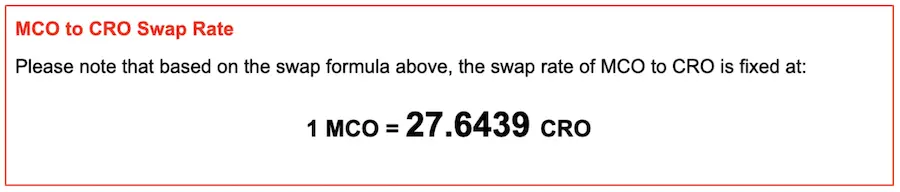
If you swap before September 2, you will get 20% bonus and the rate will be: 1MCO = 33.1726 CRO. So remember to do it before September 2nd!

When you do this conversion, whether your MCOs are stakes for the card, in EARN or simply in your wallet, you will receive the CROs in the same place.
example: if you have 100 MCO in earn for 3 then you will receive 2764.39 CRO. With 16% interest and with the same duration of EARN you have left.
However, be careful! the 20% bonus, will go on the exchange and will be stakes on the exchange. That is to say for 6 months and with 20% internet.
Also note that if you already had CRO stakes on the exchange (for 6 months), then the 6 month stake period will be reset. If you only had a few days / weeks left, you are leaving for 6 months !!!
Do the swap
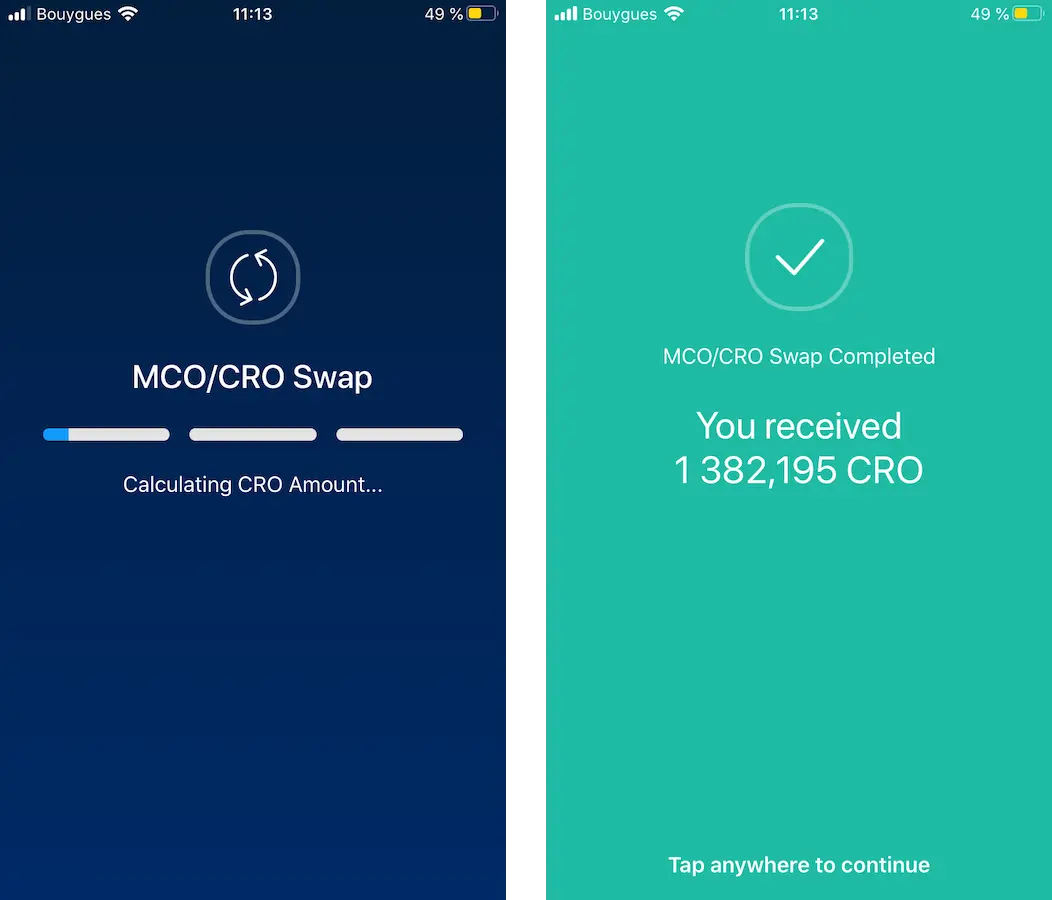
Making the swap is very easy. Just click on the new window that appears when you update the application. Then just follow the steps. I personally had to do the conversions one by one. It is possible to convert all the MCOs in the app in 1 click (stake for the card, EARN, Wallet) but it did not work for me.
New tiers for cards
At the current rate (1 CRO = $ 0.17) here are the new rates for obtaining MCO cards:
5,000 CRO card = $ 850
50,000 card = $ 8,505
500,000 = $ 85,050
5,000,000 card = $ 850,500
If we take the example of the 50MCO card for example, this card has been around 200 - 250 $ for some time (the MCO stagnant between 4 and 5 $).
If the CRO does not decrease (or worse, increase), acquiring a metal card will become very expensive. Is this compatible with the urge for mass adoption? I have a doubt…
It would seem (to be taken with a grain of salt because this info has not yet been verified) that once the 6-month period is over, and if you had the 50MCO card for example and you therefore received 1,382 MCO, you will not don't have to staker 5,000 CRO. It seems that it is possible to keep the advantages of the card while only storing those 1,382MCO. For my part, I really hope that will be the case. Otherwise there is a good chance that I will look elsewhere….
My opinion
At first glance and hot my reaction was not good. Why change a system without warning? transparency at CDC was not their strong point, but it is still reaching another level.
The +
To see the positive side: An ecosystem based on a single token still makes more sense. The MCO was not used much. In addition, CDC will (or has already) launched its own blockchain for the CRO.
Your former MCOs are now earning you a lot more interest. The cashback will also be paid in CRO, and you will therefore also have 12% interest (minimum) in addition to your cashback if you put it in EARN (provided you can reach the minimum required for this of course).
The -
First of all, transparency. What is CDC looking for in doing this? why not have warned users in advance Why did you mention the White paper and the fact that the OLS would increase because of it. That having a card was going to become scarce given the amount of MCO in circulation. Many articles explained by A + B that the OLS would increase because of all these factors and the fact that CDC is aiming for mass adoption!
We end up with a card that we get with CRO, which is almost unlimited. So it's a winner for CDC. With potentially more customers and therefore more sales. But is this serious? the card, even formerly at 50 MCO, is becoming very expensive and is no longer accessible to everyone. Is this consistent with mass adoption? With cashback now in CRO, many people risk reselling it. Are we therefore going to see a stabilization in the price of CRO?
I'm also having a lot of trouble with the stake of the 20% CRO bonus in the exchange. For people who already had CRO stakes, the 180 day period starts again from 0 (180 days to be exact). Not everyone wanted to leave for 6 months. And what will happen in 6 months when everyone arrives at the end of these 180 days at the same time?
Why do this conversion now? The CRO at its highest and the MCO really not in shape for some time.
A lot of people had plans to upgrade their card, notably going from the 50 to the 500MCO thanks to the cashback obtained and the purchase of a few MCOs during the dumps or the long period of stagnation that we observed. If you had the 50 MCO (therefore 2764.39CRO after conversion), you will have to add more than 47,000 CRO, ie more $ 7760 at the current rate. Is this reasonable? who will do it? especially after that. So I have a hard time understanding CDC's strategy. The cards increase, the upgrade becomes very difficult and who will believe them now? ...
Was this predictable?
As said above if you follow the news from CDC a bit, everything seemed to point to an increase in MCO in the next few months. But on closer inspection the signs may already be present. Several thread on twitter are speaking about that. A list of the big points:
- end of airdrops for MCO holders
- MCO abandoned in the CDC comm
- Total supply
- MCO stagnating despite an increasing number of users?
- Sale of MCO + use of blocked MCO
Conclusion
Everyone will have their own opinion on this change and its more or less long-term benefits. Nonetheless what (me) mainly poses is, again, a lack of transparency on the part of CDC. And the dangers of a custodial wallet. I'll just end with this clause on their blog regarding swap:
b. We cannot guarantee that technical issues on the Crypto.com App or Crypto.com Exchange will not arise during the MCO swap program time period that may result in financial loss.
All is said ….





