
Dear Friends,
We all know that the development of AI has changed the lifestyle of every human being over here.
Are you interested and fascinated to get to know, work and use the advent of AI technologies?
Then, this article is for you and its quite interesting.
What exactly AI is doing?
This is one of the most critical questions facing humanity today.
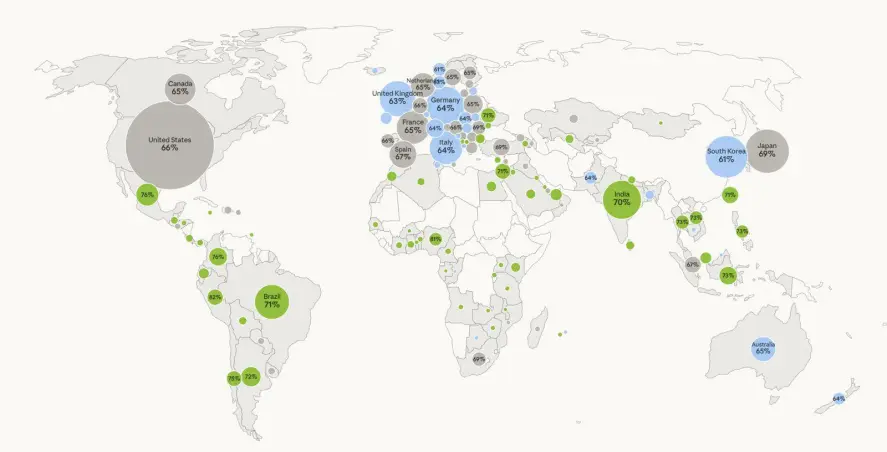
Anthropic has conducted a massive survey with over 81,000 participants in 159 countries across the global in 70 languages. The results is just out. If you work in the field of AI, you should take a look at these findings.
The objective of this initiative was to uncover the expectations and fears that humanity harbors regarding AI.
When you hear "survey," please don't simply imagine a Google Form with a few questions, a bunch of checkboxes and some tick marks.
For this specific purpose, they utilised a specialized version of Claude: the "Claude Interviewer." It poses questions much like a seasoned expert would not merely asking from a pre-set list, but generating subsequent questions dynamically based on the answers provided by the participant.
This isn't just about research; it suggests that, in the future, even job recruitment interviews may no longer require human interviewers. That is yet another massive implication—but never mind that for now. Let's get back to the study itself.
It is said that this is the largest study ever conducted to date regarding the utility and impact of AI.
The researchers sought to understand the fundamental nature and practical applications of AI. This is something you absolutely should not miss.
"What do the humans expect from AI?" This being the foundational level of question. Topping the list of expectations is the "Professional Development."
This means, people expect AI to assist them in refining and optimizing the tasks they perform in their daily work.
If that still isn't clear, here is the detail.
Consider a medical Doctor. Their primary duty is to cure diseases. However, in today's environment, the doctors are inundated with various documentation-related tasks. These administrative chores consume a significant portion of their time. The expectation is that AI should step in and handle all these mundane, routine tasks. A doctor can only practice medicine.
Now, replace the word "Doctor" with any profession of your choice. People expect it to be helpful. Fair enough. But is it actually helping?
The answer given to this question has, for the most part, been a resounding "Yes."
"AI has begun performing at a human level of quality. These days I allocate much of my work portions to AI and the remaining time is well spent for my daughter's day care, remarked software engineer from Japan.
"Tasks that used to take 173 days to complete are now finished in just three days." This individual is an American—and a software engineer as well. One would have to conduct a separate investigation just to find out exactly what kind of work he is doing!
"I am unable to speak. With the help of AI, it is easy for me to convert speech from all the text and I have developed a software for myself for this, shared a person from Ukrain.
"I have owned a butcher shop for twenty years. Since the advent of AI, I have been able to explore with other business endeavors as well. AI has significantly improved my quality of life," shared a respondent from Chile.
It is impossible to transcribe here everything that eighty thousand people had to say. Instead, they have collectively erected a "Quote Wall" of their own. Read it, and be enlightened. So, does that make AI a hero? Yes, it does. But it is also the villain.
Now, let's turn to its villainous side. What is the single greatest fear surrounding AI? "Unreliability." Deciding what to believe and what to disregard in what AI tells us has become a major headache. The next concept in this series is 'Cognitive Atrophy.' What exactly does that mean? AI performs our tasks which were great. But if this trend continues, won't our brains become dulled? This very fear is what constitutes Cognitive Atrophy.
Students losing their capacity to learn, and even experts hesitating to engage in deep, critical thinking all of these are consequences stemming from the mindset that, "Well, AI is there to handle it..." In a lengthy article published by Anthropic, one section is titled 'Light and Shade'. This is a fascinating concept: AI offers a benefit, yet that very same benefit can lead to a detriment.
This duality is what they refer to as 'Light and Shade. 'Consider a job interview. If you prepare for it with the assistance of AI, would be much excellent. AI helps you land the job. Yet, within a few days, AI ends up taking over that very job itself.
The study also deep dived into various perceptions regarding AI on a national level. India scored 70% in this assessment; that is, out of every one hundred Indians who participated in the survey, seventy marked for AI as a "virtuous force. "This score differs from nation to nation: The US has scored 66%, Japan 69%, and Germany 64%. While the global average stands at 67%.
A link to the Anthropic's research paper is annexed below to get to know more on this. Whether during a tedious afternoon or on a fierce battlefield, AI is inevitable in every walk of life.
It is transforming the world right before our eyes.
The question is: will it be shaped according to our desires, or according to its own?






