
Introduction
When Valve launched the Steam Machine initiative back in 2015, it was doomed to fail. The Steam Machines were marketed as pre-built PC pre-installed with SteamOS that can imitate the console experience. However, limited to only games that had native Linux versions, the playable library was miniscule in comparison to what was available on Windows.
It wasn't until the summer of 2018 where Valve began making moves in the Linux gaming landscape again. But this time, it wasn't with hardware. Instead, it was with a fork of the WINE compatibility layer, Proton. This was a large development as it made many Windows-only games playable on Linux. The Linux community put together the ProtonDB website in order to test and document which games worked well and not worked well.
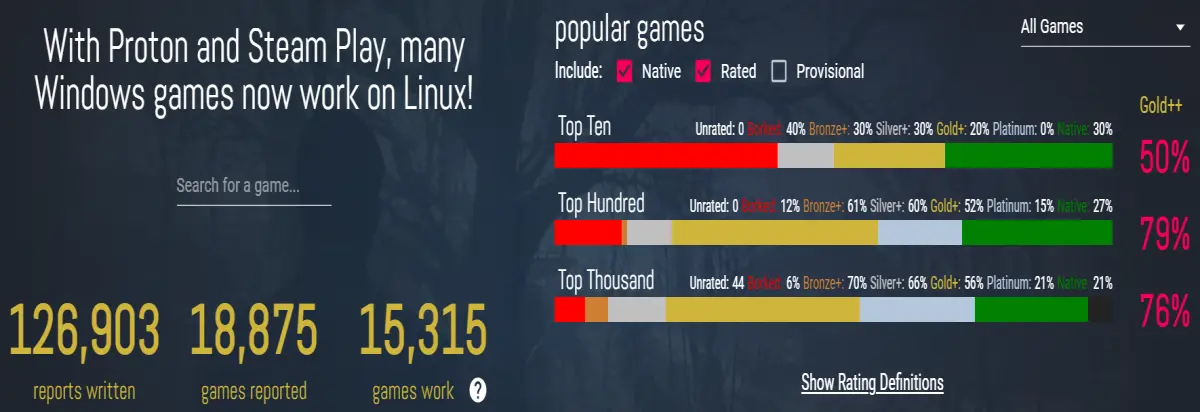
On top of that, a gamer who wanted to be able to play Nier: Automata on Linux developed DXVK, a layer that translates DirectX10 & 11 calls to Vulkan. This translation layer had much better performance than the WineD3D layer which was very slow. Other translation layers like D9VK and VKD3D came up to address DirectX9 & 12, respectively. The former eventually merged with DXVK and Valve has made its own fork of VKD3D called VKD3D-Proton.
However, despite all of this, Linux gaming hasn't really taken off. While the number of games that can be played on Linux has greatly increased ever since Valve launched Proton in 2018, Linux still only makes up a very tiny fraction of the Steam marketshare. In fact, it has yet to cross 1%.
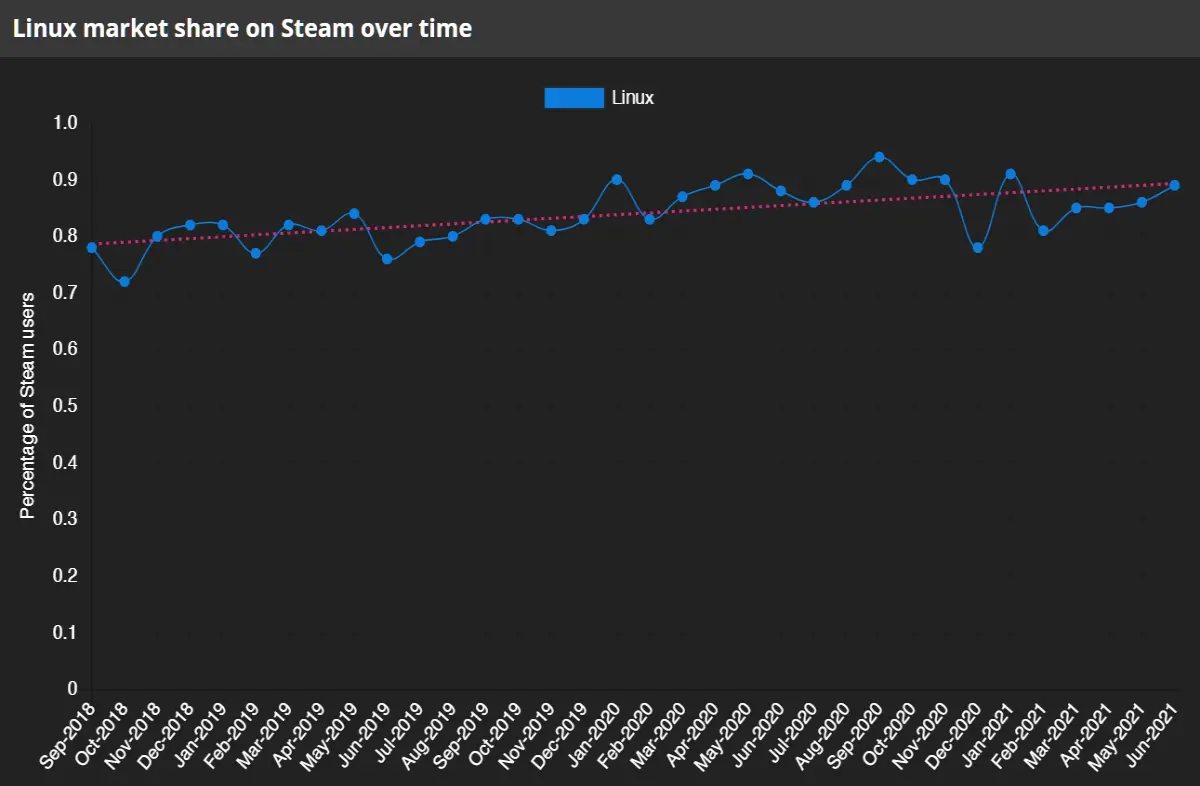
The trend is going upward, but at a snail's pace.
There are many reasons for this. Part of it is due to the fact that in order to game on Linux, you need to install a Linux distro yourself. Vendors that preinstall Linux for you are rare. For everyday people, this is an automatic turnoff as they just want a machine that works out of the box without much fiddling. Other reasons include the fact that BattlEye and EAC do not work with Proton, rendering several multiplayer games unplayable. Lastly, for Nvidia GPU owners, Linux tends to lag behind Windows in terms of features like DLSS and raytracing.
Nonetheless, this month, multiple significant announcements suggest that Linux gaming will take the next step up and perhaps get over the seemingly untenable 1% hump.
The Steam Deck, SteamOS 3.0, and Proton
On July 16, 2021, Valve announced the Steam Deck, a mobile PC in a Switch-like form factor that can play games from your Steam library, games from other PC storefronts, and more. I wrote about how impressive the hardware was from the AMD Zen 2/RDNA2 APU to the dual trackpads to the grip buttons.
The Steam Deck may be what finally tips the scales in Linux's favor. In fact, an HTML hole revealed that within the first 90 minutes of the preorder period, preorders exceeded over 110,000 units. According to Statista, the number of concurrent Steam users now hovers somewhere around 26 million, meaning there are about 230K Steam Linux users online at the same time. Provided that (1) the 110,000 of the Steam Deck users not replace SteamOS with Windows (which is possible) and (2) they use it daily, then that will boost the concurrent Steam Linux user count by almost 50%.
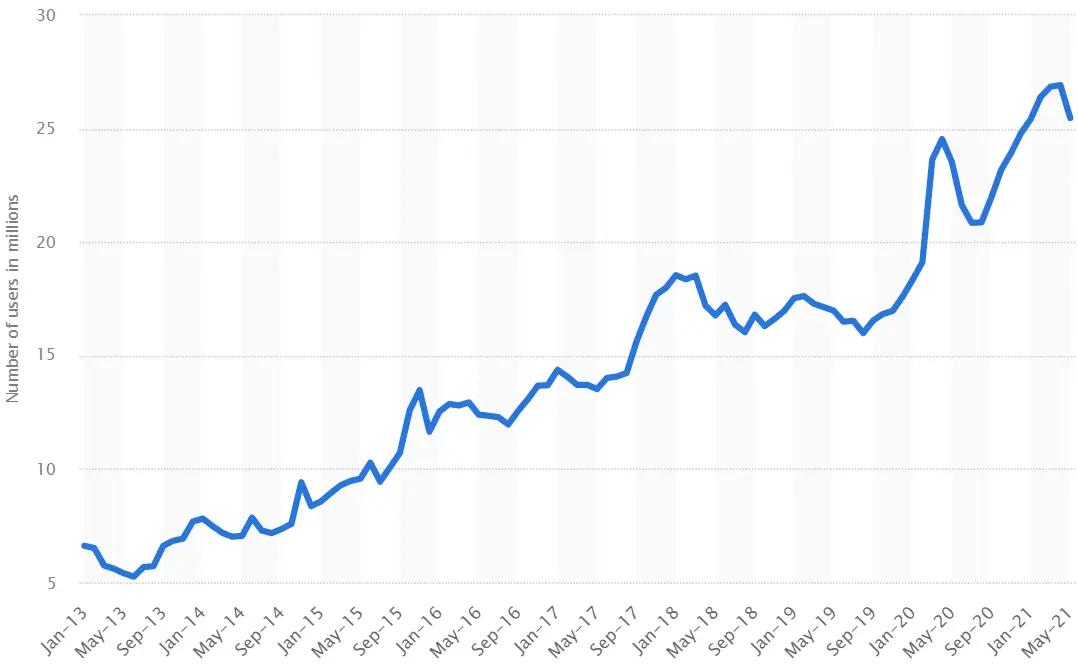
Concurrent Steam user count from Statista.
Speaking of SteamOS and Windows, it's imperative that Valve leaves a good impression on the UI. All of Valve's efforts into improving Linux gaming will be sort of meaningless if all Steam Deck users just replace SteamOS with Windows. The old SteamOS looked pretty outdated and clunky, and it seems like Valve was aware of this. As a result, the company bases the 3.0 version on Arch and uses KDE for its desktop environment, and I have to say, it look pretty damn good.
Timestamped to what the SteamOS 3.0 desktop looks like.
In fact, it almost looks like Windows and I think Valve did that on purpose to make sure users feel right at home. That said, for Steam Deck users to stay on SteamOS, there is one last hurdle: game compatibility.
As I mentioned in the introduction, while Proton has significantly increased the number of games playable on Linux, it cannot play multiplayer games that use BattlEye or EAC. Multiplayer games make up a rather large chunk of the total games available in the market. If Steam Deck users can't play games like Destiny 2 or Rainbow Six Siege, they're just going to replace SteamOS with Windows.
The good news is that Valve is aware of this and in their FAQ, the company has stated that it is working with BattlEye and EAC to bring support to Proton ahead of launch. On top of that, the company has stated there are many improvements to Proton that have yet to be released publicly. Overall, it appears that Valve has learned its lessons from the Steam Machine debacle.
And apparently, Valve isn't the only big company that's adding to Linux gaming.
Nvidia, an Unlikely Major Contributor
Unlike AMD and Intel, who contribute to FOSS, Nvidia keeps its GPU drivers closed-source. Even though AMD has made major improvements to its graphics cards, Nvidia remains the undisputed market leader on that front and with the majority of PC gaming on Windows, what reason is there for Nvidia to go open-source?
However, even a little bit of competition can push Nvidia towards supporting Linux a bit more. This seemed to be the case with FidelityFX Super Resolution (FSR) vs. Deep Learning Super Sampling (DLSS). With FSR yielding decent results on AMD's first try, Nvidia released the 470.42.01 beta driver on Linux which adds DLSS support to Proton and WINE.
Apparently, Nvidia did not stop there. Just today, the company announced an expansion of its RTX SDKs to support Arm and Linux. It even showed a tech demo of Wolfenstein: Youngblood running on a NVIDIA GeForce RTX 3060 GPU and a MediaTek Kompanio 1200 Arm processor under Arch Linux with raytracing.
While the video states that the Arm version of Wolfenstein: Youngblood will not be commercially available, it does show that Nvidia is taking Linux more seriously. On top of that, there is speculation that Nvidia's partnership with MediaTek may lead to a line of Arm-based Chromebooks with RTX graphics. If this comes to fruition, then this may give Linux gaming another boost as ChromeOS is a Gentoo-based operating system (though it is proprietary software).
Closing Thoughts: Cautious Optimism
Of course, nothing is set in stone. The Steam Deck has yet to release and we don't know if the handheld PC is good or not. While Nvidia's tech demo is impressive, it remains a tech demo until actual Arm-based Chromebooks with RTX graphics come out.
Nonetheless, the demand for the Steam Deck is very high and it looks like Valve will meet its goal of selling "millions" of units. Even if the Deck does not sell millions of units, as demonstrated with my math, even just 110,000 units can substantially grow the Steam Linux marketshare. On top of that, SteamOS 3.0 looks very good and user-friendly, and if Valve backs up its word on Proton compatibility, then I think the majority of Deck users will stick with SteamOS.
As for Nvidia, it's great to see the company bringing RTX SDK support to Linux. Whether it was planned all along or in response to AMD's FSR, who knows. However, if AMD continues to make improvements to FSR and contribute to FOSS, then that should be enough to incentivize Nvidia to keep supporting Linux even though the GPU driver remains closed-source.
Obviously, Linux will not overtake Windows, if ever. However, if it can achieve over 1% marketshare and then some, then that will encourage more developers to target Proton or even make a native Linux version of their games.






