Introduction
Today, AMD launches FidelityFX Super Resolution (FSR) for its own graphics cards as well as its competitor's. The overall mission of FSR is to boost performance while minimizing image quality reduction. This is very similar to Nvidia's DLSS though the fundamentals behind how they work are different.
While DLSS is only available to Turing and Ampere, i.e. the RTX 2000 and 3000 series, FSR will be available to a wide range of cards. The RX 400 series is compatible with FSR even though those cards are 5 years old. Heck, according to big PC gaming channels like Gamers Nexus and Hardware Unboxed, FSR can even be used on Nvidia's Maxwell cards, i.e. the GTX 900 series.
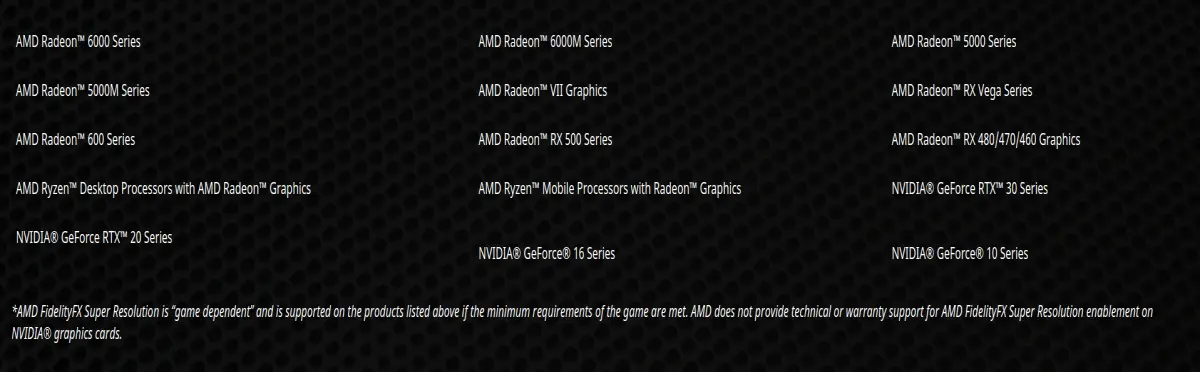
It's open source, is cross platform, and is supposedly easy to implement (it supposedly took one developer took only 2 hours to get it running). All of that sounds nice, but does it actually look good? When I wrote about FSR at the beginning of June, I said that the Ultra Quality setting looked pretty good. However, the demo with the GTX 1060 on Quality mode looked extremely rough. Has FSR improved since then or is it more of the same?
How Does FSR Fare?
Gamers Nexus, Hardware Unboxed, and Linus Tech Tips gave their impressions on how well FSR ran. Of the three, I found Hardware Unboxed's review to be the most extensive.
If you don't want to watch any of the videos, here's the short rundown:
- At 4K, Ultra Quality looks almost indistinguishable from native resolution. Quality mode also looks pretty decent. The lower quality modes will begin to introduce noticeable shimmering.
- At 1440p, Ultra Quality still holds up pretty well. However, there is a noticeable reduction in image quality starting from Quality mode.
- At 1080p, no matter what mode you use, you're going to see a significant reduction of image quality.
- The performance uplift was also pretty impressive with the Ultra Quality providing somewhere between 30%-40% at 4K depending on the game.
Something that I got wrong in my previous writeup was when I assumed that you can run Radeon Image Sharpening over FSR. It turns out that FSR uses its own sort of sharpening different from RIS or CAS. That said, when Hardware Unboxed tested FSR against CAS on Godfall, the image quality was noticeably better when using FSR. The channel even used Adobe Premiere to see how the best possible sharpening solution would fare against FSR and the latter still looked better. All in all, FSR is not just some simple upscaling method with a sharpening filter slapped on top.
How does it compare to DLSS? Well, because none of games that support FSR have DLSS support, none of the channels were able to make an apples-to-apples comparison. Hardware Unboxed did, however, observed that there is a smaller image quality penalty when switching modes on DLSS. In contrast, with FSR, Balanced and Performance modes look substantially worse than Ultra Quality and Quality modes. In addition, because DLSS also does temporal reconstruction whereas FSR does not, the former is able to gather more information by courtesy of referencing past frames. As a result, I would assume DLSS at its best will look better than FSR at its best.
To give AMD some credit, they did not botch the launch unlike what happened with DLSS 1.0.
Closing Thoughts: Support Is Still King
What will be FSR's biggest obstacle is to get it supported on as many games as possible. Yes, it will be support on a much wider variety of video cards. Yes, it is supposedly easier to implement than DLSS by virtue of not needing to rely on machine learning. However, none of that matters if only a few games support it. And that's the main issue with its launch: only 7 titles support FSR.
On top of that, some of those games are not high profile. Godfall, while a looker, is overall a pretty bad game. As pointed out by Gamers Nexus, Terminator: Resistance only has around two dozen concurrent players on Steam. Not so great... Compare that to DLSS, which thanks to its multiple year head start, is supported on some very popular titles like Fortnite.
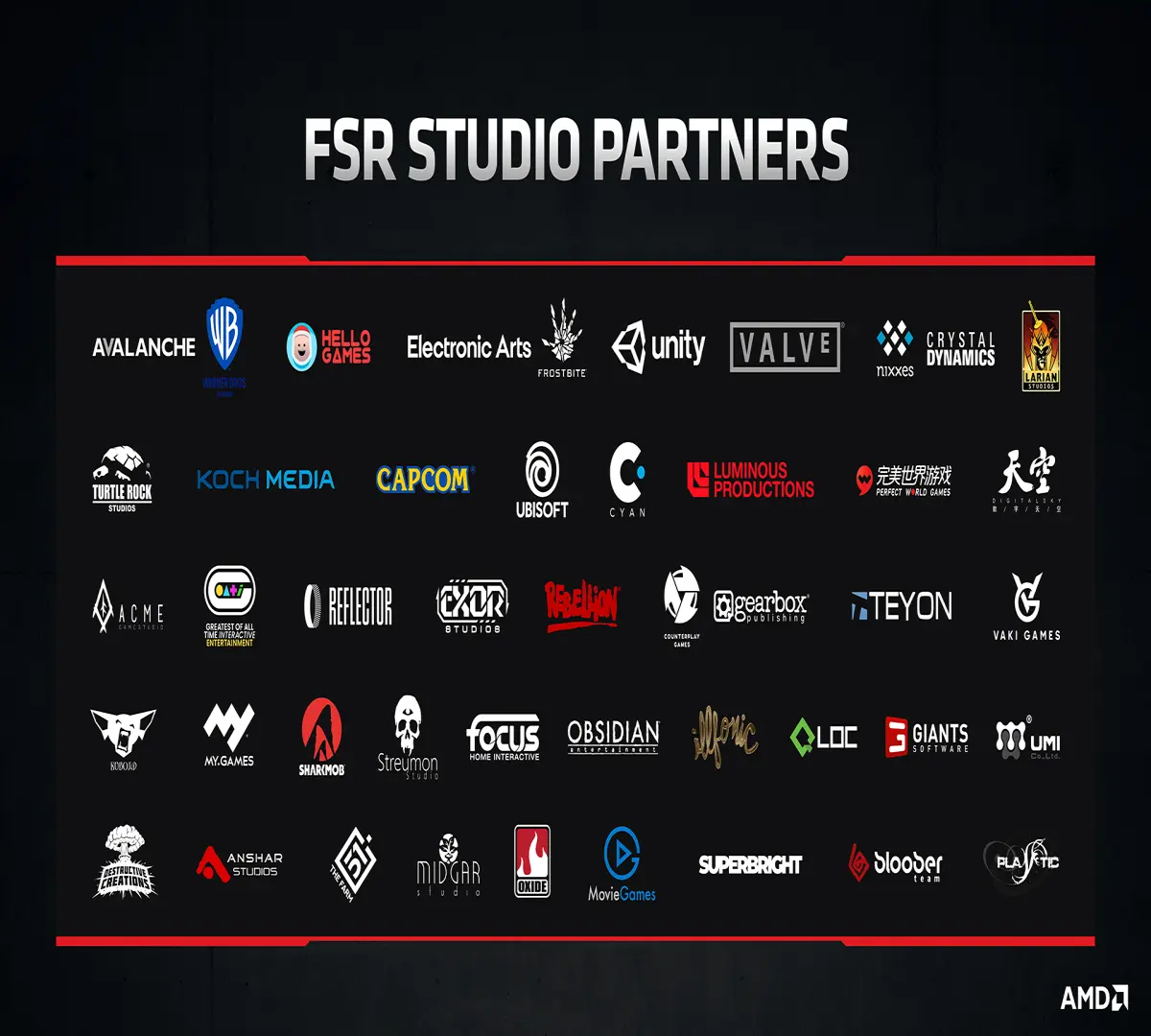
On a more optimistic note, AMD did confirm that several developers will be implementing FSR. Some of them are notable big names like EA, Capcom, Ubisoft, and Avalanche. Now, it's a matter of will they actually do it. If they follow through and impressions from the consumer end are very positive, then I would expect FSR support to be widespread.