
Introduction
On March 2, Governor Greg Abbott lifted the mask mandate and capacity restrictions in the state of Texas. His executive order drew a lot of criticism from mainstream media reporters and left wing politicians. Beto O'Rourke described it as a "death warrant"; Paul Krugman of the New York Times described it as identity politics to "own the libs" in exchange for Texan lives; Chris Cillizza of CNN described the executive order as "anti-science"; and Joe Biden described it as "Neanderthal thinking".
As you can see, these are rather extraordinary claims. However, does the data corroborate their descriptions? The simple answer to this question is no.
What Does the Data Say?
According to Worldometer, ever since March 2, Texas has actually exhibited a downward trend in new cases, active cases, and daily deaths. This is the complete opposite of the "death warrant" description put out by Beto O'Rourke. For his claim to be true, we should be seeing more new cases, active cases, and daily deaths.


Texas's daily new cases, active cases, and daily deaths data with the March 2 marker.
If we are to label Texas as an extreme "no rules" state and compare it to Michigan, which is on the opposite side of the spectrum, this is what the latter's data looks like:


Michigan's daily new cases, active cases, and daily deaths data.
Comparatively, Michigan exhibits a positive trend in terms of new cases and active cases. Daily deaths were already pretty low and remained unchanged.
If you compare Texas to the rest of the states, it's in the middle of the pack in terms of total cases per capita and total deaths per capita.
Climate, Vaccination Rates, and Population Density
One can argue that because Texas is in the south, the climate down there is much warmer than somewhere like Michigan up north. With at least the flu (which is also a coronavirus), warmer temperatures and humidity strongly affect flu transmission, with dry conditions being the most favorable. That said, never will one factor solely affect the overall trend. Several other variables come in play, too.
Vaccination rates play a large role in the rate of transmission, as well. If a larger percentage of a state's population is vaccinated, then transmission rates should be lower. If we check out the Washington Post, Michigan has 30.5% of the population vaccinated with the first dose with 17.5% being fully vaccinated. In contrast, Texas is close to the bottom of the pack with 27.5% of the population vaccinated with the first dose and 14.3% being fully vaccinated. Other states like Connecticut, New York, and New Jersey have significantly higher vaccination rates than Texas.
In theory, that would mean the transmission rate in Texas would be higher. Relative to other states, it has a lower proportion of the population that is either resistant or immune against COVID. However, the data does not correlate with this hypothesis as Michigan, Connecticut, New York, and New Jersey see their 7-day moving averages in new cases rise.
What if we look at population density? Perhaps these comparisons are unfair because Texas is a big state and thus, Texans are more spread out than Michiganders, New Yorkers, etc. As a small experiment, I compared Dallas County, Texas to Wayne County, Michigan as they have nearly identical population densities (~3000 per sq. mi.). However, when I looked at Google Maps with the COVID layer enabled, this is what I observed:
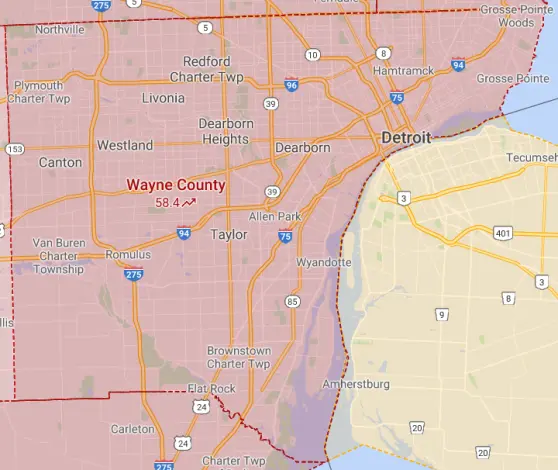
Wayne County has 58.4 new cases per 100,000 as of today.

Dallas County has 11.1 new cases per 100,000 today.
This is just one comparison, so it may not be representative of the full picture. However, if you go directly south of Dallas County, you will see Ellis County with 31.9 new cases per 100,000 as of this post. The population density, however, is only a miniscule 191 per sq. mi. If I were to look at Essex County, New Jersey, it has 60.4 new cases per 100,000 as of this post. That is almost 6x the cases as Dallas County, but Essex County only has twice the population density. Overall, there isn't a strong correlation.
Conclusions
Despite all the doom and gloom from the mainstream media and left wing politicians, Governor Abbott's executive order ended up aging rather well. Claims that it was a "death warrant", an "anti-science" policy, or "Neanderthal thinking" turned out to be complete hyperbole. Paul Krugman was correct to cry foul on the identity politics, but he pointed his criticisms in the wrong direction.
It is worth noting that although the mask mandate and capacity restrictions were removed, it does not necessarily mean that businesses are prohibited from enforcing their own rules. After all, private businesses are free to enforce their own guidelines on customers and there is an incentive for business owners to do that, too. They don't want to risk their customers getting sick because that would mean losing their revenue streams. I think Governor Abbott came to this conclusion and determined that there was no need to impose a government-based mandate.
The executive order also greatly benefits small business owners. Throughout the past year, many small businesses shut down for good, never to come back. This is especially true in the service industries like restaurants. Many people's livelihoods depend on the survival of their businesses as that is how they put food on the table. If new cases and daily deaths have dropped, then there is no need for the government to enforce strict rules. Otherwise, that would hamper the recovery.






