
Introduction
A few months ago, Schwarz et al. published a study on Research Square that investigated the effects of prolonged mask wearing on German students. Scientific literature of side effects of wearing masks, let alone schoolchildren wearing masks at school, is sparse. This study is particularly relevant to American schools as a bunch already have or are starting to transition to a hybrid model. The rules put in place are extremely strict. On top of keeping masks on at all times, desks need to be spaced out and some schools even require windows to be constantly open for ventilation.
Disclaimer: The study is still under the process of peer review hence why it has not been published in a journal yet.
Methodology
The study set up a registry where parents, doctors, teachers, and others can enter their observations. Up to 363 doctors made entries to the registry and also communicated the registry to parents and teachers, bringing the total registrants to 20,353 people. Information included in the entries included "demographic data, previous illnesses, situation and duration of mask wearing, type of mask, existence of complaints from the child about an impairment via the mask, symptoms, behavioral problems, and personal attitude to corona protection measures of the government". A total of 25,930 children had their data entered into the registry.
The Results
The side effects data provide a pretty bleak picture. A substantial fraction of the 25,930 children exhibited several symptoms as a result from prolonged mask wearing. These symptoms include, but are not limited to, the following along with their percentages:
- Headaches (53.3%)
- Concentration difficulties (49.5%)
- Discomfort (42.1%)
- Impairment in learning (38%)
- Drowsiness (36.5%)
- Shortness of breath (29.3%)
- Dizziness (26.4%)
Something that should be noted is that these percentages do not take age into account. When the study measured the percentages by age groups, the situation looks even worse. The 0-6 age cohort's percentages are significantly lower than the averages. However, when the 7-12 age cohort falls on the averages with the 13-18 age cohort having percentages higher than the averages. For example, of the 53.3% that had headaches, only 24% of the 0-6 children had the same symptom, but 54.6% of the 7-12 children and 66.4% of the 13-18 students suffered from headaches.
The Conclusions
The percentage of children and adolescents suffering from a variety of symptoms as a result of prolonged mask wearing is non-negligible. Schwarz et al. advised that these children should not be stigmatized and that a benefit-risk analysis must be done immediately.
The study does not delve into any possible causes behind these symptoms. My wild guess is that with the mouths and noses covered by these masks, it increases the risk of respiratory acidosis. As you exhale, not all of the exhaled air escapes out the mask. Consequently, when you inhale, you're breathing back in some of the carbon dioxide you just exhaled. This will increase the carbon dioxide concentration in your blood.

The CO2 will react with the water in your blood into carbonic acid (H2CO3), hence why your blood pH drops from higher CO2 blood concentrations. Symptoms of respiratory acidosis include shortness of breath, headaches, lethargy, and restlessness.
One possible solution to get around this problem is to wear face shields rather than masks as they are less restrictive to the airways (example below).
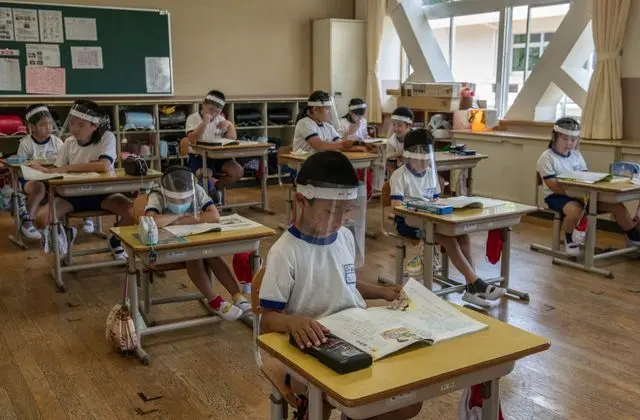
And while it looks quite extra, it kills two birds with one stone. The face shields adhere to the schools' safety measures and students can wear them without suffering from symptoms that hinder their learning.






