
Meta description: The DeFi craze continues in 2021 with many trading, yield farming, and staking opportunities. Learn what DeFi is and what are the best ways to get exposure to the industry.
Decentralized Finance (DeFi) has been one of the hottest trends in the cryptocurrency industry for the last few months, along with non-fungible tokens (NFTs) and stablecoins. Nevertheless, many people who’re new to crypto are still not sure what DeFi is. In the present article, we’ll discuss the ins and outs of this emerging sector and explore some DeFi investment opportunities.
What Is DeFi in Layman’s Terms?
DeFi is the trend revolving around financial services built on blockchain infrastructures. The end goal of DeFi is to move traditional financial services to decentralized platforms to get rid of unnecessary middlemen and ensure peer-to-peer interaction, transparency, decentralization, and low costs.
Think about all kinds of banking and financial solutions, such as lending, insurance, payments, asset management, trading, issuance of money, and the list goes on – what if they were operated and governed by communities rather than centralized institutions? This is possible today thanks to blockchain, and many DeFi projects are working to provide the best alternatives to banks and centralized exchanges.
Unlike in traditional finance, where the big banks rule, the main point of interaction between the end-user and the DeFi is the decentralized application (dApp). The DeFi ecosystem is all about financial dApps powered by blockchain smart contracts and often fueled by native tokens, which are commonly referred to as DeFi tokens.
DeFi Industry Relies on Ethereum
As of today, the DeFi sector is very much reliant on Ethereum, which enables users to create smart contracts that power dApps. Smart contracts are programs running on distributed networks. They can execute automatically and independently when predetermined conditions are met.
In other words, smart contracts nullify the relevance of third-parties like banks, regulators, and companies needed to authorize transactions, lending contracts, sales, and any financial deals between multiple parties. Smart contracts are the core of financial dApps, as they enable developers to implement complex features and functionalities. dApps can use isolated or multiple smart contracts to automate processes.
Thanks to dApps, the DeFi industry has no borders and no human involvement whatsoever, as the conditions are built in the smart contract code itself.
Ethereum has improved the smart contract standard over the years, and it has remained the most popular platform for building dApps. This is why many DeFi projects are built on Ethereum, although the trend may change soon. Projects like Polkadot aim to help blockchains better interact with each other and thus challenge Ethereum’s dominance.
How Big is the DeFi Market?
DeFi has been the fastest-growing sector within the crypto space, and it has become quite enormous. One of the main challenges of DeFi applications is to ensure liquidity for the new projects. This has to be done without the involvement of a central institution, and one of the best ways to achieve this is through liquidity pools. They represent accumulated funds locked in smart contracts to ensure liquidity for DeFi projects.
Anyone can become a liquidity provider by locking crypto funds into a DeFi application and get incentivized for doing so. This process is known as yield farming or liquidity mining.
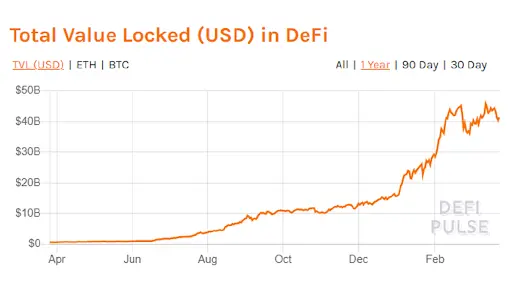
To understand the size of the DeFi market, one of the best metrics used is the so-called total value locked (TVL), which literally means the total value of crypto funds locked for yield farming and staking purposes. According to DeFi Pulse, the TVL in DeFi as of mid-March is over $43 billion. That figure was less than $16 billion at the beginning of 2021 and about $600 million exactly one year ago.
Thus, the DeFi sector has surged by over 7,000% in less than 12 months, based on TVL data.
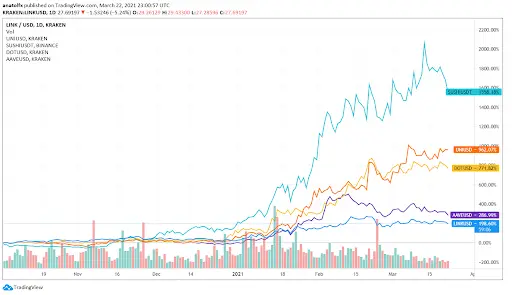
We can also observe the increasing size of the DeFi space based on the market cap of DeFi tokens, some of which have consolidated among the 10 largest cryptocurrencies. Some examples of large DeFi-oriented projects that are Uniswap, Polkadot, and Chainlink.
Speaking about use cases, we can determine three key trends within the DeFi space:
- Monetary banking services, like issuing stablecoins – by the way, stablecoins are one of the main drivers of the DeFi sector, as many liquidity providers lock stablecoins to mitigate the risk of extreme volatility. Thanks to the DeFi trend, USDT and USDC have become some of the largest cryptocurrencies.
- P2P lending and borrowing services – some of the most popular lending platforms are AAVE, Compound, and Maker. In fact, Compound is often regarded as responsible for triggering the DeFi craze in the summer of 2020, when it released COMP as a governance token. These platforms allow users to earn interest on deposited crypto, borrow cryptocurrencies, and participate in yield farming strategies.
- Sophisticated financial instruments and services, such as decentralized exchanges (DEXes), tokenization platforms, and derivatives and predictions markets – DEXes are increasingly popular, as they enable users to swap tokens conveniently without passing through KYC verifications. Uniswap, Sushiswap, 1inch, Curve, and Balancer are some of the most popular DEXes. They rely on Automated Market Makers (AMMs), which revolve around liquidity pools and represent an innovation possible with blockchain.
Some platforms go even further by providing tokenization venues and thus enabling users to create digital representations of both crypto and traditional assets, including gold, oil, USD, stocks, etc. Synthetix is one of the best most relevant examples.
How to Invest in DeFi?
There are many approaches to get exposure to the DeFi space. To begin with, even if the industry is currently consolidating, there is still room for much growth, so you’re not late.
That being said, here are the three main ways to invest in DeFi:
- Build a portfolio with DeFi tokens or actively trade the tokens on exchanges like KuCoin.
- Provide liquidity for DEXes and thus implement yield farming strategies to aim for passive income.
- Earn interest on lending platforms by staking tokens.
Note that all DeFi crypto opportunities involve some risks, so make sure to implement proper risk management techniques.
Good luck with your DeFi journey!
Keywords: DeFi crypto, what is DeFi, What is Decentralized Finance, invest in DeFi, yield farming, DeFi benefits, how to invest in DeFi, DeFi projects, DeFi tokens






