
In our "One Day, One Token" series, we explore tokens that bring something unique to the crypto table. Today, we delve into Helium (HNT), a token that's revolutionizing not the traditional finance sector but the very infrastructure of the Internet of Things (IoT).
Basics of Helium (HNT)
- Token Name: Helium
- Ticker: HNT
- Type: Utility Token (based on a custom blockchain)
- Creator(s): Helium was co-founded by Amir Haleem

- Shawn Fanning (notably known for creating Napster)

- and Sean Carey
 This trio aimed to leverage blockchain technology to create a more accessible and cost-effective wireless network for IoT devices.
 - Network: Helium Network
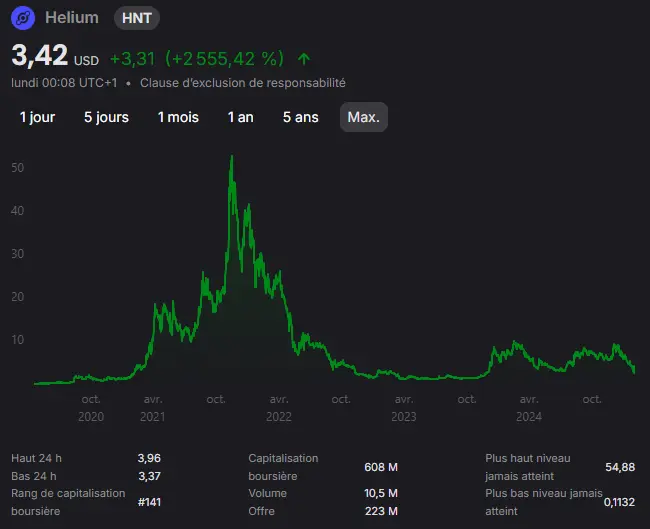
- Current Price: Approximately $3.80 USD (based on recent data)
- Total Supply: Dynamic supply, with a maximum cap set at 223 million HNT per year until 2025
- Market Cap: $420 million USD
Project Overview
Helium is not your typical blockchain project; it's a decentralized wireless network specifically designed for the IoT. The Helium Network uses a unique Proof-of-Coverage (PoC) consensus mechanism where individuals can run hotspots to provide long-range wireless coverage, earning HNT in return.
Token Utility
- Network Incentive: HNT is used to reward individuals for operating and maintaining nodes (hotspots) that provide coverage to IoT devices.
- Data Credits: HNT can be converted into Data Credits, which are used to pay for data transfer on the Helium Network.
- Governance: While not fully decentralized, there's a governance process where HNT holders can vote on certain changes or upgrades to the network.
Market Performance and Trends
- Price History: HNT has seen significant volatility, with peaks around $55 and lows below $1. Its current price reflects a market adjustment but with potential tied to IoT growth.
- Adoption: The Helium Network has grown to cover significant parts of the world, with thousands of hotspots deployed, indicating real-world utility.
- Trading Volume: HNT maintains a steady trading volume, often in the tens of millions, showing consistent interest.
Innovation and Ecosystem
- Decentralized Wireless: Helium's model of incentivizing coverage through token rewards is a novel approach to expanding IoT connectivity without traditional telecom infrastructure.
- LongFi: Helium's proprietary technology, combining LoRaWAN with blockchain, provides long-range, low-power communication ideal for IoT devices.
- Real-World Use Cases: From smart cities to agriculture, Helium's applications are as diverse as the IoT itself, providing a tangible use case for the token.
Current Developments
- Helium Mobile: Recently, Helium has ventured into providing mobile service, expanding its network to support smartphones, which could significantly increase its user base and the utility of HNT.
- Legal Challenges: The SEC filed a lawsuit against Nova Labs, the company behind Helium, regarding the classification of HNT as an unregistered security. This could impact the project's future but also brings attention to regulatory considerations in the crypto space.
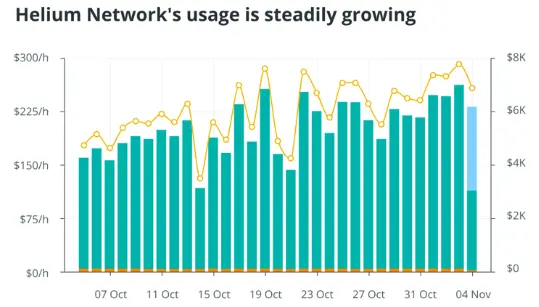
The Helium Network is often referred to as "The People's Network" because it's built by everyday people setting up hotspots, covering more area with each new participant
Helium Mining: The Backbone of Coverage
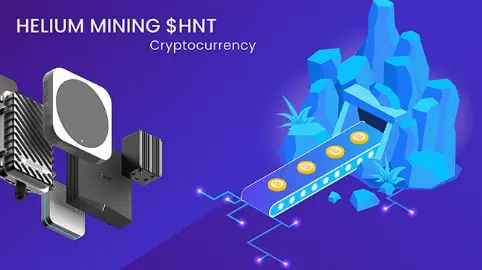
Helium mining is crucial for the operation and expansion of the Helium Network. It differs from traditional cryptocurrency mining, as it involves setting up and maintaining devices known as "hotspots" that act as nodes in the Helium wireless network. These hotspots provide long-range, low-power connectivity for IoT devices, and in return, miners receive Helium tokens as rewards. The process of Helium mining is relatively straightforward and involves several key steps:
-
Installation: To become a miner, one can purchase a Helium hotspot and set it up in an area where coverage is needed or can be expanded. The location of the hotspot is critical, as it determines the amount of tokens that can be earned based on the coverage provided.
-
Proof-of-Coverage: The Helium Network uses a unique mechanism called Proof-of-Coverage, where hotspots must prove they are providing coverage to earn rewards. This involves periodic challenges where one hotspot sends a signal to another, and if the signal is received, both hotspots involved in the transaction are rewarded with tokens.
-
Earnings: The amount of tokens earned depends on factors such as the hotspot's location, the amount of coverage it provides, and the network's current token issuance rate. Miners can also earn additional rewards by facilitating data transfers for IoT devices.
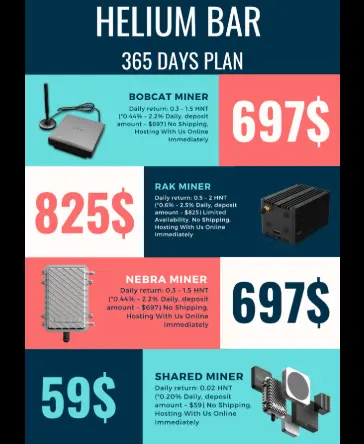
 Helium hotspot miner.
-
Community Aspect: Helium mining has created a community of enthusiasts who contribute to building a global, decentralized wireless network. This communal effort has led to significant growth in the network's coverage, making IoT applications more accessible and less reliant on traditional telecom infrastructure.
The importance of Helium mining lies in its ability to democratize network infrastructure, allowing individuals to participate in and benefit from the expansion of IoT connectivity, which in turn drives the value and utility of the tokens.
Challenges and Opportunities
- Scalability: As more devices connect to the network, scalability becomes both a challenge and an opportunity for growth.
- Market Expansion: While gaining traction, Helium needs to continue expanding its reach and proving its utility to compete with traditional telecom solutions.
Investment Potential
Helium offers a unique investment opportunity in the realm of IoT infrastructure, where the growth of connected devices could significantly increase the demand for HNT.
The token's utility in a real-world application, alongside its community-driven network expansion, makes it an intriguing case study for those interested in tech beyond just finance.
Helium (HNT) stands out in the crypto space by focusing on connectivity rather than currency. It's not about lending, borrowing, or even trading in the conventional sense; it's about building a new layer of internet infrastructure.
For readers looking for something different, Helium's approach to decentralizing wireless coverage for IoT devices offers a glimpse into how blockchain can transform physical infrastructure and open up new investment frontiers.
Hey ! dear P0xies ! This article does not constitute investment advice. All information should be verified by YOU for relevance and accuracy to your investment strategies.

One Day, One Token, It's Out !
Kleo 4 u.