
Galaxy Digital, one of the largest companies in the cryptocurrency sector, believes that Bitcoin has not yet reached its bottom. In a report published this Thursday (11), analysts cite four targets for this cycle.
Since the peak in 2025 was less aggressive than previous ones, they believe the fall will also not be as deep as in other years.
In addition to using the four-year cycle as the basis of their theory, analysts also cite several indicators to justify their thesis.
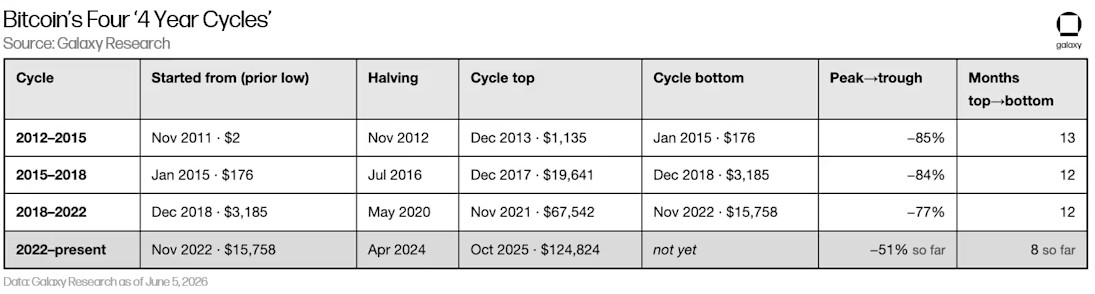 Galaxy highlights Bitcoin's 4-year cycle. Source: Galaxy/Reproduction.
Bitcoin's bottom in this cycle is between US$40,000 and US$46,000, says Galaxy.
One of the first pieces of data presented by Galaxy is the average price paid by buyers. "This is a crucial piece of data ," the analysts write, noting that it would influence the size of the drop in this cycle.
Therefore, the asset manager presents four possible funds for Bitcoin, one of which has already been discarded from the forecasts.
- Raso: US$ 51.000 a US$ 54.000
- Base scenario: US$40,000 to US$46,000
- Severe adjustment: US$30,000 to US$37,000
- Abandoned: US$19,000 to US$29,000
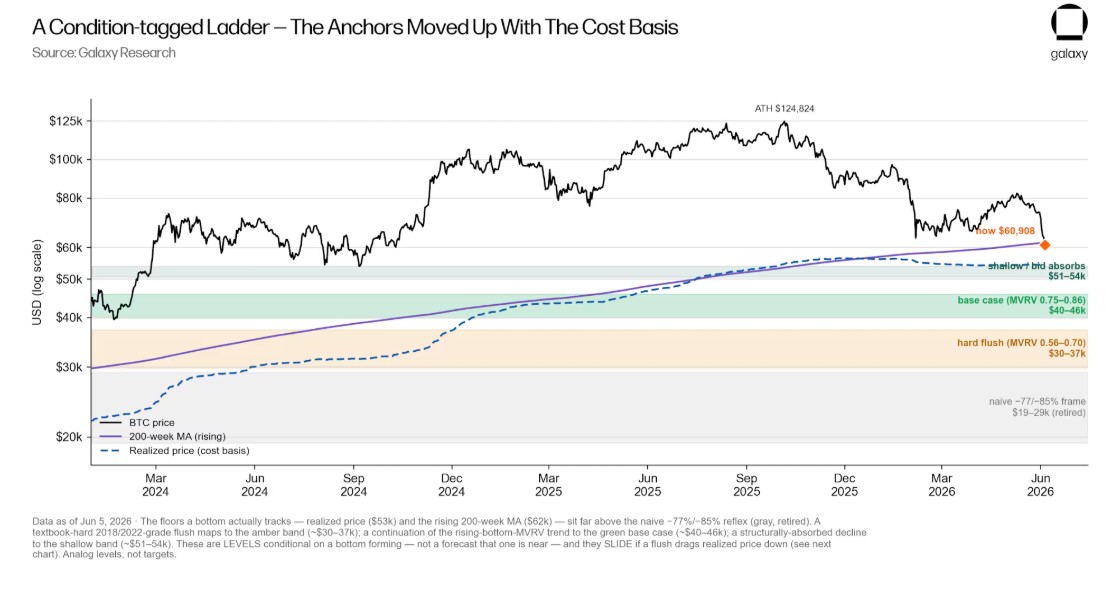 Galaxy's base-case scenario suggests that the Bitcoin bottom would be between US$40,000 and US$46,000 in this cycle. Source: Galaxy/Reproduction.
Despite this, the text points out that the cost base may fall as further declines occur, which could revive the possibility of Bitcoin falling to the most pessimistic range of the forecast.
Until then, Bitcoin's lowest price was US$59,100, recorded on June 5th.
Analysts share indicators to strengthen their thesis.
Following the text, the analysts present 13 indicators that strengthen their thesis that Bitcoin has not yet reached its bottom in this cycle.
Among them are the MVRV ratio and the MVRV Z-Score, as well as the Puell Multiple, NUPL (Net Unrealized Profit/Loss), and the Cycle Clock (which calculates the months after the most recent peak), none of which have been reached so far.
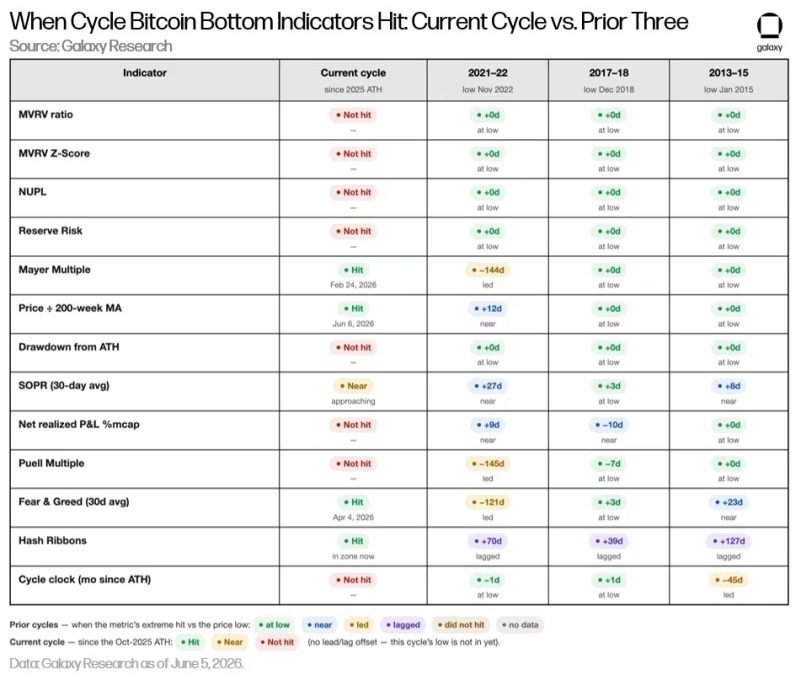 Compared to other cycles, analysts point out that 9 of Bitcoin's 13 bottom indicators have not yet been reached this time. Source: Galaxy/Reproduction.
The target numbers for each indicator can be found in another chart in the report.
"It is extremely difficult, if not impossible, to identify a top or a bottom while they are happening, but both are obvious in retrospect. Thus, we assess how many of the conditions that appeared in all past tops and bottoms are present at the same time."
Five other points observed by Galaxy are:
- Valuation — is the price high or low relative to what the holders paid?
- Profit-taking — are holders selling on the strength of the market or capitulating on the weakness?
- Miners — are the participants who produce bitcoin seeing high profits or experiencing stress?
- Trend — how far is the price above or below its long-term averages?
- Feeling — greed or fear?
Finally, although Bitcoin is known for its long rallies, the timing of entry can be decisive in determining the size of the gains. Therefore, this explains the motivation behind this complex analysis.





