
Something strange happened while everyone was watching Bitcoin bleed.
DeFi total value locked dropped every single month of 2026. From $115 billion in January to roughly $70 billion by late June. That is a 39% collapse. Two April exploits alone, Drift Protocol and KelpDAO, accounted for over $588 million in losses. Aave shed 46% of its deposits in days. The narrative around decentralized finance shifted from "the future of money" to "the future of getting rekt."
Here is the part most people missed. While capital fled DeFi protocols, another category of on-chain entity was multiplying fast.
Autonomous agents. Software that does not just trade. It thinks, decides, and acts. And it is building an entirely new layer of crypto infrastructure right under the noise.
This is not another "top 10 AI agent coins" list. You have seen those. They read like casino menus. This is a framework for understanding what is actually happening, why it matters now, and where the durable value lives in a sector where most tokens will die.
The Setup: Why Agents Matter Now
Crypto has a timing problem. We build infrastructure for futures that arrive unevenly.
In 2020, DeFi proved blockchains could handle lending and trading. In 2021, NFTs proved digital ownership could be valuable. In 2024, AI crypto tokens proved people would buy anything with "AI" in the name. But 2025 was different. That was the year agents stopped being chatbots and started being economic actors.
Circle, the company behind USDC, reported something remarkable. Over 400,000 agents with purchasing power. One hundred forty million agent-initiated USDC transactions across nine months. Ninety-eight point six percent of agent payments settled in stablecoins. Those are not test numbers. That is a payment layer emerging in real time.
Virtuals Protocol, one of the clearer agent ecosystems, hosts more than 18,000 tokenized agents. ERC-8004, a new standard for agent identity, cleared over 10,000 testnet registrations before mainnet even launched. x402, a machine payment protocol, processes roughly 57,000 daily transactions.
The agent economy is not coming. It is already here. It just looks smaller than the hype because the hype was wrong about what to measure.
The $942M Security Crisis Creating Demand
Here is a framing most AI agent articles skip. The reason agents matter in mid-2026 is not because AI is cool. It is because DeFi is bleeding and needs a tourniquet.
One hundred twenty-one hacks. Nine hundred forty-two million dollars stolen. The second quarter of 2026 produced 85 separate incidents and roughly $775 million in losses, making it the most active exploit quarter on record.
Human auditors cannot keep up. Retrospective bug bounties do not stop attacks. What DeFi needs is proactive defense. Agents that watch the mempool in real time, detect malicious patterns before confirmation, and either front-run the exploit to move funds or pause the contract.
Forta is building exactly this. A decentralized network of sentinel agents scanning for flash loan attacks and anomalous withdrawals. Cyfrin has moved into real-time AI monitoring where agents act as automated circuit breakers.
The demand for agent security is not theoretical. It is a direct response to a $942M problem that human processes failed to prevent.
The DeFi TVL Exodus
When Bitcoin dropped over 50% from its October 2025 peak near $126,000, collateral values across DeFi compressed. That alone explains part of the TVL decline. But price does not explain everything.
The KelpDAO exploit showed how interconnected fragility works. The attacker posted stolen tokens as collateral on Aave. Aave was never compromised, yet it lost half its deposits in days because trust is a network effect and fear spreads faster than code.
This matters for agents because the survivors of this contraction are protocols that can demonstrate autonomous resilience. If an agent can rebalance collateral, detect oracle manipulation, or exit a position before a bridge fails, that is not a feature. That is survival infrastructure.
What Makes an Agent an Agent
The word "agent" is becoming meaningless. Every project with a Telegram bot calls itself an agent now. So let us be precise.
An AI agent in crypto is autonomous software that perceives on-chain state, reasons about goals, and executes transactions across multiple protocols without requiring step-by-step human approval for each action.
A trading bot follows rules. If price hits X, sell Y. An agent handles ambiguity. You tell it, "maintain my ETH exposure while maximizing yield, but cap drawdown at 5%," and it decides which pools, which chains, and which bridges serve that goal best.
Agents vs. Bots vs. Oracles
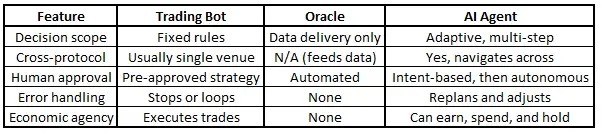
The difference is economic agency. An oracle delivers data. A bot executes commands. An agent manages a balance sheet.
The Three Things Every Real Agent Needs
If you are evaluating whether a project has a real agent or a rebranded bot, look for three elements.
First, intent parsing. The agent must understand natural language or high-level goals, not just parameter inputs. Second, multi-step execution. It must handle bridging, swapping, depositing, and verifying without human hand-holding at each step. Third, feedback loops. It must learn from outcomes, whether that means updating risk models or adjusting yield strategies based on historical performance.
Most projects calling themselves agents today have one of these. Maybe two. The full stack is rare.
The Agent Stack Framework
Think of the agent economy as having three infrastructure layers. Identity at the bottom. Coordination in the middle. Settlement at the top. Most investors focus on the application layer, the shiny agents themselves. But infrastructure is where durability lives.
Layer 1: Identity (ERC-8004 and KYA)
Here is the most underreported story in crypto AI.
Sean Neville, co-founder of Circle and architect of USDC, put it bluntly. "The bottleneck for the agent economy is shifting from intelligence to identity." In financial services, non-human identities now outnumber human employees 96 to 1. Yet these identities remain unbanked ghosts. Merchants block them at the firewall because there is no way to verify who built the agent, what it is allowed to do, and who is liable when it makes a mistake.
KYA, or Know Your Agent, is the proposed solution. Just as humans need credit scores and KYC profiles, agents need cryptographically signed credentials linking them to their principal, their constraints, and their liability.
ERC-8004 is the technical standard emerging here. It defines three lightweight registries: identity, reputation, and validation. An agent gets a portable on-chain handle, a metadata file, and attached feedback records. Once an agent has persistent identity, it becomes measurable, trustable, and insurable.
Without this layer, the agent economy hits a ceiling. With it, agents can rent GPU power, borrow capital, and enter service agreements. Identity is not bureaucracy. It is the unlock.
Layer 2: Coordination (Virtuals, Olas, Mech Marketplace)
Individual agents are interesting. Agent networks are powerful.
Virtuals Protocol has built what is essentially an agent launchpad and economy. With 18,000+ tokenized agents, it is the clearest example of agents as on-chain economic units. Each agent can have its own token, its own revenue model, and its own user base.
Olas takes a different angle. Its Pearl app store and Mech Marketplace enable agents to offer and request services from other agents. This is agent-to-agent commerce. One agent might specialize in market analysis. Another in yield execution. They transact with each other.
The coordination layer matters because no single agent will be good at everything. The winning infrastructure will look less like a monolithic AI and more like a marketplace of specialized agents that discover, negotiate, and collaborate.
Layer 3: Settlement (USDC, x402, Stablecoins)
Agents need money that does not sleep. That means stablecoins.
Circle's data is revealing here. When machines pay machines, they want settlement finality without price volatility. USDC has become the default because it is programmable, widely accepted, and transparently reserved.
x402 extends this by creating a payment protocol designed specifically for machine commerce. It enables agents to negotiate prices, authorize payments, and verify delivery of digital services without human invoicing.
The settlement layer is boring compared to agent personalities and token launches. But boring infrastructure is where the fees accumulate.
Real Agents Doing Real Things
Hype is easy. Function is hard. Here are three agent categories with working products and measurable usage.
Sentinel Agents
Forta operates a decentralized network of detection bots that scan for exploits in real time. Unlike static audits that happen before launch, sentinel agents monitor live traffic. They flag flash loan attacks, large anomalous withdrawals, and contract interactions that match known exploit patterns.
Cyfrin has advanced this with automated circuit breakers. If a sentinel agent detects a likely exploit, it can trigger protective actions before the malicious transaction confirms. This turns security from a retrospective report into a live immune system.
Yield Optimizers
Meteora and aPriori are pioneering AI-driven liquidity management. These agents monitor thousands of pools across chains, analyzing liquidity depth, historical volatility, and smart contract risk scores. A user sets parameters like "maximum 5% drawdown" or "blue-chip stablecoins only," and the agent handles rebalancing.
Enzyme Finance now supports hooks for AI-driven asset managers. The value proposition is simple. It turns "passive income" into something that is actually passive, recovering the hours users currently spend manually chasing yield.
Intent Wallets
Morpheus, working with Brian APIs, allows users to run local Smart Agents that execute complex on-chain tasks via natural language. You type, "Find me the best APY for my USDC on an L2 and move it there." The agent handles the bridge, the swap, and the deposit.
This is the UX shift crypto has needed. Not more buttons and sliders. A conversation with your wallet. Chain abstraction happens in the background. The user expresses intent. The agent manages infrastructure.
The Missing Piece: Know Your Agent
I want to linger on this because almost nobody is talking about it, and it is the single most important primitive for the agent economy to scale beyond crypto natives.
Right now, if you are a merchant or a protocol, an autonomous agent approaching your service is a threat vector. You do not know who deployed it. You do not know what it is programmed to do. You cannot sue it if it steals funds. So you block it.
KYA changes the economics. With cryptographically verifiable identity, reputation scores, and liability bonds, agents become trustable counterparts. A lending protocol might offer better rates to agents with high reputation scores. A marketplace might prioritize agent vendors with verified track records.
a16z crypto called this out explicitly. "The industry that built KYC infrastructure over decades now has just months to figure out KYA." That is the timeline. The projects solving this first capture the trust layer.
The 3 Infrastructure Bets Actually Worth Making
I am not going to give you a list of tokens to buy. That is not useful. What follows is a framework for where durable value is most likely to accrue in the agent stack.
Bet 1: Agent Identity and Reputation Standards
The ERC-8004 ecosystem and KYA infrastructure are the picks and shovels of the agent gold rush. Without identity, agents cannot get loans, enter contracts, or build reputation. With it, they become economic citizens.
Look for projects building persistent agent registries, reputation oracles, and validation networks. The tokenomics should tie value to the number of verified identities and the volume of reputation queries.
Bet 2: Cross-Chain Coordination Protocols
Agents do not care about chain maximalism. They will use Ethereum for security, Solana for speed, and Base for cost, all in the same workflow. Infrastructure that makes this seamless captures value from every agent transaction.
This includes intent-based routing protocols, cross-chain messaging layers, and agent marketplaces where services are chain-agnostic. The winners here abstract complexity rather than adding to it.
Bet 3: Machine Payment Infrastructure
USDC is winning, but the rails around it are still being built. x402 and similar protocols enable agents to pay agents, subscribe to services, and settle microtransactions without human invoicing.
The opportunity is in the payment middleware. Protocols that enable agents to discover prices, negotiate terms, and verify delivery of services. If the agent economy reaches even a fraction of Circle's current transaction volume, the fee generation here is substantial.
Why Most Agent Tokens Will Fail
I need to say this clearly because the hype is dangerous.
Most agent tokens today are narrative compression trades. They rise when AI is trending and fall when attention shifts. Virtuals Protocol, despite being one of the clearer plays, trades at a valuation where sustained agent launch activity is already priced in. AIXBT, the research agent, has lost significant value as the initial novelty wore off. OLAS has strong technical credibility but thin liquidity that makes serious position-building difficult.
The pattern is familiar. Governance tokens that do not capture fees, agent tokens that do not generate revenue, and launchpad tokens that benefit from launch volume but not from agent success. We have seen this movie before. It was called DeFi Summer, and most of those tokens died.
What survives? Infrastructure with usage-based revenue. Protocols where token value is tied to query volume, transaction fees, or identity registrations. Agents that generate real economic output rather than speculative attention.
How to Participate Without Getting Rekt
If you want to explore this sector without becoming exit liquidity, use this checklist.
The 5-Question Checklist:
- Does the agent or protocol have measurable on-chain activity, or is it all promises?
- Is the token tied to actual revenue (fees, queries, registrations) or just governance?
- Can you verify the team, the audits, and the contract risk?
- Does the project solve a problem that exists today, or one that might exist in five years?
- Is the liquidity deep enough that you can exit without moving the price against yourself?
Starting Small: Use testnets. Many agent protocols offer simulation environments where you can observe agent behavior without risking capital. Watch how agents handle edge cases before trusting them with real funds.
Red Flags to Avoid:
- Agents with no clear error handling or recovery mechanism
- Projects where the whitepaper is 90% vision and 10% architecture
- Tokens with concentrated ownership (check wallet distribution)
- "Agents" that are just ChatGPT wrappers with a token attached
- Any project promising "passive income" without explaining where the yield originates
Key Takeaways
The agent economy is not a prediction. It is a measurable trend with 400,000+ economically active agents, 140 million USDC transactions, and working products in security, yield optimization, and wallet UX.
The real opportunity is not in individual agent tokens. It is in the infrastructure layers that make agents trustable, coordinated, and financially integrated. Identity, coordination, and settlement.
Most agent tokens will fail the same way most DeFi tokens failed. Narrative without revenue dies. Focus on protocols where usage drives value, where the team is verifiable, and where the problem being solved is urgent today.
DeFi lost $942 million to hacks this year. Agents are emerging as part of the answer. That is not hype. That is infrastructure responding to pain.
FAQ’s
Q: What is the difference between an AI agent and a trading bot?
A trading bot follows fixed rules. An AI agent adapts to new conditions, handles multi-step workflows, and can reason about goals rather than just executing commands.
Q: How many AI agents are actually active in crypto?
Circle reported over 400,000 agents with purchasing power. Virtuals Protocol hosts 18,000+ tokenized agents. ERC-8004 has 10,000+ testnet registrations. These numbers overlap and should be treated as layered signals rather than a single total.
Q: What is KYA and why does it matter?
KYA stands for Know Your Agent. It is an emerging standard for cryptographically verifying an agent's creator, constraints, and liability. Without KYA, merchants and protocols cannot trust autonomous agents, which limits the agent economy's growth.
Q: Are AI agent tokens a good investment?
Some infrastructure tokens may capture durable value, but most individual agent tokens carry high risk. Focus on protocols with real usage, verifiable revenue, and deep liquidity. Avoid narrative-only projects.
Q: Which blockchains are best for AI agents?
Base and Solana are popular for agent deployment due to low costs and fast finality. Ethereum remains the preferred settlement layer for high-value transactions. The best agents will be chain-agnostic.
Q: Can AI agents prevent DeFi hacks?
Sentinel agents can detect exploit patterns in real time and trigger protective actions before malicious transactions confirm. They are not perfect, but they represent a shift from retrospective auditing to proactive defense.
Q: What are the main risks?
Risks include smart contract bugs, opaque agent decision-making, concentrated token ownership, thin liquidity, and the possibility of agents being manipulated or exploited themselves.
DISCLAIMER
The information contained in this article is for educational and informational purposes only. It does not constitute financial advice, investment advice, trading advice, or any other sort of advice. Cryptocurrency investments carry substantial risk of loss. The author may hold positions in assets mentioned. Always conduct your own research and consult a licensed financial advisor before making investment decisions. Past performance and narrative trends do not guarantee future results. Agent tokens and infrastructure projects are highly speculative, and you should never invest more than you can afford to lose.






