
Some governments have “omnipresent” reputations, but the reality is often not as bad as conspiracy theories describe. If a headline claims that a specific state hacked a cryptocurrency protocol or is about to, we should take it with more than a grain of salt. Decentralized ecosystems were built with very strong cryptography to resist tampering (from anyone), so that’s not directly possible.
However, there are other, indirect things a government could do to seize, block, or censor crypto transactions. Let’s see what they can and cannot do.
Why Crypto Is Hard to Hack
Most crypto networks rely on public key cryptography: a system that uses two mathematically linked keys, one public and one private. The owner of the private key can create a signature, and no one else can do it. Then, anyone with the public key can verify that signature. It’s technically not impossible to break this system, but, with our current technology, it’d take thousands of millions of years.
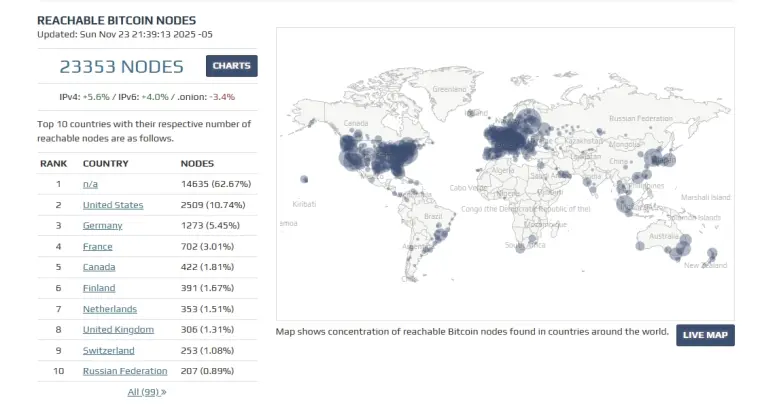
Distributed ledgers, where transactions are registered, are another protective layer. Once a transaction is confirmed and added to the chain, altering it would require controlling a massive portion of the network’s validating power and sustaining that control long enough to rewrite history. That means controlling thousands of separate nodes (devices), and assuming the economic costs of “betraying” the network. In Bitcoin, the cost would be over $1.8 million per hour, for instance. Enough hash power to surpass most current miners isn’t likely at all.
The defensive mathematical structure of cryptocurrencies is still intact. Even if it wasn’t, if a “fatal” bug was exploited or a government takes the time and money to control a major chain for some crazy reason, it’s worth remembering that most cryptocurrencies are open-source. This implies the code is available for anyone to copy and modify as they wish. Therefore, the community would just “fork” (copy) the chain elsewhere and start over, without state control.
What Governments Can Actually Do
Breaking encryption may still be a tall order, but governments can create laws and rules to wield some control over industries, including crypto. As of early 2026, most countries have some kind of crypto-related regulation in place, especially concerning Anti-Money Laundering (AML), Countering the Financing of Terrorism (CFT), payments, and taxes. In practice, this means that you’d need to hand over your ID to use centralized crypto exchanges and other custodians, and of course, declare your coins within your income taxes.

In some countries, cryptos are limited or totally banned. Governments can’t directly know who uses them if they never reach regulated exchanges, but if they somehow find out, users could face legal issues. Besides, even in regions in which crypto is allowed, authorities can issue summons or warrants to obtain ID records from crypto companies, for a variety of reasons. The US Internal Revenue Service (IRS), for example, has sent summons to crypto exchanges seeking customer data for tax investigations.
Another thing authorities can do (and anyone with the right tools, really) is track crypto transactions. Most networks, including Bitcoin, Ethereum, and Obyte, have public ledgers where all transaction data and their journey are widely available. Specialized firms build analytics tools that cluster wallet addresses, follow fund flows, and connect activity to known services or even individuals. Governments purchase or contract these tools to support investigations.
The infamous Lazarus Group
Well, as we may know, not all governments adhere to “fair” laws. The hacking group known as Lazarus has been repeatedly linked to the North Korean government, and they’ve been responsible for big attacks on crypto protocols and holders, taking millions away. It’s considered that they’re behind the global WannaCry ransomware in 2017, a malware that encrypted thousands of devices and asked for Bitcoin for the decryption keys. They’ve also robbed millions from the crypto companies Bithumb, Youbit, WazirX, Bybit, and Nicehash.
None of that was at the cryptocurrency internal level, though: they just broke the security of those companies and distributed malware. Attacks that might look like they actually broke crypto started in 2022, with the incidents involving Ronin Network (from Axie Infinity) and the Harmony Horizon Bridge. The hackers managed to steal $620 and $100 million from these protocols, respectively.
However, they didn’t “break blockchain cryptography.” In the previous cases, vulnerabilities were especially in weak smart contracts and social engineering (human manipulation). In the Ronin attack, for instance, they tricked a Ronin employee into installing malicious software that gave them access to internal systems. With control over several validator private keys, they approved fraudulent withdrawals and drained the funds.
So, crypto is strong, but the weakest link is always human.
Sanctions and Censorship
Depending on the decentralization level of a network, governments could apply censorship to it as well. This is actually the most realistic and practical way governments can wield their power on crypto, and they do it all the time (or try to). Case in point was Tornado Cash, a crypto mixer built on Ethereum that helped users obscure the origin of their funds. In 2022, the US Treasury sanctioned this platform, arguing that it was used to launder billions of dollars —including funds from the Lazarus Group, indeed. GitHub removed the project’s code repository for a while, and the developers were arrested.
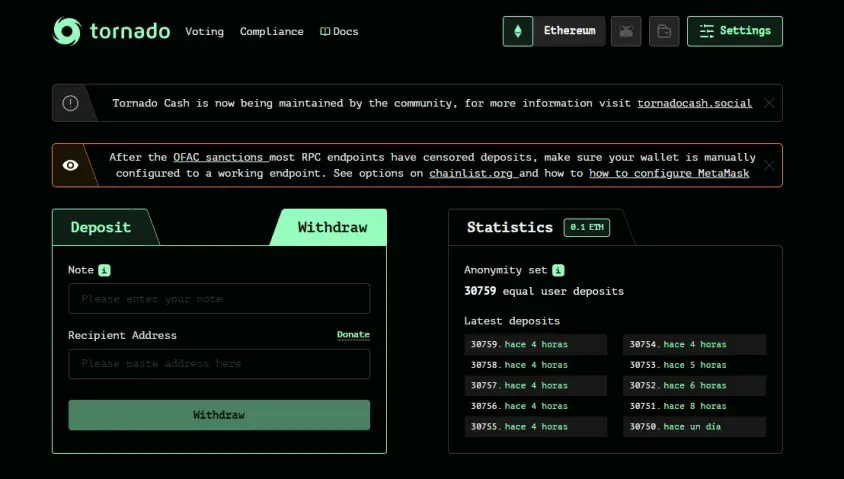
Some Ethereum validators and infrastructure providers began filtering or avoiding Tornado Cash transactions to comply with sanctions. That didn’t erase them completely, but it reduced their accessibility and visibility. When a network relies on identifiable validators, miners, or service providers, governments can pressure those middle layers.
In the end, they lifted the sanctions, and Tornado Cash remained operative all along. But the attempt at blocking it was there, it had an impact, and it can repeat.
What About Quantum Computers?
While our current computers use a binary system (0 and 1) to create and secure everything, quantum computers would be able to use multiple states with qubits. This simultaneity would increase their capabilities with a huge number of possibilities at the same time. In theory, these machines would even be able to solve private keys from public keys. And governments like the United States, China, and the European Union are investing in them right now.
Nevertheless, that doesn’t mean we should panic. Developing quantum computers has been a titanic task, and they’re still in very early stages. The qubits are extremely sensitive to the environment, and they don’t fully behave as they should yet. Current quantum computers are heavy, expensive machines with just a few uses, and limits that no one has been able to overcome so far. In any case, post-quantum computing security methods are already in development, and they'll likely be integrated into crypto networks sooner than later.
What Can We Do to Protect Our Funds?
Governments don’t need to break cryptography if they can reach exchanges, custodians, or poorly secured devices. For that reason, self-custody matters. Holding private keys in a cold wallet (offline) and separating long-term savings from daily spending wallets reduces risks. If a centralized platform freezes accounts or hands over user data, assets stored outside that system will remain under your exclusive control. It takes more responsibility, yet it also removes a layer of dependency.
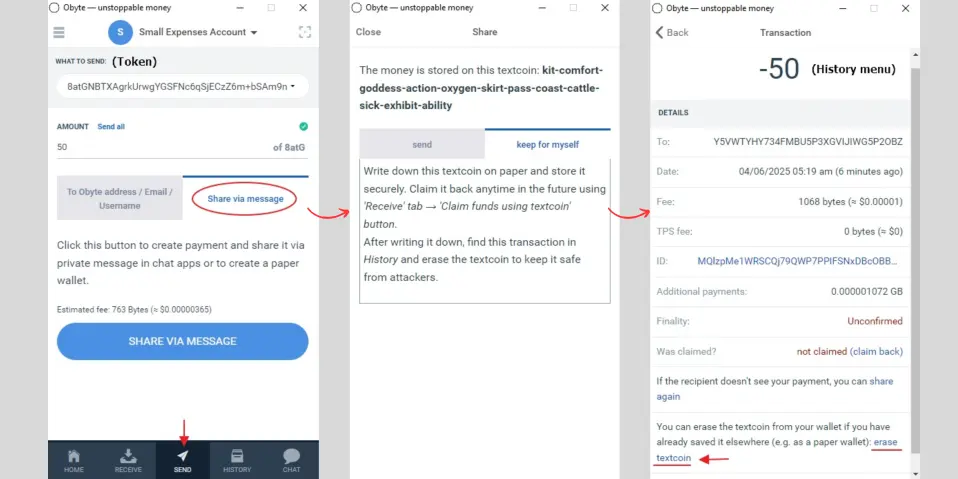
In Obyte, it’s possible to create a simple textcoin to keep your funds offline.
Network choice also matters. Some chains rely on identifiable miners or “validators” who can be pressured to filter transactions. Using highly decentralized networks with no miners or “validators”, such as Obyte, completely removes the middlemen who can be influenced. When there are no gatekeepers producing blocks, there are fewer choke points.
Remember that choke points are the spots where control can creep in, like exchanges, "validators", or key service providers. So, avoiding them means fewer ways for transactions to be delayed or filtered. Leaning on self custody and highly decentralized networks keeps control closer to you, where outside pressure has far less reach.
Featured Vector Image by Freepik





