
Reactions have trailed the Central Bank of Nigeria’s announcement and proposal to launch the e-Naira, Nigeria’s digital currency. The first being that despite the country’s ban on cryptocurrency-related activities, it has gone ahead with a product that works on the blockchain, a quasi-cryptocurrency of its own. This action not only questions the integrity of the apex bank and chief regulator of money-related activities but is akin to cutting the nose to spite the face.
The e-naira, a virtual currency meant to facilitate digital transactions, is built to drive the Central Bank’s crusade of financial inclusion among Nigerians and relieve the pressure on the country’s domicile currency (Naira). Another primary intention is its service as a medium of exchange and financial services between cross-wallet holders through its native wallet. With this, the Nigerian government prides itself as the first country in sub-Saharan Africa to take the initiative of going digital with its plan to financially include a significant underbanked, unbanked, and digitally anonymous mass of its growing population.
The immediate impact of this policy might not be measurable with the depressed state of Nigeria's finances. However, the unprecedented fall of the Naira has given cause for a belief in its operability and inherent solution. According to a statement credited to the Central Bank of Nigeria, there has been a surge (to the tune of over a million visits) in the number of visitors to the new digital currency's website (enaira.com) ahead of its official launch on the 1st of October 2021 – the country’s independence day.
This novel initiative comes as an opportunity for Nigerians who have defied the ban on cryptocurrency activities to engage in peer-to-peer trading and investment activities. According to the Central bank of Nigeria, the e-naira will have its wallets like every other cryptocurrency wallet on the virtual space which will enable it to operate as a tool of international trading activities and payment. With this, there will be a reduction in the demand for cash-facilitated payment, resulting in a reduction in the pressure on the naira vis-a-vis its exchange rate against the dollar. The most significant implication of this development is that Nigeria, the most populous black nation on earth, is blazing the trail in digitizing its fragile economy by reducing age-long bureaucratic procedures that have hampered the smoothness of trade, payment, and financial inclusion.
This author discusses some of the remarkable and relatable ways through which the soon-to-be-launched E-naira can help the scores of financially unidentified Nigerians through participation in decentralized finance projects and investments. With this knowledge, Nigerians can trans-route investments from the traditional saving operations and off-chain activities to cryptographically recognized and digitally ledgerized investments in the digital space.
Despite the successes of mobile money operators like MTN Money and MPesa, the mobile-phone-based money transfer payments and micro-financing, founded by Safaricom, Vodafone group, and MTN Africa, there is a gulf existing between what these operators offer and what can is satisfactory service(s). Mpesa, inaugurally adopted in Kenya, parts of eastern, central Africa, and the Middle East operates mainly through the Unstructured Supplementary Service Data (USSD). In contrast, the E-naira is a revolutionary digital currency that will bring the majority of Nigerians into digital investments.
Despite the sceptical disposition of many Nigerians towards cryptocurrency operations, like the religiously formed opinions about it as fraudulent and somewhat esoteric, many young persons have embraced the opportunities it presents by making a fortune off trading cryptocurrencies. The investment opportunities during the bullrush cannot be discounted as one-off as many people still come into the crypto space daily scouring for assets trading in price values characterized as the dip. Very little is yet known about Decentralized Automated Organizations (DAOs) as a legitimate forum to accumulate tokens from smart-contract-based projects, liquidity-providing programs, trading contests, bounty rewards through valued contribution, and many more. However, with the introduction of the e-Naira, the channel is now unofficially opened by Nigeria’s apex bank for an increase in crypto-related activities. The e-Naira also provides an opportunity for monitoring tax compliance and the full integration of the Tax Identification Number(TIN). The government can leverage it to reduce the threshold for cash transactions by restricting high-volume transactions to be digitally facilitated.
BANKLESS, A CASE STUDY FOR NAIRA INVESTMENT
An example of a product launched by the Index Coop – in partnership with the Bankless DAO - is the $BED index. At its launch in July, the $BED sold for $84, but it has risen steadily to $125 despite the current depreciation in crypto-assets during the recent bearish run. Taking a mathematical look as an investor at the launch of the $BED index, the exchange rate of the Naira to the dollar was 411 naira to the dollar, while it is at 580 Naira to the dollar. Hence, an investment portfolio of a $BED index (which has returned 38% in dollar value) valued at 34,500 Naira at the launch of the $BED (at 411 Naira per dollar) is valued at 72,500 naira (for the 580 Naira per dollar exchange rate), which is over 100% appreciation in three months.
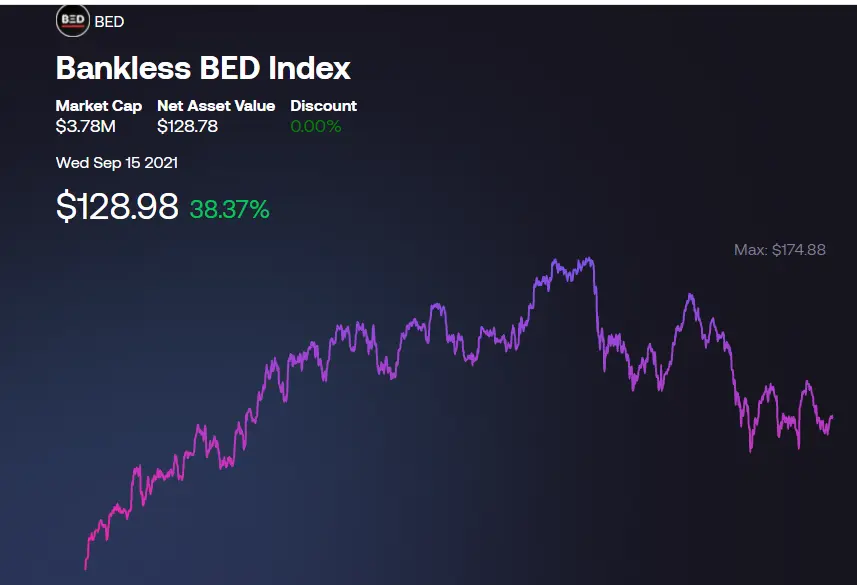
Chart showing a three-month performance of the $BED index by the Index Coop
In an economy where investment in treasury bills, fixed deposit in banks, peer-to-peer lending initiated by Fintech firms are returning less than 19% profit per annum while the country’s official inflation rate stands 16%, a mid-term investment in the crypto space with the potential of yielding over 50% in a year is life-saving and futuristic.






