
Hello My Friends; Fine arts is a multi-billion dollar industry. Collectible paintings and sculptures are purchased by collectors for huge amounts of money in auction houses and galleries. With the spread of the internet, this sector, like many other sectors, moved to the internet environment. In a short time, digital art began to become the new favorite of collectors. However, there were problems with the preservation of digital artworks. At this point, blockchain and NFT technology came to the rescue...!!!
If you're ready, let's see how he does it...
NFT (Non-Fungible Token); It is a cryptocurrency term that provides a unique and immutable representation of digital assets. Differently, while cryptocurrencies are generally equivalent and interchangeable, NFTs are unique and cannot be interchanged with each other. Therefore, NFT is a completely original and unique Blockchain unit of value.
Digital art and fraud before NFT
Digital art existed before NFT and blockchain technology. Digitally created or digitized artworks are sold on online auction sites; It was exhibited and shared on websites or social media.
With digital art, art has undoubtedly become more accessible. People began to easily access works of art from all over the world. However, the problem of counterfeiting and intellectual property protection has arisen.
Due to advances in digital technologies, copying and forging works of art has, unsurprisingly, become more complicated. In the field of digital art, it was becoming very difficult to detect whether a product was fake or not, even for expert eyes. This raised concerns among both sellers and buyers. Fraud and forgery were increasing all over the world and affecting physical art as well as digital art.
Artists have begun certifying their digital works on the blockchain and distributing them peer-to-peer through the IPFS network. Bitcoin (BTC), which became operational in 2009, and other blockchains that followed became the salvation recipe for digital art against counterfeiting. Thus, thanks to the decentralization and immutability of blockchains, the concept of “crypto art” emerged.
People started asking: If a digital image can be viewed or downloaded for free, what is it worth...? Producing or purchasing digital art has been an uncertain option for artists and collectors, as images can be easily copied and subject to plagiarism.
If a work of art can be reproduced for free, its market value is reduced or non-existent.
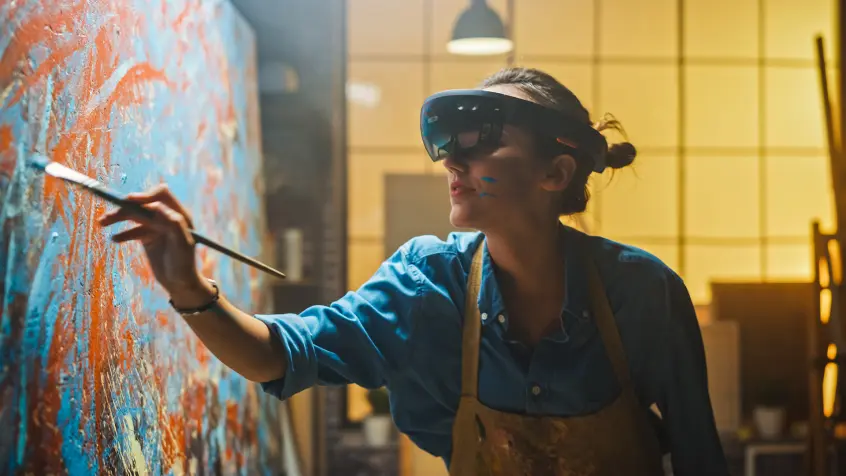
Digital Art and NFT
What solution does NFT offer in this regard ... ?
To preserve the value of digital items, the concept of blockchain-based “Digital Scarcity” has been introduced, implemented through Non-Fungible Tokens (NFT).
NFT; A cryptographic token that represents a unique object or part of it. An NFT is created as a blockchain transaction that binds itself to a unique digital fingerprint, or hash, on an always-on, distributed, and permanent ledger. Owning a work of art turned into an NFT means having verified and unquestionable ownership of it. In other words, NFTs are proof that a work of art is original and show who it belongs to. NFTs can work as a resource that guarantees that a work of art is original and provides accurate information about past ownerships.
While online art auctions have gained a negative reputation due to malicious sellers claiming to document ownership of fake works of art, NFTs are emerging as a vital alternative. If the official blockchain address for a particular work of art is published on relevant sites and social media, anyone can check the authenticity of this work. Because all transactions on the blockchain are transparent and immutable. The immutability of the blockchain means that the NFT, as a document of art, is also immutable.
However, one should not forget: What gives value and scarcity to a digital work of art is not the work itself, but a “License” ownership in the form of NFT.
Owning an NFT gives a buyer or collector the right to display and resell the work contained in that NFT, but not the right to commercially reproduce it. The creator reserves all intellectual property rights.
My Last Words; Of course, NFT technology is not a magician that solves all problems radically. No one can stop a fraudster from imitating another artist's work, tokenizing it, that is, turning it into an NFT, and then selling it on NFT marketplaces as his own. In this respect, the fate of NFT artworks is no different from the fate of physical artworks.
On the part of users or buyers, minimal due diligence is still necessary to avoid being scammed. Blindly buying from random and anonymous artists is not recommended. Artists must be able to show their portfolio, history, and blockchain address.
As I always say; Listen to everyone, decide for yourself... Good Luck...
Luck does not help those who do not want to work.Sophocles






