
To preface this article, a reminder to everyone that this is not financial advice and I am definitely not a financial advisor. The contents of this article are really for educational and entertainment purposes only. Please be sure to do your own research to figure out what the best investments might be for you.
More LUNA please...
If your goal is to accrue as much LUNA as possible in the quickest amount of time, I've learned the hard way that staking doesn't really cut it. I'll go more into detail about this later, but with so many different things pegged to LUNA nowadays, there are a ton of really easy arbitraging opportunities out there which are really easy to do, no matter how much LUNA you have starting out with.
Staking LUNA (7-10% APY)
Like I'm sure many people did when they first started out with the Terra ecosystem, one of the first things I did with my LUNA was to stake it via my Terra Station. And look, if your personal goal with your LUNA is to support the Terra ecosystem, then by all means, go to your favorite validators and stake away. That being said, the purpose of this article is to not knock on stakers or validators, but if your goal is to stack as much $LUNA as you can, then staking really doesn't make sense.
For those of you unfamiliar with the staking process of $LUNA, generally you want to choose a validator that has:
- the highest percentage of uptime (hopefully this is self-explanatory, but if there's downtime, then the validator isn't generating rewards)
- the lowest commission, or the fees that they're taking off the top
- and of course one that has overall high returns
Now the actual rate of reward emissions is a bit variable, but in a nutshell because of how integral LUNA is to the levy system that holds Terra together, staking rewards will vary as the price of LUNA varies. But generally speaking, according to Terra Station's analytics, the current 10-day moving average returns for LUNA stakers are around 7% APY, and have been fluctuating between 7-10% APY since July 2021.
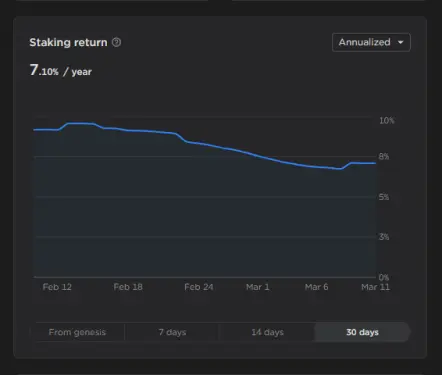
Another consideration about the rewards is that only about half of your rewards will be paid out in native LUNA, and the yield is not compounding, meaning that you have to claim and redelegate your rewards periodically. The other half that is paid out in mostly UST, and then a big basket of minute amounts of other stablecoin bits. I personally don't mind if rewards are being paid out in stablecoins, but there are transaction fees to consider if you're trying to convert them back into LUNA.
A last major consideration is the unbonding period that you get hit with whenever your choose to undelegate your staked holdings. In other words, the moment you decide to unstake your LUNA, you start a 21-day unbonding period at which you do not accrue staking rewards. And honestly, as annoying as this is, I actually do appreciate that the unbonding period is there. I think it makes the entire Terra system more stable when you have people that are not unstaking massive amounts of LUNA on a whim.
Arbitraging (44-55% APY)
So if you're like me when I first heard about arbitraging LUNA, I really didn't look into it because I made the assumption that it was going to be overly complicated. I foolishly made the assumption that I was going to have to bridge my LUNA over from somewhere else, paying more fees, and then trying to time it right with another exchange...yada yada yada. Little did I know (until now) just how freaking simple it is to take advantage of arbitraging LUNA. What makes arbitraging even more simple is that with the terra ecosystem, there's always super cheap transaction fees regardless of the volume you're moving.
So I'm not to go into a super deep dive on this one, simply because there are so many freaking opportunities with this out there, but I'm going to go over this step-by-step to breakdown just how easy it is.
Step 1: Get LUNA
There's tons of places to get native LUNA, but the easiest places I've found myself are either through Crypto.com or through Okcoin.com. Another option is to converting via KuCoin where you can trade BTC/LUNA.
Step 2: Trade LUNA for discounted LUNA-peg.
Now the LUNA-peg could be a few different things, but perhaps the easiest and most notable option is bLUNA. Just a quick search on Astroport and Terraswap got me these:
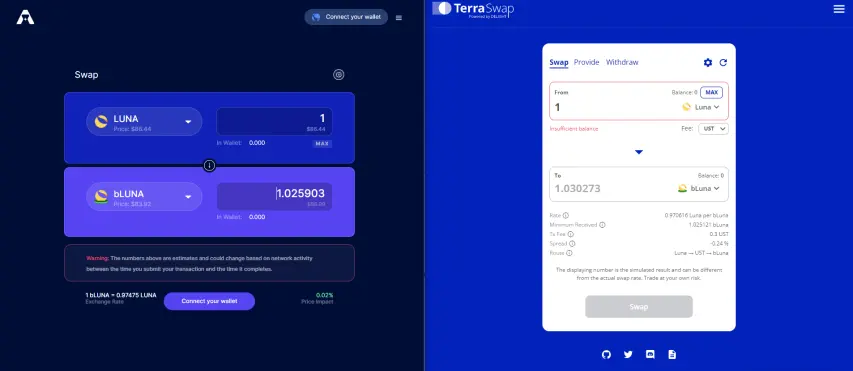
This is roughly 1 LUNA to 1.025 bLUNA, or inversely 1 bLUNA for every 1 LUNA. Therefore you are buying the bLUNA at a discounted price of about 2.5-3%.
Step 3: Burn your bLUNA back to LUNA at a 1-to-1 ratio on Anchor:
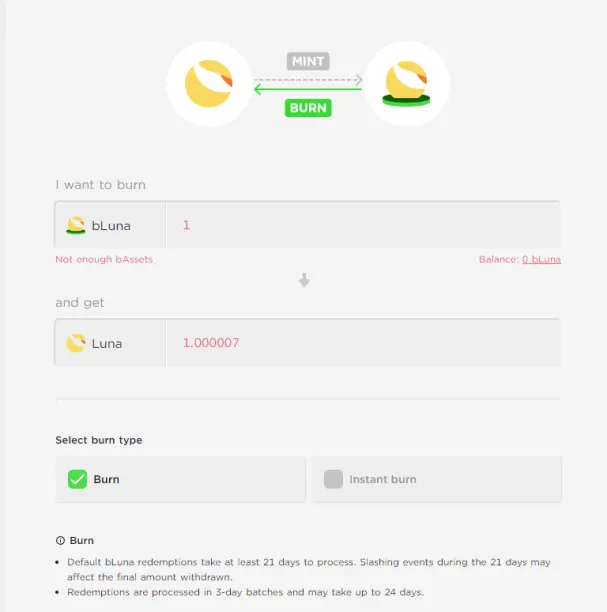
And there you have it, voila, you have now just completed a successful arbitrage of LUNA to bLUNA and then back to LUNA. Putting these figures into an APY calculator, this arbitrage accrues around 44.81% APY, far far better than the 7-10% APY one would make staking.
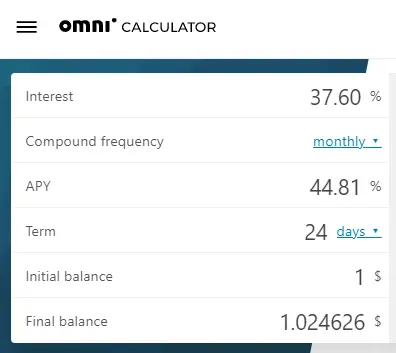
An additional notes on bAssets, is that there is a 21-24 day slow burn period when converting your bLUNA to LUNA. If you're lucky and you're able to do this in 21 days instead of 24, then your APY would go up to the mid 50% APY range, which is even better.
Risks
As I mentioned before, there area a lot of other pegs out there to LUNA (cLUNA, xLUNA, pLUNA, etc.) but my speculation is that bLUNA is by far the safest of not losing its peg since it's a centerpiece to the Anchor protocol, Terra's main flagship. That being said, even though the peg has kept up extraordinarily well, the rate between LUNA and bLUNA does tend to fluctuate, albeit slightly.
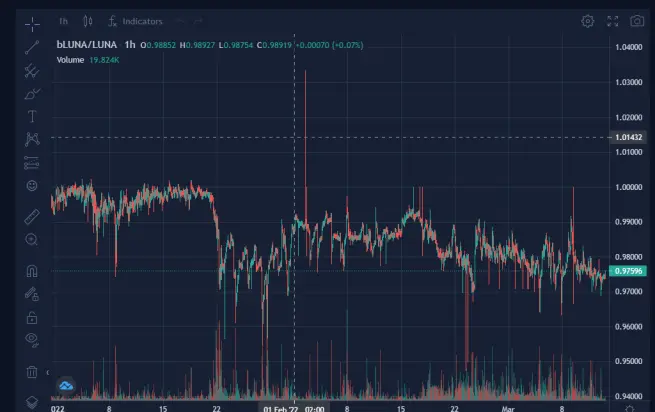
You can see in the above graph that although it's been pretty stable, there have been some times over the past couple of months where the price of bLUNA has darted above the price of LUNA. Looking at the historical data however, if this happens, it makes sense that the price is only temporary so it'd make sense just to wait until the price stabilizes back to a discounted price. An added side benefit too is that if you're "stuck holding" bLUNA when you're waiting for a beneficial arbitraging rate, you can also simultaneously accrue UST rewards which you can see on the bASSET page over on Anchor.
Another risk is inherent to LUNA itself, or in other words if you're holding onto LUNA or bLUNA (or any other other form of pegged LUNA) the price of LUNA can dip significantly as we saw when it took a huge hit during the correction in January. In these instances when the price drops, it may be more beneficial to stake rather than arbitrage because as I mentioned before, staking will accrue half of your rewards in stables rather than LUNA itself, and also historically we've seen that APYs for staking do increase (although seldom to the 40% range).
Conclusion
So there you have it--arbitraging your LUNA can get you significantly better returns on native LUNA than simply staking it. The thing that sucks with both staking and arbitraging are these long unbonding or slow burn periods, but they are cons to both staking and burning, not just staking. I know there are several liquidity pools out there that offer better than 7-10% APY returns as well, but many (if not all) of these expose you to a significant amount of impermanent loss as different protocols will usually offer the protocol's native token rather than LUNA itself.
What are you doing with your LUNA? Are you staking it? Or if not, have you found a better/easier way to arbitrage?






