
Last February when I heard the news that Umami Finance’s CEO (Alex O’Donnell) left and was dumping all his bags, I had assumed that the Umami team was going to disband, or at the very least, stick around trying to hold together a dying protocol:
I wasn’t invested with Umami at the time, but I knew that tons of people were pissed, especially when this token dump basically crushed $UMAMI’s token price, not to mention the protocol’s TVL:
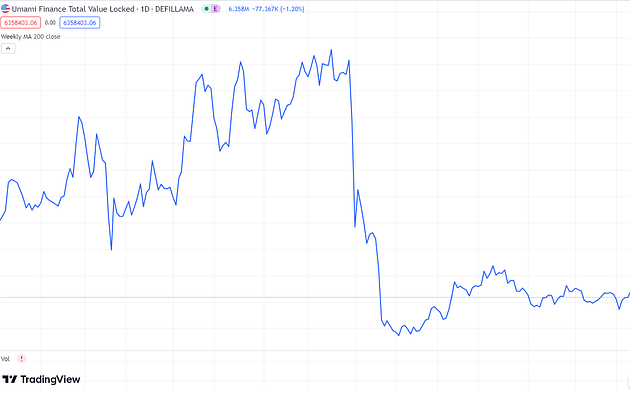
Seeing protocols get buried for far less drama, I was pleasantly surprised to learn that the team never stopped building, and now they have created some strategies that are offering some of the most lucrative returns on your $ETH, $BTC, and $USDC:
So after half a year, how did Umami.finance bounce back and how are they producing such great yields? Let’s find out…
Rising out of the FUD
A CEO dumping his ownership shares or tokens is a hit for any company, whether it’s in DeFi or TradFi, and in Umami’s case O’Donnell allegedly gave his middle finger with his unhappiness with the direction Umami was going and dumped his bags in the process.
Similar to some to the FUD that surrounded Solana when FTX collapsed, Umami’s fundamentals, the treasury, the multi-sigs — all essentially stayed the same. The temporary collapse of Umami simply serves as a reminder that even though it is/was technically a DeFi protocol, it doesn’t necessarily mean that it’s controls were decentralized. In response to this realization, the Umami team made a strong turn towards hardening their token-owner-controlled DAO governance framework, and within just a few weeks, government support team members were nominated and Umami’s marinating faucets were all turned back — all clear signs that the team was dedicated to continue building.
Printing month after month
As I mentioned before, Umami’s tech didn’t change with O’Donnell’s departure, and incidentally, neither did Umami’s returns. According to their monthly treasury updates, month after month following the crash, Umami was able to continue printing profitable returns:
March 2023 = 27.5% APR on Treasury Assets
April 2023 = 12.7% APR on Treasury Assets
May 2023 = 8.5% APR on Treasury Assets
June 2023 = 11.7% APR on Treasury Assets
July 2023 = 7.6% APR on Treasury Assets
Aug 2023 = 5.7% APR on Treasury Assets
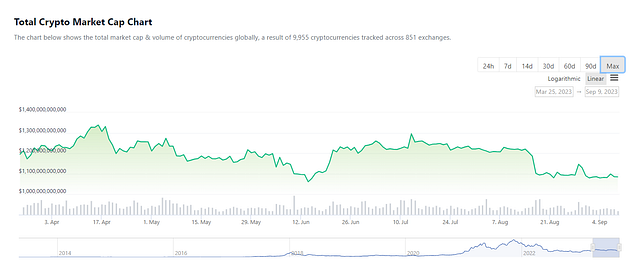
Keep in mind that during the same period of time, the total Crypto market cap has declined by more than 20% since the local top last April:
How has Umami been able to continue to print? I’d recommend reading their monthly treasury updates where they give a pretty comprehensive breakdown. But the hottest ticket? In my opinion it’s all about their Deconstructed GLP vaults.
Enter Deconstructed GLP Vaults
Gaining nearly half a million in TVL in just the past week (at time of writing of course), the majority of Umami’s GLP vaults are at capacity, and looking at the rates it’s not that hard to figure out why:
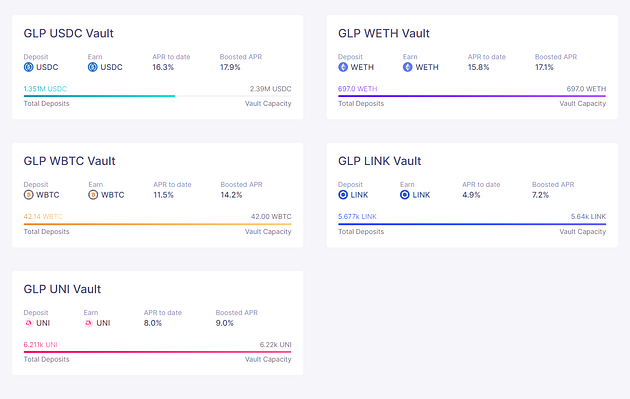
16% returns on USDC I've seen before, but what’s most impressive to me is getting 11.5% (14.2% boosted) APR on $WBTC and 15.8% (17.1%) APR on $WETH. A user can elect ‘Boosted APRs’ if they’re willing to slow-release their funds over 14 days for increased returns, thus allowing the vault to better adapt and anticipate appropriately to large liquidity exits.
If you’re unfamiliar with $GLP, essentially it’s the liquidity token of the GMX.io platform, and it is composed of several different crypto-assets, namely $ETH, $BTC, $LINK, $UNI, and $USDC among others. Umami’s vaults “deconstruct” these assets apart, which is the reason why you see separate Vaults for each.
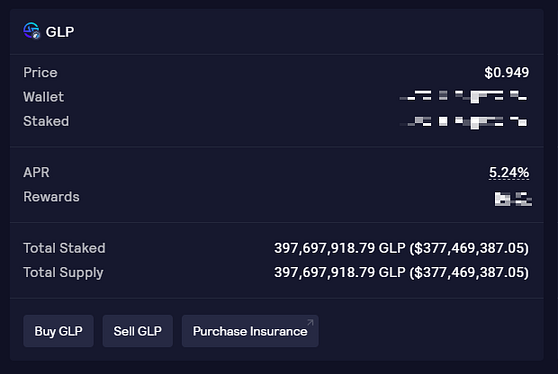
Now if you go over to GMX’s website, you’ll probably notice that the current APR rewards are barely at 5%, significantly lower than what you can earn through Umami’s Delta-optimized and algorithmically adjusted vaults:
Because price fluctuations between $GLP’s indexed tokens can change rapidly, consequently each asset’s allocation in $GLP can as well. What Umami has been able to do is develop a hedging strategy that performs well despite these asset reallocations which enables the vaults to “offset market delta in GLP with extreme precision.”
If you’re interested in reading more about these strategies and how they work, I strongly recommend that you take a read of a deep dive article on how they initially back tested these vaults, then even demonstrating higher returns.
Putting this altogether, Umami has been able to launch a product that nearly triples that of some of their biggest competition, like GMD (which offers USDC/ETH/BTC vaults) or Jonesdao.io (which offers a leveraged Delta GP vault — all built on top of GMX as well too. One could argue that you could further leverage your gains on GMD with protocols like Ghast, but there’s one key difference that makes me feel a lot safer about Umami — Umami has been audited, and Ghast has not. And for me personally, a few percentage points in yield just isn’t worth the risk.
And speaking of risks, there are a few things to consider before aping into one of these vaults.
Fees — Like many vaults, there are a few different fees that need to be taken into account, including:
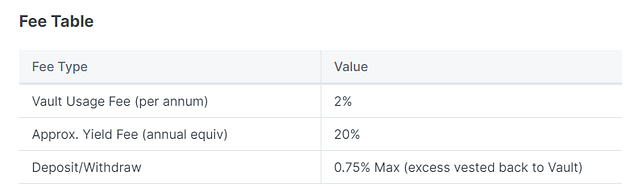
But apart from the deposit/withdraw fee, the other fees are inclusive in the advertised rate. In other words, if the vault advertises a 16%APR, this is the rate after 2% reduction has already been levied. And in regards to the yield fee — this is only levied if there’s actually a profit.
Traders could have an astronomically good day — These vaults are all tied to GMX and it’s traders, and like with most perp dexes, if traders do exceptionally well, this hurts those who are providing liquidity. That being said, even excluding trader profit and losses, according to the backtests, the USDC vault’s baseline strategy still was able to produce 3.3%APR from platform fees alone.
Geoblocking — If you reside in the United States, you may find that you might be blocked from using Umami. As one of their adjustments the team made last February, people from “complicated jurisdictions” (namely the United States) are restricted from using it. Comments on discord indicate that United States citizens might regain access in the future once there’s a “clear pathway to compliance.”
Conclusion
Umami has been extremely impressive coming out of the depths of last February and their continued testament to build and ship products like their deconstructed GLP vaults gives me a lot of conviction for their team — It’s just a shame that most of these vaults are at capacity, and I’m going to be keeping an eye out for announcements in their discord for when they might be increasing their caps.
Can these rates last forever? Probably not, but their 8-month back tests as well as what they’re able to print now in the depths of a bear market are extremely impressive nonetheless.
Unfamiliar with GMX? Feel free to check out previous articles I’ve written about crypto’s most beloved perp dex back in the days when the $GMX token was barely trading at $20 bucks.
And as always, thanks for taking the time to read this and be sure to follow me on twitter (https://twitter.com/CryptosWith) to get all my latest updates. Also, looking for a gift for your Crypto-loving/hating friend? Give them a REKT journal to cheer them up!
Disclaimer: And as a final reminder, this is not financial advice and this is for educational and entertainment purposes only. Please as always, do your own research and find what investments are best for you. Cheers everyone!





