
Hello everyone, welcome to my November update to the best places I’ve found to stack stablecoins, all earning yields of at least 13% APY or more. There’s been a great deal of changes since I last did my last list in September, and I imagine that the next time I do an update, the landscape will continue to change just as fast as the cryptocurrency market does. There were two news items that caught my attention in the last couple of months in regards to dollar-saving — the recent announcement of a wind-down for $USN in late October, and the Series I U.S. Savings Bonds rate topping at 9.62%. Due to the announcement from the Near foundation, I did not include any of the high yield rates I saw for $USN because I expect that those rates will disappear dramatically in the coming days, and as for the Series I-bonds, for this reason I didn’t do an announcement last month as I was accumulating most of my spare cash to max out my I-bond before the deadline on October 31st (Call me risk adverse, but in my opinion there’s nothing out there’s that’s as minimal risk making 9.62% on your USD than putting into the US government).
Anywhoo, let me reiterate the criteria that I’ve set out for all of these strategies that are on this list:
- No algorithmically-backed stablecoins: I know that there are some great algo-backed stables out there generating some crazy returns, but after the Terra death spiral, it will be some time before I trust anything that’s linked algorithmically again.
- No lock-up periods: If you’re looking into earning into the 20%+ APY range, I highly recommend that you check out my previous articles on platforms such as Haru Invest where you can earn significantly more if you agree to lock-up your funds for 30+ days.
- The protocol pays out in the native asset (stablecoins, not in alts): I know there’s some great returns that can be had with platforms like echnida or platypus finance, but the rewards from staking are all in altcoins, which are too volatile in price, especially in a bear market.
With these factors in play, I will breakdown the following protocols and try my best to identify the pros and cons of each so that you hopefully might be able to make a better decision for where you want to park your stables as you’re waiting this bear market out. In no particular order we have:
Zunami Protocol on Binance/Ethereum: 17.45% APY
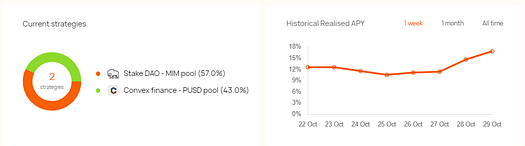
If you read my last article, you’ll have seen that Zunami made it on my honorable mentions list yet now I’m listing them first. Why the change? Last month the Zunami DAO voted to remove their $USDD strategy and instead now their strategies are split between Stake DAO using $MIM and Convex Finance using $PUSD. The Stake Dao strategy is a bit more vanilla as it utilizes the $MIM pool (an overcollateralized stablecoin) on Curve. $PUSD on the otherhand is an overcollateralized stablecoin backed by NFTs. Normally I’m wary about NFTs in general, but it seems that the JPEG’d protocol really has a good thing going here and has attracted some of the bluechip NFTs (including cryptopunks and BAYCs) to be held as collateral as $PUSD gets minted:
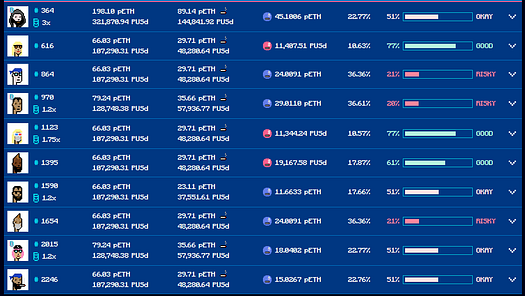
In the case of JPEG’d, essentially if the value of these NFTs drops, the NFT holder is at risk for liquidation with the liquidated NFT getting auctioned off.
Zunami’s yield rates have historically sat around 12% APY, but over the past week it has been climbing steadily, mostly due from what I expect is from the introduction of their new native stablecoin $UZD. I haven’t done too much of a deep dive into $UZD, but from their latest article, they state that Zunami users can “mint it and supply liquidity to Curve Finance in order to increase resulting yields.” Perhaps ending soon, but right now with added bootstrapping funds, users can earn an elevated 42.863% APR on their $UZD.
Pros: Zunami is really proving to be a sound yet innovative protocol, and I believe their team will continue to adapt their strategies which will ensure the continued profitability on their stablecoin strategies.
Cons: It’s unclear to me what the prolonged effect of the bootstrapping for $UZD will have overall for stakers, and I imagine that eventually the high 17% rate will come back down to earth.
Autofarm on Cronos: 13.63% APY
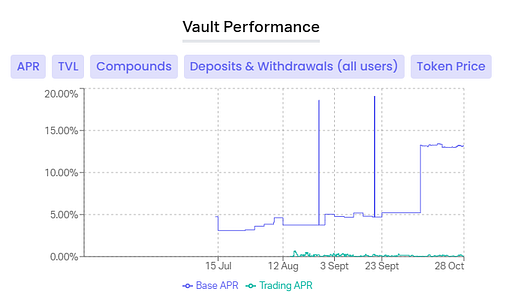
The TUSD-USDC LP via VVS on Autofarm has been generating some consistently high returns on their TUSD-USDC LP over the last couple of months. Personally I haven’t done a whole lot on Cronos because I’ve been soured by $CRO’s horrible price action over the past year, but being a simple LP, this strategy seems pretty straight forward and I personally consider it to be pretty safe. Perhaps the biggest risk on this one is the inherent risk on $TUSD, as it’s based from TrueFi’s lending platform. In October there was a defaulted loan by Blockwater of $3.4 million $BUSD which may have raised some alarms, but it appears that TrueFi was able to create a manageable payment plan with Blockwater in order to weather the storm.
Overnight.fi on Optimism: 13.9%APY
I’ve mentioned Overnight.fi on Binance in my previous article, but as I’ve been digging a bit deeper into their strategies, its been clear that over the past month their most successful yields are on Optimism, utilizing their ETS Garnet via Velodrome:
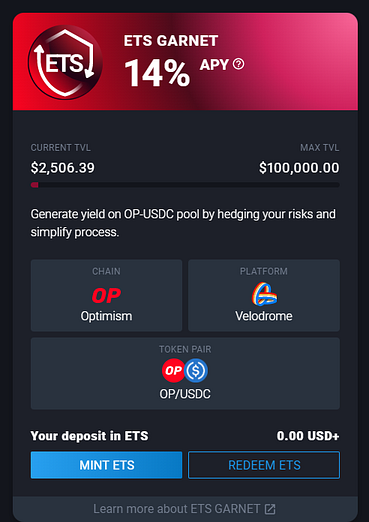
Note that you can utilize this strategy on your own directly on Velodrome for currently 28.99% APR, but there you will be exposed to impermanent loss via altcoins. It’s also important to recognize that Overnight.fi advertises other higher APR strategies on other chains, but the Garnet ETS on Optimism has been the best performing over the past month.
If you’re unfamiliar with Velodrome, essentially its an upgraded stable liquidity protocol like Curve, which offers its users low fees and low slippage trades. If you’re curious to learn more about Veldrome Finance in general, I highly recommend reading more about it from a newsletter article from Bankless. Velodrome has really been killing it lately and I have thoughts to do a write up specifically on their protocol as they have many different lucrative strategies on stables that are 10%+ APY.
Pros: Overnight.fi is relatively easy to use, their strategies are transparent, and the rebasing mechanism is genius — it means no gas fees are wasted that there is nothing to keep track of except how many tokens are in your wallet.
Cons: The rates can vary a lot and are not fixed. Some days you might have stellar returns of 20%+and others you might have below 4%.
Midas Investments on Binance/Ethereum: 13.1% APY
Out of all the strategies, Midas is the only one I’m listing that is CeFi, which I realize will deter a lot of people because if it’s not your keys, not your crypto. But as far as I’m concerned, Midas has become increasingly transparent offering regular investment reports as well as providing very consistent returns over a long period of time. Surviving now three bear markets, the Midas team continues to innovate, finding more ways to capitalize on their $MIDAS token which is currently (once again) hitting ATH’s.
With newly added boosted tiers this past month, if you choose to earn your yields via $MIDAS rather than your stables, you can essentially earn up to 17.1% APY if you hold at least 20% of your portfolio in $MIDAS at the Diamond tier:
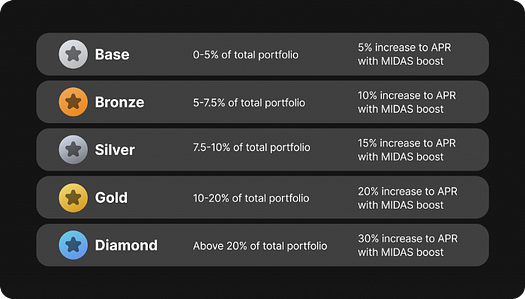
Obviously if you don’t want exposure into the $MIDAS token, I wouldn’t care about the Midas Boost, but even without it, 13.1% ain’t that bad.
Pros: Out of all the strategies I’ve listed, Midas has definitely been around the longest and they’ve shown stellar results while at the same time pivoting responsibly through whatever the market condition may be, while having little negative impact on their yield rates.
Cons: Because it’s a CeFi platform, if it’s “not your keys, then it’s not your crypto.” That being said, I’ve scoured through different user reviews and no one over the past 4 years has ever had their funds locked up, and transparency about how they generate their yields has been increased as they are now regularly publishing monthly investment reports.
Beefy.Finance on Optimism: 17.36% APY
Similar to the Garnet strategy on Overnight.fi, with Beefy’s USD+/LUSD vault you can currently get around 17.36% APY and it seems even with a slightly increasing TVL, the APY keeps rising:
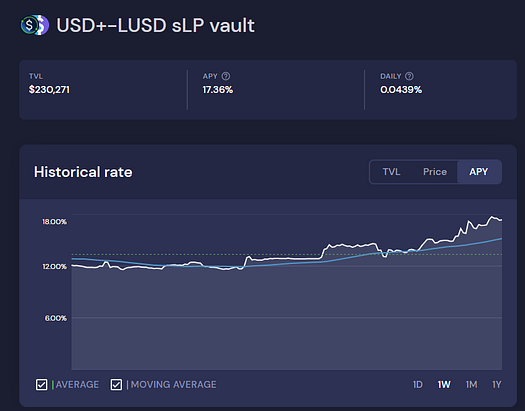
$USD+ is the native stablecoin of Overnight.fi, and if you’re unfamiliar with $LUSD, it’s the native stablecoin for Liquity, a lending protocol similar to JPEG’d where instead of NFTs, users can overcollateralize their $ETH in order to mint $LUSD. As safe as I think the Liquity protocol is, you can read my analyses here where I break down my perceived potential risks.
If you’re unfamiliar with Beefy.finance, they are a self-described “Multichain Yield Optimizer” where you can easily access liquidity pools to more than 15 different blockchains. Where Beefy.finance really shines is that you can “zap” into any LP and then auto-compound in that same native LP token. In other words, Beefy.finance automatically takes whatever rewards you gain from the LP and reinvests back into that same LP pool. The way that Beefy.finance makes money is that they skim a bit off the top as a “performance fee.”
There’s a few considerations that you should take when using Beefy:
- Look at the historical rate of returns to track volatility. There are some pools that might look great, but the pool itself could just be experiencing a temporary spike in activity.
- Check out the TVL because that will give an indication of how sustainable the yield rates might be. If you compare the two LP’s I’ve outlined above, with a TVL of more than $1 Million, the DAI/BUSD/USDC/USDT Vault will probably be a lot more sustainable long term than the USDC/BUSD/USDT vault on Fuse that only has a TVL of $60k.
- Each pool has a “safety score,” and Beefy will help you breakdown where the APY’s and also outline whether or not the contract(s) are audited.
Pros: The Beefy team has been evolving quickly, constantly adding new projects and chains in order to allow users to access countless numbers of liquidity pools, that and their ‘Zap” feature makes the whole process easy and quick to get in and out of each pool.
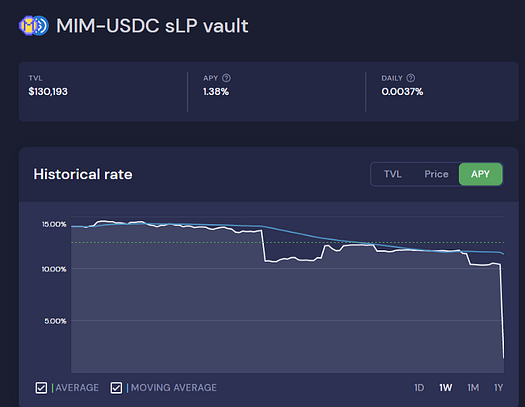
Cons: The APR’s can be quite volatile, so if you want to sustain higher APR’s every day, it might take a bit of extra effort checking in on the rates. A greater than 10% APY can go down to 1.38% overnight:
Honorable Mention - Gains Network on Polygon: 13% APY
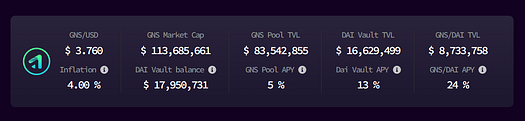
I’m including the Gains Network’s $DAI vault not only because it’s currently generating 13% APY, but because I feel like the whole protocol is on a tear right now. If you’re unfamiliar with Gains, its probably most similar with GMX’s $GLP token, and is basically the vault from which transacts with trader’s profit and/or losses. In other words, the yield rates for the $DAI vault will vary depending on how many people are winning or losing at trading on the Gains Network platform. The reason why I’m considering this an honorable mention however is that because once your $DAI is staked, only 25% of your stake (from your initial stake) can be withdrawn once every 24 hours. Therefore, if you stake $100 dollars worth of $DAI, you are able to withdraw only $25 dollars every 24 hours. To date, the $DAI Vault is providing roughly around a compounded 13% APY. The rationale behind this staggered 4-day lock-up period is to help prevent bank run on liquidity. So although there is technically a lock-up period, its only for 4 days and the yields generated from the vault are legit.
Conclusion
Hopefully you’ve discovered a new protocol to capitalize off of and if you’ve heard of any others that aren’t listed here, please drop me a comment below because I’d love to check it out. If you’re interested in digging for more stablecoin opportunities with disregard to my low risk parameters (no algos, no lock-ups, no altcoins) I’d recommend checking out stable.fish — a great compiled list of any LP involving any stablecoin out there. They don’t have their stats updated in real time, but it will give you a really good picture of what’s out there.
Thanks for taking the time to read this and be sure to follow me on twitter (https://twitter.com/CryptosWith) to get all my latest updates.
Disclaimer: And as a final reminder, this is not financial advice and this is for educational and entertainment purposes only. Please as always, do your own research and find what investments are best for you. Cheers everyone!





