
Hey folks, if you’re more of a silver or goldhead, this is probably going to come as old news to you, but if you’re siloed in the Crypto-Twitter bubble, than it might come as a surprise that the whole concept of bridging Real World Assets (RWAs) to the blockchain actually isn’t new — in fact, as evidenced by Kinesis Money, with gold and silver, they’ve been at it for the last five years.
There’s a a great deal of questions and information that I’ll dive into about Kinesis Money and whether it sounds like a viable investment vehicle, so be prepared for a long one. (Otherwise just skip to the TLDR)
But let’s start with the basics first…
What is Kinesis and how does it work?
The main purpose of Kinesis is to allow people to be able to get access to, mint, and/or store their bullion through their respective Kinesis tokens $KAU (which 1 token is backed by one gram of gold) and $KAG (which 1 token is backed by 1 oz. of silver). To date according to Kinesis’ dashboard, there is roughly a little more than $150 million dollars’ worth of both $KAU and $KAG in circulation:
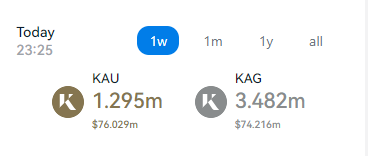
Both $KAU and $KAG are reportedly backed 100% by its underlying bullion, which can be redeemed for the actual underlying gold/silver for a 0.45% fee plus delivery costs. Additionally both tokens exist on the “Kinesis Mainnet” which is a fork of Stellar, and according to Coinmarketcap are tradeable on the following exchanges, albeit with very little liquidity or volume:

Therefore, it’s clear that Kinesis Money is an extremely enclosed centralized ecosystem, which begs the question of what benefits user from holding their bullion through their blockchain as opposed to anywhere else. This is where the next section comes in:
Yields
Kinesis is a Gold and Silver investment platform that hosts its own exchange, and also provides yields in the following ways:
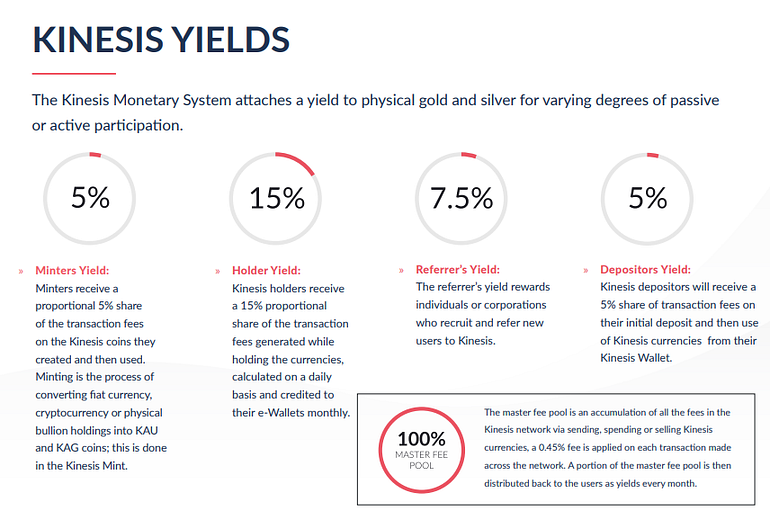 https://kinesis.money/resources/kinesis-whitepaper-summary-en.pdf
This does NOT mean that you’ll earn 15% APY by holding your gold or 7.5% of the rewards a referrer makes of his/her referee, but instead 15% of the cumulative sum from the entire ecosystem, named the “master fee pool.”
For simplicity’s sake, I’m only going to break down two of these yields in this article, the holder’s yield and $KVT yield (not pictured above because it was introduced later).
Holder’s Yield
The primary reason I’ve gathered for why people go to Kinesis is because they can buy bullion at or slightly below spot (via $KAU/$KAG), but users are further incentivized to hold their $KAU/$KAG in order to earn “Holder’s Yield.” If you’re wondering about how much Holder’s Yield you can earn, I found it quite difficult to discern because on their dashboard, because on their dashboard you only see the accumulative amount of yield by month or for all-time, but not for TVL of underlying assets:
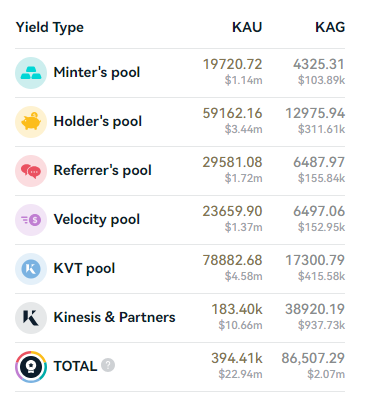
Without seeing the underlying assets for the same set time periods, it’s quite difficult to calculate approximately how much yield is being generated. What I have been able to gather from several different reddit posts is that historically the yields have fluctuated from <1% to around 10% annualized. This makes sense because looking at the past Master Fee Pool data, the fees generated vary greatly going from almost $3 million to less than $100k dollars.
Regardless, let’s plus some numbers in to try to do a math break down to see it this matches up…
▹If there were $100 million in Kinesis TVL and you personally owned $1000 dollars worth, you’d own 0.001% of total value.
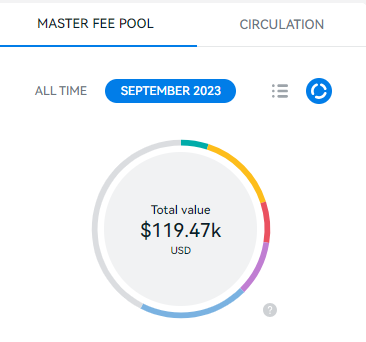
▹Considering that the total Master Fee Pool generated approximately $120,000 in the month of September, you would get your proportion of the holder’s yield (15%), meaning you would get $120,000 x 0.15 x 0.00001 = $0.18 cents:
▹Making $0.18 cents off of a $1000 investment during a one month period annualized would equate to approximately a 0.22% APR.
▹(I used $100 million for simplicity’s sake, but the actual TVL in KAU/KAG appears to be about $150 million, meaning that the actual yield for a $1k deposit would be even significantly less, but I think you get my point).
Once again to be completely fair, September 2023 was one of the lower earning months, and had I gone back to 2021, I’d probably making more when fees were at all-time highs. However my main point here is that earnings can be very volatile, and that right now they’re pretty low.
I won’t go into the other yield-bearing streams in detail, but I should also perhaps mention yield provided by $KVT holders, which holders can earn the largest share of fees, coming in at 20%.
What is $KVT?
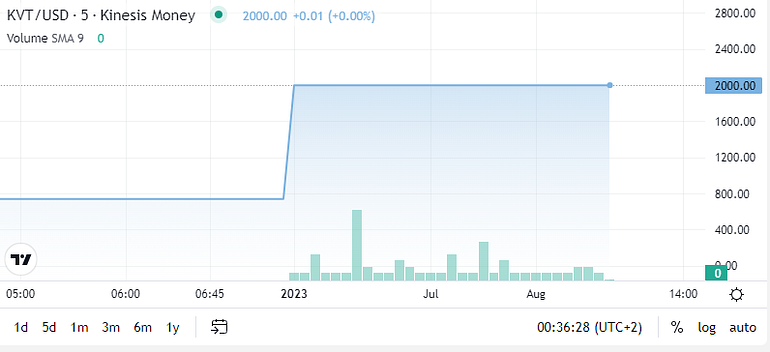
The 3rd token native to Kinesis is called $KVT, which unlike $KAU/$KAG, is an ERC-20 token and can be tracked on etherscan. With $KVT, otherwise known as the “Velocity Token,” Kinesis currently has a Kinesis Exchange market price of $2000 per token and has been that way since June 2023:
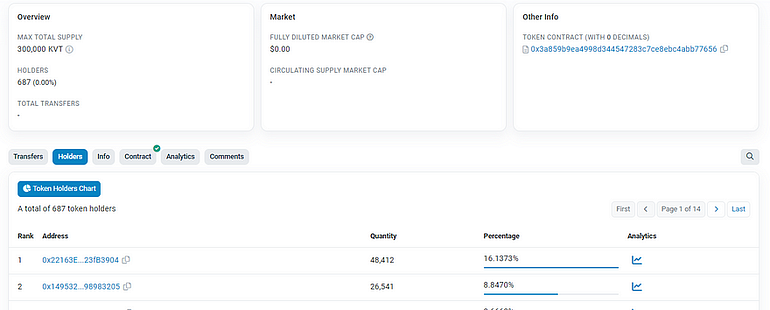
As I mentioned before, the purpose of $KVT is to award its holders a 20% share of all revenue from the entire Kinesis ecosystem all via more $KAU and/or $KAG. $KVT has a total max token supply of 300k, and at time of writing currently has 687 unique holders:
What’s interesting about $KVT, is that even though it’s an ERC-20, from what I can tell it’s not listed at all on Coinmarketcap, Coingecko, or even DexScreener:

By deduction, this most likely indicates that the $KVT token completely circulates solely inside the Kinesis ecosystem and is not exportable/tradeable on the open market.
Other Factors/Takes to consider
OK, so now that we know a bit about how the Kinesis system actually works, let’s dive into some of the other things that I think are important to consider…
Inspections/Audits — To date, Kinesis has had several previous audits, the most recent from July 2023:
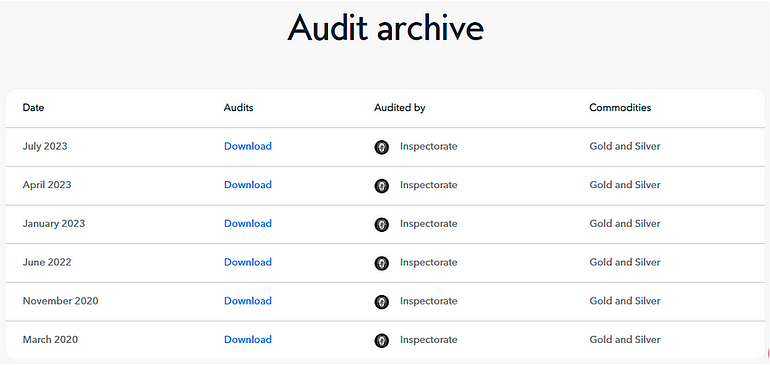
I’m not a professional accountant or auditor by any means, but if you’ve followed some of my previous articles on so-called-audits in the past, it’s reassuring to read that this was indeed an actual commodities audit done by actual commodity auditors (unlike fake “audits” done by invested Youtube influencers like James Pelton). In full transparency I’m definitely not a commodities expert nor do I know what all has to be in a commodities audit/inspection, but what I do know is that Bureau Veritas is a 200-year-old institution that’s one of the largest global commodities inspectors.
If you’re looking to get any information about contract codes or tokenomics, you’re going to be out of luck. Reading through the documentation, it’s clear that these aren’t corporate financial audits but instead they are commodities inspections — this leads me to my next point…
We can attest that the Gold/Silver exists — we don’t know if loans are being taken out against them, we don’t know if there’s registered serial numbers for each bar of gold, but the inspection audits attest to the fact that they do exist. Kinesis does advertise the fact that $KAU and $KAG are not exposed to counter-party risk and that they are redeemable 1:1 for the physical underlying asset (albeit with a 0.45%+$100 dollar delivery cost).
Doxxed Team — Kinesis’ team and its advisory board is fully doxxed and accessible on Linkedin:
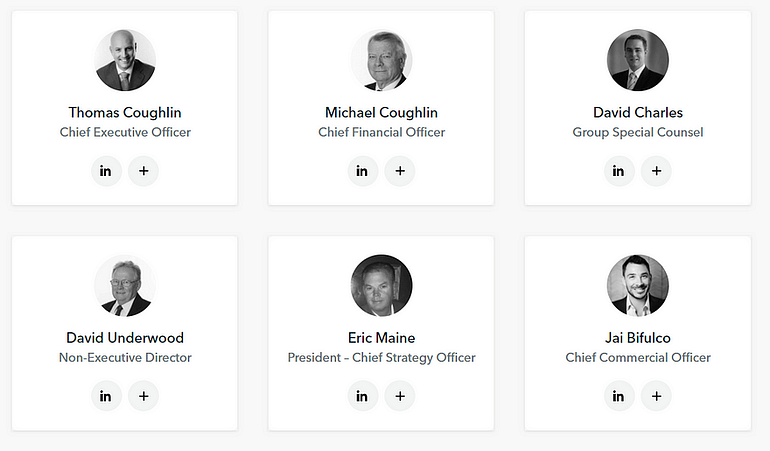
As we’ve seen with asset-frozen projects like Celsius and Voyager, being doxxed isn’t a failsafe to prevent you from getting rugged, but at the very least it can provide you some legal recourse or justice.
Verify, don’t trust — Most of the criticisms I’ve read about Kinesis is their lack of transparency. Similar criticisms were/are in place for Tether, Circle, Binance…and for each scam that takes place, more skepticism grows and conversely more transparency is demanded. Is it reasonable for Kinesis to build out so much transparency to its customers? TradFi certainly doesn’t. And this brings me to my final point…
Should Kinesis be treated like a Crypto project or a Bullion project? — Crypto people are asking for code audits, they’re asking for updates and promises to be rolled out in real time, and they’re asking for more and more transparency. Are they wrong for expecting these standards? No. And just because TradFi doesn’t, mean Kinesis should either. But go as someone at your local bank these same questions, and I’m sure that just like Kinesis, you won’t get all the answers you’re looking for. The more I read from the Kinesis team, it’s more and more apparent that they’re primarily using the blockchain as a ledger system, and that their priority seems more on keeping account of where your gold is, not if there’s a contract exploit. Does Costco give 100% transparency about their financials when they’re selling out their gold bars? I think not.
TLDR/Conclusion:
Given Kinesis’ current market conditions, it doesn’t appear that you can make crazy yields overnight, but then again my guess is that many Bullion Bulls would argue that this isn’t the point. Similar to $BTC-maxis, many people go into bullion to hedge against state-sponsored fiat, and Kinesis offers a custody solution without storage fees and pretty decent advertised prices that are close to spot.
I’ve read through many of Crypto Informers articles bringing some of Kinesis’ opaqueness to light, and I’ve also arduously sorted through many of the responses and counterarguments on Kinesis’ forums, and the conclusion I’ve drawn is that Kinesis does take steps bridging RWAs to the blockchain, but for the crypto-minded people who have been burned by the likes of FTX, Voyager, BlockFi, Celsius, etc. — there’s still an extremely long way to go.
In conclusion, this might be a cop out answer but I believe that every investor has to gauge their own risk appetite and decide whether or not the benefits are worth it. Personally from what I’ve found, there are a lot of questions unanswered, but Kinesis is still a pretty solid place to buy gold/silver close to spot, and I have yet to find an actual review where people aren’t able to withdraw funds or redeem their bullion as intended. Does this me it’s failproof? No. But does this mean that it’s not worth trying out? That’s up to you.
I know there was quite a bit of information in this article, but here’s some additional information that I’d recommend taking a look at if you’d like to learn more:
Whitepaper
Crypto Informer’s Substack
Forum on Kinesis’ responses to Crypto Informer’s claims
Kinesis Chain Explorer
“Understanding the Kinesis Blockchain”
Are you already a part of Kinesis? If so, I’d be really curious to hear about what your overall experience has been like in the comments below. If you don’t have an account but would like to see what it’s about, signing up for an account is free (and you can use my referral link so that I can earn less than $0.001 a month on your $1000 deposit 😂).
Thanks for taking the time to read this and be sure to follow me on twitter (https://twitter.com/CryptosWith) to get all my latest updates. Also, looking for a gift for your Crypto-loving/hating friend? Give them a REKT journal to cheer them up!
Disclaimer: And as a final reminder, this is not financial advice and this is for educational and entertainment purposes only. Please as always, do your own research and find what investments are best for you. Cheers everyone!





