
Hi folks, if you’ve been following the trends for the past couple of months you’ve probably seen an insane number of different GMX forks pop up advertising “real yield.” As one of the clear winners of 2022, it’s no wonder why GMX has been trending, but I felt it pertinent that people fully understand what they might be getting themselves into before aping in. All forks are not built the same, or at the very least, there are specific metrics for why GMX is clearly more successful than others.
Before we get into the list of things to look at, let’s first do a recap of what GMX.io is and how it works.
GMX: $GMX and $GLP
Like many other native DEX tokens, $GMX gets its value and utility off the protocol’s fees (i.e., swaps/trading fees and token emissions). The more fees that the platform accrues, the more value that goes to the $GMX token. To be more exact, 30% of the total protocol fees goes towards $GMX stakers, and 70% go to GLP holders. However what really has made $GMX popular is that if you stake $GMX, the rewards you receive are given out in $ETH and escrowed $GMX
The sister token $GLP primarily generates its revenue (70% of total protocol revenue and emissions to be exact) from trader liquidations. In other words, you’ll be making money from all those people getting rekt on leveraged failed longs and shorts. Additionally, $GLP itself is more akin to an ETF than it is to a cryptocurrency, as it’s comprised of a rebalancing basket of cryptocurrencies.
Now that we’ve familiarized ourselves with the mechanics, let’s dive into the factors for why GMX has been so successful, and why others may or may not be successful as well:
Liquidity
Probably the most obvious indicator is liquidity, or in other words how much leveraged traders can borrow in order to make their trades. In fact, one could argue that liquidity is the mother of all necessities no matter what type of finance-related platform that you’re running. In GMX’s case, it’s pretty clear that there’s really no rival when it comes to AUM, and as far as AUM growth, it certainly looks like there’s no stopping it:
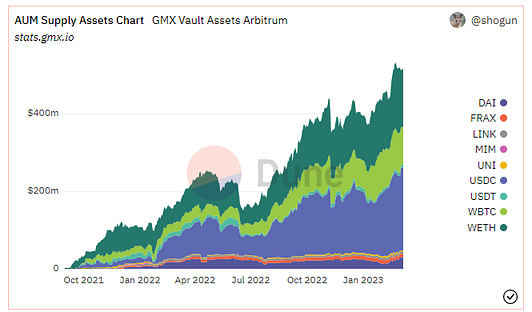
If you don’t have liquidity, then you can’t do leverage, and if you can’t do leverage, then you can’t make a money off your trades. And if you can’t make a lot of money off of your trades, then traders will indefinitely look elsewhere to make those trades.
If you take a look at the relatively new options trading platform Buffer Finance for instance, Buffer’s $BLP pool (which is also called a USDC Vault) has a hard cap of $2 million dollars worth of $USDC, which is also the reason why we see a hard ceiling of $2 million in their AUM:
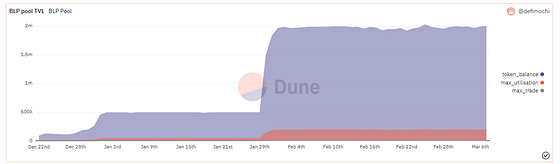
Does this mean that Buffer Finance can’t be successful? No, because the main allure for Buffer is options trading, not doing 50x leverage. Nonetheless, I would argue that if there’s a ceiling on liquidity, then there’s probably a ceiling on profitability.
The Early Bird Gets the Worm
Another reason why GMX has been so successful, is simply because they were the first. Many people (including myself) have been touting GMX for several months now, and their reputation has grown even stronger having come out still printing money regardless of all the Luna/3AC/Celsius/Voyager/BlockFi/FTX/Genesis contagion that has caused other protocols and tokens to lose more than 90% in value.
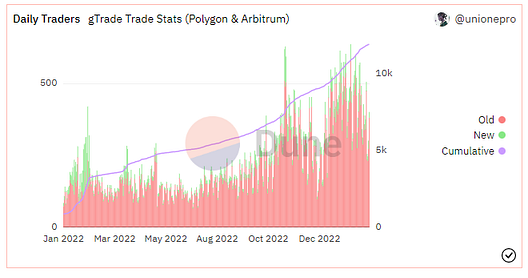
Being a tried and true product has attracted not only investors but traders as well too, which is why we still see meteoric growth. Arguably, this is the same reason why Gains Trade (gTrade) done so well too. As one of the first leveraged trading platforms on Polygon, I believe that “being first” had a huge effect on their continued ability to attract traders and liquidity. Although they’ve been around now for well over a year, this is still exemplified in their 2023 stats alone:
To further argue my point, if you take into account another Polygon competitor Metavault, their vault pool is still impressive in size in its own right, but having launched several months after Gains, I wouldn’t call their growth “meteoric”:
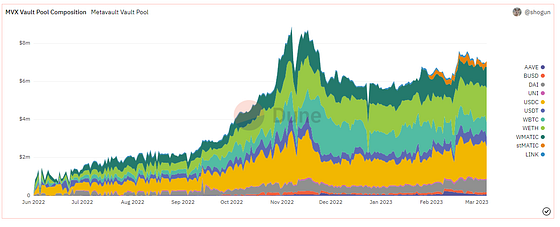
However as you can see in the graphic above, Metavault still has been doing pretty well, which is why although some of these platforms may not be as successful as their forbearers, it’s pretty clear from Metavault’s metrics that there’s still plenty pieces of pie to go around.
This leads me to my final point on being the early bird —not all L2s and chains have a clear and dominant leverage trading platform, and things may get even more complicated in the future once you see more platforms like Gains build on Arbitrum. On chains where’s there is not a clear frontrunner like GMX or Gains, I’m keeping an eye on potential forks that might take up this mantle with little competition. These include Mummy Finance on Fantom opera and OPX Finance on Optimism.
Run the Numbers
One of the great things about a lot of these leverage trading platforms is that they all have excellent stats pages where you can check to see whether the platform has been growing, and/or whether or not the platform has shown consistent growth. Take the leveraging platform Unidex for instance on Optimism:
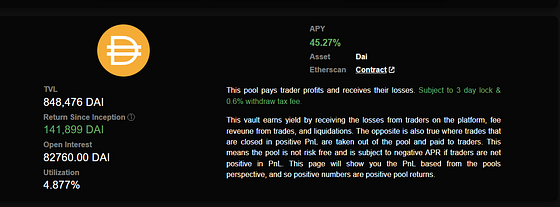
On first glance, being able to earn 45.27% APY on your $DAI is pretty jaw dropping. However if you look a little deeper on how the APY is being calculated, this isn’t necessarily reflective of a daily/weekly return, but instead these figured are most likely derived from earning since the platform’s inception (October 2022). This isn’t to say that this APY can be sustained or bolstered in the future, but as I found out personally, you’re not going to be earning at this rate every day. In fact, looking at their metrics, if you had deposited some $DAI on January 14th and then withdrew a month later on February 14th, according to the cumulative returns chart you would have been close to net zero:
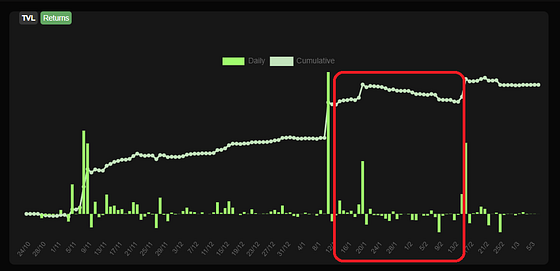
Could your deposited returns be subsidized by trading fees? Perhaps, but I would strongly doubt that during this period of time that you’d be earning the advertised 45.27% APY.
Therefore, be sure to see how some of these numbers are being calculated. Most forks will specify how they calculate their APR rate, which you can check in their analytics page or on the earnings page itself:
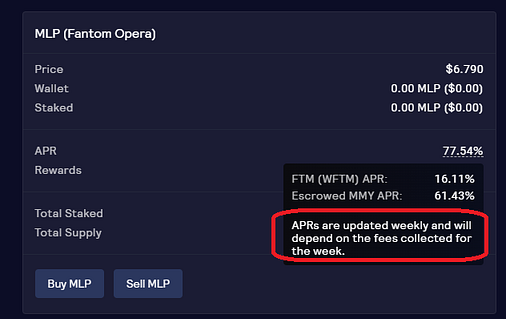
By looking at the numbers, hopefully you’ll be able to discern what platforms might be a one-shot wonder or one that keeps hitting home runs.
Take in account lock-ups/fees and how long you’re willing to invest
Several different platforms also have different lock-up periods or fees for entering funds in and/or out of the protocol. Generally I’m pretty adverse to lock-up fees for any reason, but from a trading platform’s perspective, I completely understand the drive to maintain high protocol liquidity in order to attract more traders.
Gains Network, as we’ve already mentioned has an epoch-wait period in which you have to request in advance to redeem your $gDAI (yield bearing $DAI). If you miss your redemption window, just be weary that you’ll have to put in another request and wait another set of epochs before being able to redeem again:
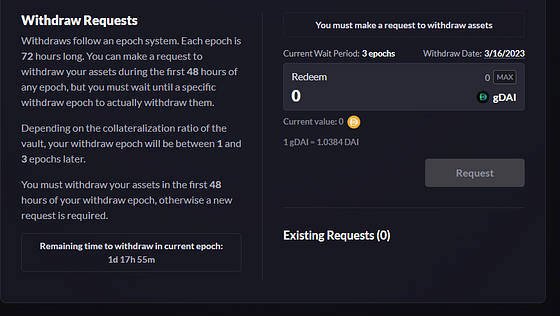
As you can see in the graphic above, the current wait period is 3 epochs, or 9 days.
Conclusion:
GMX has shown that platform-sharing generated fees can be wildly successful, so it’s no wonder why there’s so many different forks that have sprung up all over DeFi.
However as more competitors are popping out of the woodwork, it’s important to take in account what your investing time horizon might be, and also what attributes the platform has in order to ensure it’s long-term success. Many platforms will prove to be successful, but perhaps just as many (if not more) may fail, or at the very least, make you pay in opportunity cost lost.
Thanks for taking the time to read this, and if you feel like there are any considerations that I’ve missed, feel free to let me know in the comments below. If you haven’t already, be sure to follow me on twitter (https://twitter.com/CryptosWith) to get all my latest updates. Also, looking for a gift for your Crypto-loving/hating friend? Give them a REKT journal to cheer them up!
Disclaimer: And as a final reminder, this is not financial advice and this is for educational and entertainment purposes only. Please as always, do your own research and find what investments are best for you, especially when it comes to leverage. Cheers everyone!





