
There has been a ton of information that’s come out in the past 24 hours that’s come out between the battle between FTX (Sam Bankman Fried) and Binance (CZ), and staying as objective as possible, there’s a ton of observations that I’ve been making from this whole soap opera of an episode.
High gas fees make cascading liquidations worse
I still have about $ETH locked up as collateral, and luckily my loan is overcollateralized by more than 200%, but if I was in danger of getting liquidated (and who knows, maybe I will be later for this crash probably still isn’t over) I’m not 100% certain that I’d be able to deleverage my position. At around 500 gwei in average gas prices, it would have taken me roughly $300 dollars worth of gas fees to get out of my positions altogether — and that’s assuming that my transactions would go through successfully, otherwise it may have cost me more. If you’ve ever tried going through a popular NFT minting period, you’ll know that if there’s a lot of transactions trying to go through at the same time, this basically causes a car crash where no one can get out:
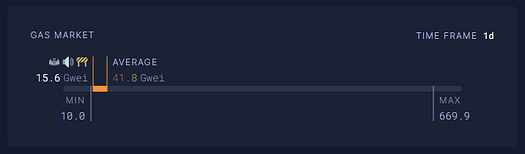
If prices aren’t volatile, then it’s fine to take some time to wait, but as prices keep dropping, more assets that are being liquidated are essentially getting sold off, causing the price to crash even further.
CeFi platforms can’t abide by the same TradFi — a.k.a. fractional reserves
If you’re unfamiliar with fractional reserves, it’s a requirement held by TradFi banks where they are required to hold a fraction of their reserves in cash (liquid), while the rest can be loaned out. Banks can do this without scaring the hell out of people because people know that their money is FDIC insured. Unfortunately, crypto CeFi platforms are not.
When there’s any scare about a crypto platform— rational or not — a bank run can easily occur. As we’ve been seeing over the past several months, there’s more and more examples of CeFi platforms freezing withdrawals which I imagine will make people more and more skiddish going forwards. In other words, if any CeFi platform has a significant proportion of its reserves loaned out, what happened to Voyager, Celsius, or FTX could easily happen to that platform if there is any whimisical market scare. Should CeFi platforms not be able to have fractional reserves? CZ certainly thinks so:
If Binance truly follows through and creates 100% transparency of its reserves and if they show that 100% of its reserves are liquid, it should theoretically be impossible to scare people into a Binance bankrun. This leads to me to my next point…
Never cross CZ
I’m not saying that he’s a bad guy, I’m not saying that he’s bad for crypto, but what I am saying is that he scares the hell out of me. I can only speculate what his end-game intentions were for all the different tweets that he came out with, but regardless of what his intentions were, it’s pretty clear that he is now the crypto kingmaker:
Like I said, I have no reason to believe that he’s a bad guy, but this comparison of FTT to LUNA is a pretty tight jab if I’ve ever seen one:
Assuming that this acquisition goes through, this means that Binance will be the de-facto “ruler” of not only FTX, but all the companies that FTX itself has bailed out, including BlockFi and Voyager. What worries me personally is that we are now seeing one entity gaining more control and influence over DeFi, which of course…goes against the ethos of DeFi.
Be wary of platform coins, and be investigative of how they’re used
Reading more of CZ’s tweets, he highlights a very important point for basically how FTX got screwed — they used their own token as collateral:
If you zoom out far enough, whether it’s $BNB, $FTT, s investors I think it’s important to remind ourselves that the price for whatever token or currency we have, may only really backed by market confidence. If society (or in the case of $FTT, more like crypto twitter) believes that $FTT has no value, the market will inevitably reflect that. Likewise, if everyone has faith in it, the market will probably reflect that too.
Therefore, this whole downfall has been a reminder to me to think much harder about native platform tokens, that I’m investing into. In other words, please ask yourself whether or not your platform token is priced more on utility or on simple market confidence.
This will probably delay crypto regulation
One of the main catalysts that caused FTX’s downfall was the skepticism that many had over Sam Bankman-Fried’s role in politics, and the crypto legislation that he was trying to get pushed through Congress:
In a nutshell, from what I could gather the draft was pushing for a crypto licensing system where DeFi platforms would have to register and get approval in order to gain compliance with the US government. The reason why many people were wary about this was because from the one test-case we have of something similar happening is in New York, which passed a “Virtual Currency Regulation” and BitLicense requirement back in June 2015. The outcome? People just left New York:
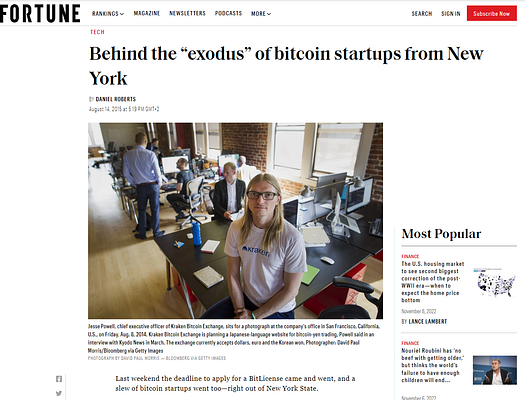
In the same vein, if the DCCPA were to get passed in the US, many people worried that this would eliminate the US from the “crypto race” altogether:
With the downfall of SBF and FTX, all the lobbying he has done in Congress will probably go to deaf ears, and I would be shocked if anyone wanted to publicly associate themselves with this controversy until all the dust settles…which I’m imagining can be awhile. According to Coindesk (who btw is sponsored by FTX), SBF has donated:
FTX exchange founder Sam Bankman-Fried said in a podcast Monday he might donate up to $1 billion in the 2024 U.S. presidential election.
$200 million of his net worth, according to the podcast interview. Much of that has gone to political efforts: He donated $23 million to a single Political Action Committee (PAC) this year.
His political donations have yielded mixed results. Bankman-Fried was one of the single-largest donors backing President Joe Biden’s victorious 2020 campaign. But his favored candidate in an Oregon congressional primary was trounced last week despite benefitting from $11 million in Bankman-Fried PAC money.
Unless someone comes in to fill this vacuum of money up, I imagine that cryptocurrency regulation will not be pushed any quicker through an already slooooow working US government.
Conclusion:
Like I said before, so much information is coming to light that I wouldn’t be surprised if this story continues to reverberate through Crypto Twitter for weeks to come.
In the mean time, please remember that much of this space isn’t regulated, and if you’re engaging the world of crypto it’s important to keep on top of what’s going on out there because as we’ve just seen, one of the largest exchanges can collapse in the span of less than 24 hours. Hopefully none of you had money on FTX, but if you did, I hope you were able to get money out before they started freezing withdrawals. If you were one of the unlucky ones, I would highly recommend that you start following Crypto-news outlets that can help alert you to when the writing is on the wall. Who can I recommend? DYOR for people you can trust, but I was given a nice enough heads up Digital Asset News and Ran Neuner with Crypto Banter.
Thanks for taking the time to read this and be sure to follow me on twitter (https://twitter.com/CryptosWith) to get all my latest updates.
Disclaimer: And as a final reminder, this is not financial advice and this is for educational and entertainment purposes only. Please as always, do your own research and find what investments are best for you. Cheers everyone!





