
Hey folks, if you’ve follow my previous posts, you’ll know that I’ve been a pretty big fan of Midas Investments, and my faith has only strengthened as it’s still putting some amazing numbers throughout our current bear market. Even as other CeFi competitors such as Celsius and Voyager have been taking a wash, Midas appears to be going on strong, attracting hundreds of millions of dollars in new investments.
As I’ll highlight in this article, I’ll go over some of the communications that Midas’s CEO and other staff have divulged over the past month as the rest of the market has been continuing to flounder.
A Quick Introduction to Midas
Similar to other investment platforms, Midas Investments is a crypto-investment platform where you can earn passive income on a wide variety of different cryptocurrencies. But what sets it apart from other platforms? The exchange APY rates. With no lock-up periods, they still continue to offer some of the best native returns (or even significantly higher with their Midas Boost), which are compounded and added daily:
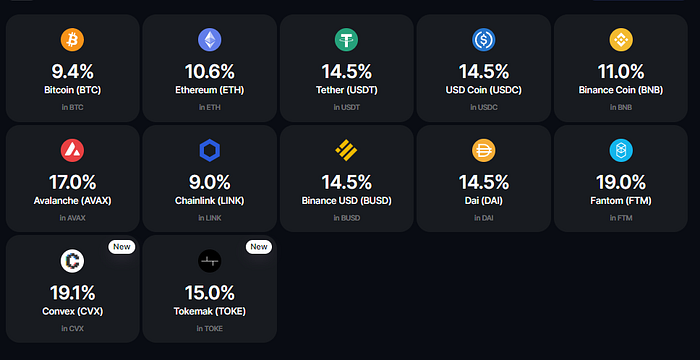
As a platform they’re now going through their 3rd bear market, and they have consistently provided returns that are higher than any non-custodial platform out there. Despite the market crashes over the last few months, Midas has had an exponential level of new capital that has come in, which has ultimately caused them to reformulate and de-risk their strategies again and again in order to provide consistent and stable returns.
After using Midas for now almost eight months, it’s extremely hard for me to take any other “reputable” platforms such as Blockfi and Gemini seriously, who at best might offer a paltry 3–5% APY on blue chips or if you’re lucky maybe around 9% on stables. Through their AMA’s, youtube videos, and discord, without giving away competitive-edge secrets, the team continues to try to be as transparent as possible and they continue to give fairly adequate notice about what steps or changes they have made or are planning to make (I’ll get into that further) which has ultimately increased my level of trust in their ecosystem.
How do they Generate their returns?
In nearly every post and explanation is given, it’s strongly apparent that they try to give enough information as possible without giving enough away so that their strategies and methods can be replicated. However over the past month they have provided a breakdown of their methods into 4 different categories, but excluding their Yield Automated Portfolio (or YAPs, which effectively work like a small index fund or ETF) you could really lump their strategies into different parts:
1.Fixed Yield Strategies — which includes providing liquidity on Convex, more specifically providing liquidity on DeFi platforms such as Convex’s mUSD +3Crv, and FRAX + 3Crv LP’s, lending on Maple Finance, TrueFi, and Liquity, as well as algorithmic futures trading. Midas has been able to hedge these risks by creating built in monitoring tools and alerts which automates withdrawals for significant liquidity imbalances or depegs (as what happened with Terra’s death spiral), or stop mechanisms to halt trades if the market signals major reversals that need to be analyzed. And if you’re thinking to yourself, “crap lending strategies?” — then be cognizant that this is lending on DeFi protocols, not lending out to parties like 3AC. Lending on DeFi protocols are usually smart-contract based, or in other words, there’s a reason why Celsius repaid all their DeFi loans before filing for bankruptcy or repaying their retail investors— they couldn’t escape DeFi loans without smart-contract-forced liquidations.
2. Dynamic Yield/CeDeFi Strategies — Midas advertises that they have more than 50 different yield strategies which I imagine are changing constantly depending on market conditions. It’s not clear which yield strategies specifically they’re using, but there’s a ton of them out there and they can change significantly day-to-day. Take the stMatic-Matic Vault on Beefy Finance for instance:
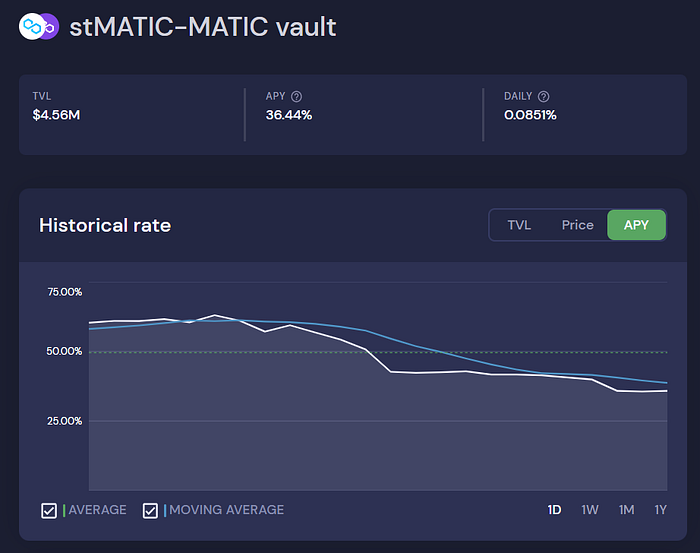
Just over the course of one day, the average APY on this vault has ranged from around 60% to 40%, and if you go further back, just in the last week the APY had ranged in the 100%’s. (Note — Midas doesn’t advertise their specific strategies, and they do not list $MATIC on their platform, I’m just giving this as an example.)
Why Can’t they be more Transparent?
This is perhaps the biggest weakness of Midas Investments, because due to the absence of specifics on their methods, they continue to get asked about this repeatedly. Probably one of the clearest explanations that I’ve read from Midas for why they’re not 100% transparent about their methods is a reddit post from their COO, Dan Carson:
We try to be as transparent as we can be
I'll address this further. We do not publish exact strategies for several good reasons:
i) this is what gives Midas our competitive edge. As I alluded to before, we have a team of analysts who constantly monitor the defi space to build strategies that can allow us to support strong yield opportunities on the lower end of the risk spectrum with a sizeable amount of liquidity. A combination of these three criteria is a difficult goal to achieve. Whilst we are not concerned about our users copying these strategies directly, it is clear publishing our strategies in the public domain would be detrimental to the USP that Midas offer. We are now of a size that competitors and potential competitors will be following our news and updates and we would simply be opening the doors to an increase in competitors.ii) Strategies change on a regular basis. What we post this week may be irrelevant next week. Whilst the broad outline of our strategies will remain constant, the actual strategies within them change constantly.
iii) It would be impossible to please everyone with the information provided. Some want more risk, some less. Some will want us to explore other opportunities. Crypto is full of opinions and opinions are often divisive. We have strong belief in our Defi team. They build our strategies taking in to account optimised yield potential with a strong element of risk management and they deliver the yields we pay out to our users without outside influence/pressure to take our strategies in a particular direction.
In a nutshell, any potential user of Midas has to weigh their ability (or inability) to give trust to a platform that in order to realize the gains that they are able to accrue. We have seen many company leaders such as CEO Alex Mashinsky do a 180-degree turnaround in a couple of days, so if all the FUD and contagion over the past month tells us anything — do not be willing to invest more than you can lose, and make sure you try to weigh all the risks versus the benefits before doing so.
Is Midas 100% transparent about all of their methods? No. But as I’m learning about how adaptable and how numbered their strategies are to different market conditions, I understand why it might be difficult to do so — many of the specifics that may give are probably subject to constant change. Regardless of all this, I do have to say that I’ve scoured YouTube videos, discord channels, and other independent reviews, and one thing is certain–people using Midas are getting paid for their deposits and they have also been depositing and withdrawing their cryptocurrencies back and forth from Midas with no problems…and they have been for years. To reiterate, I have not found a single review where they cannot withdraw or access their funds.
How have they been influenced/affected by 3AC contagion?
First rewinding back a few months after Terra’s death spiral, Midas immediately announced that they had not invested any of their funds into Anchor or UST, which I was actually personally surprised by, since I had just made a blanket assumption that this was how they were able to produce such great rates on their stables. They have also announced multiple times that part of the de-risking strategy that they have incorporated involved the de-leveraging of their assets, which I was also happy to hear, knowing that so many people have been experiencing liquidations in the current market. In case if you’ve never heard of leveraging, it’s essentially putting up collateral to borrow more collateral, and if you’re a degen you can do this over and over again. Leveraged positions have a huge upside because it allows you to have bigger gains on bigger amounts of capital, but they also can have a huge downside with bigger losses and liquidations.
Also after the announcement of Celsius’ complete barring of withdrawals, once again Midas immediately announced that only 5% of holdings were in illiquid positions, with the rest of their AUM consisting of liquid pools and algorithmic strategies. They also reported Midas had been in “full de-risk mode for weeks,” where they had exited all positions that could potentially be depegged (such as stETH that brought upon the downfall of Celsius).
My take is that this kind of immediate communication given to alleviate investors’ concerns is one of the main reasons for how Midas was able to attract more than $300 million dollars worth of new investments, a crazy feat in the middle of the bear market when so many other platforms were (and still are) experiencing bank runs.
Security Measures
Audits: Midas Investments has plans on getting an audit by Armanino, but this is only after they get done with either their Swiss asset management license and/or their Emirati (Dubai) business license, which is one of their main focuses that they are working on right now. This summer Midas intends to “have the full company structure finished and announced,” with an estimated completion of an audit by the fall. If you haven’t heard of Armanino, they were the ones that audited Nexo last year.
Insurance: Earlier this year in order for enhanced security, even though Midas itself isn’t insured, all assets have now been placed on Fireblocks, which IS insured. Now I’m not a liability expert, but my assumption is that if your assets that Midas holds gets hacked into, then there will be coverage, but if you yourself get hacked, that will not be covered. This is a really similar setup for many different platforms including BlockFi and Celsius. An interesting thing that I read was that back when they were primarily focused on Masternodes, Midas Investments did experience a hack, but Midas users never felt the impact because the company absorbed the losses themselves. Although this is concerning because hacks imply vulnerability, I am appeased by the fact that they are planning on getting audited to help identify potential vulnerabilities going further. In addition, for me, the fact that they took a hit financial hit before passing on to their users, shows integrity and increases my trust into Midas even more.
2-FA: Compared to where they were in January, they have now incorporated a 2-FA e-mail login authentication as well as KYC to their platform. Starting in May they have also introduced a 2-FA mobile authentication with google authenticator and are working on an option to allow users to whitelist withdrawal addresses as well. Although it does increase security for the platform itself, I know that things like KYC and Google logins are a huge deterrent for some, especially for those who want to give out as little personal information as possible. Alas, security does have its price.
What are the Risks?
Like any non-custodial platform, the biggest risk is if it’s not your keys, it’s not your crypto. This is why it’s highly important that you make sure you do your own research to see if you personally trust the platform with your assets. That being said, as I mentioned before they’ve been around this space for more than four years now and from what I have found have a pretty stellar track record. If you find anything to the contrary, please reach out to me because I would very much like to hear about it.
No rates last forever, and especially if the market continues on its downturn, I can’t imagine that these will either. That being said, I do believe that we haven’t seen the bottom of this current bear market, so I do believe that the rates will have to be readjusted in the future, but not because of Midas’ lack of trying. In addition, I used to hold more assets in places like BlockFi, Nexo and Celsius, but as we have seen with all three — the bigger you get, the more likely you will be subject to regulations. If Midas continues to attract more users and more growth and as the crypto market matures with more regulations, I can’t imagine that this gravy train can run forever.
Russia: Prior to the war in Ukraine breaking out, Midas was originally headquartered in Russia. Since then, they have reported that the majority of the team has relocated outside of Russia, with the remaining agreeing to do so if needed. And as I mentioned before, they are in the process of licensure with both Switzerland and Dubai, to further dissociate their former ties. In the last May’s AMA, Trevor the CEO went even further to report that he was going to Israel in to officially change his citizenship to Israel. That being said the major players on the Midas team have doxxed themselves in AMA’s and on their wiki page and it’s clear that their team is growing more and more international.
The Midas Token
Although this might be subject to change, there is currently no real utility for the $MIDAS token except for it being a store of value for the Midas platform. In other words, if you are investing in $MIDAS tokens, you are investing in Midas itself. If Midas earns more money than expected, the extra value is transferred to the Midas liquidity pool, which in turn ads more value to $MIDAS tokens. And within Midas, the token’s value is essentially circulated from Midas boosts, to liquidity pools, and then back to Midas boosts. In late February, they reported that the current emission rate of the token is roughly 1600 tokens a day, and then to be capped at around 5 million which should be in the next 3–5 years, with 1.5 million staked on Midas itself. To date, there’s around 2.8 million in circulation.
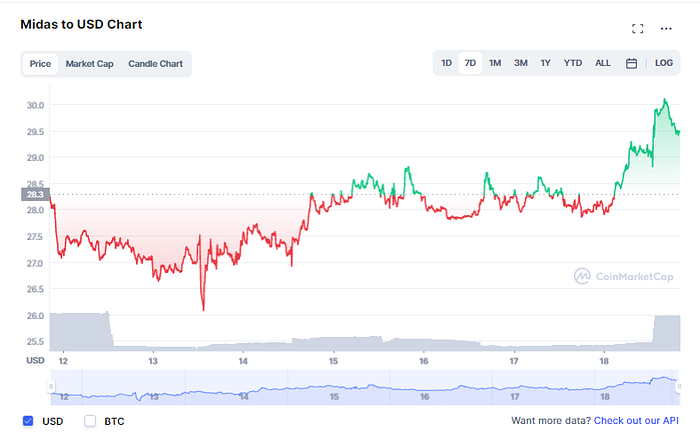
I’m personally not invested that much into the $MIDAS token, because with a relatively low marketcap, it’s a bit too risky for me, at least for the way the market looks right now. That being said I could be the biggest idiot in the room given a look at $MIDAS’ price action for the past few months, which makes it look like we’re not even in bear market:
Conclusion
It’s been a total of eight months now, and so far I have been very impressed with not only the Midas team, but also the Midas community itself. They’ve really fostered an environment to help common retailers like me try to understand the market with their weekly reports, as well as to teach people how to maximize their profits through passive income. I’ve only gained more trust in Midas, and as the market has gotten more and more dire, I’ve found Midas to be the # 1 place where I’m holding and accumulating my stable coins, especially when places like Anchor, Celsius, and Voyager are no longer viable.
If you have any more questions, I highly recommend that you check out the last AMA that was conducted via reddit with Trevor, Midas’ CEO in mid-July. Here, he answers in depth the many potential things one can expect for Midas’ future. If you haven’t tried out Midas yet but are interested, please consider supporting my blog and using my affiliate link: https://midas.investments?p=0191.
Otherwise, if you have any questions or comments, feel free to leave them below. Thanks for reading, and be sure to follow me on my new twitter account: https://twitter.com/CryptosWith
Disclaimer: And as a final reminder, this is not financial advice and this is for educational and entertainment purposes only. Please as always, do your own research and find what investments are best for you. Cheers everyone!





