
Hello again folks, if you’ve been following my other articles, you’ll know that I’m a huge fan of Midas Investments, and you’ll notice that each time I’ve mentioned the $MIDAS token, the price has consistently outpaced the market and not only that, the token seems to continually be hitting ATH’s along the way.
One of the main questions that routinely gets asked in their discord is about the token itself and how it’s able to keep generating these solid returns. In this article, I’ll be doing a bit of a deep dive into the token itself to hopefully gather a better perspective of whether or not the $MIDAS token is something worth investing in.
A Quick Introduction to Midas, and Midas Boost
For the purposes of this article, I’m not going to do a deep dive into the platform itself, but if you’re curious about how they generate their returns and their security measures, please check out my latest review. But in a nutshell, Midas Investments is a crypto-investment platform where you can earn passive income on a wide variety of different cryptocurrencies. But what sets it apart? The APY rates. With no lock-up periods, they still continue to offer some of the best native returns (or even significantly higher with their Midas Boost), which are compounded and added daily:
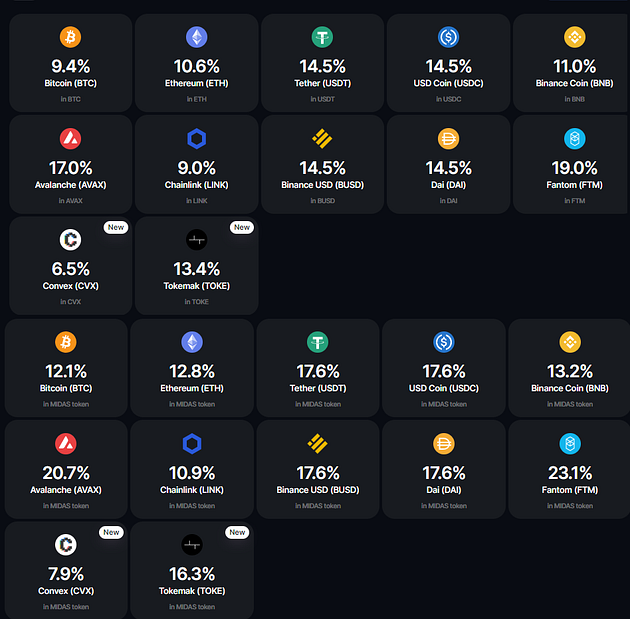
For those bullish on Midas and its long-term future, you can earn additional yield rates on your cryptocurrencies if you choose to earn them in $MIDAS rather than the native currency. So for example, users with a click of a button can decide whether or not they want to earn 9.4% APY in native $BTC, or you can earn 12.1% in $MIDAS.
Exchange coins are a dime a dozen, and they’re usually a bad investment
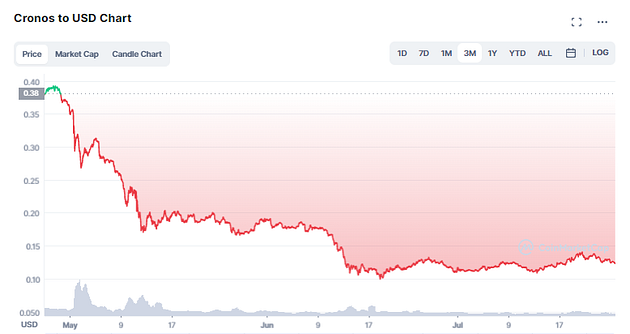
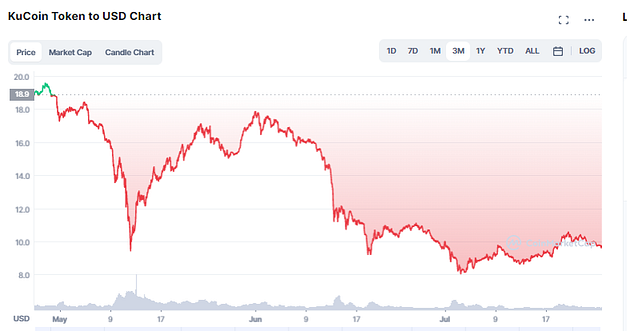
As I’ve covered in many articles before, there’s a ton of different platforms and exchanges out there that try to incentivize users to hold on to the platform’s native token. Whether it’s earning platform fees through KuCoin’s $KCS token, or being eligible for debit card perks by holding $CRO on Crypto.com, basically the fundamentals are the same —by holding more of platform token “X” you’ll get more of “Y” benefit. Regardless of how good this “benefit” might be, the token price of “X” usually tells the same story — not a profitable one. In order to illustrate this story, let’s first walk through a few charts to see some recent price action on different exchange tokens.
Last 3 month period for $CRO, native token to Crypto.com:
Last 3 month period for $KCS, native token for Kucoin:
And finally the last 3 month period for $BNB, native token for Binance:
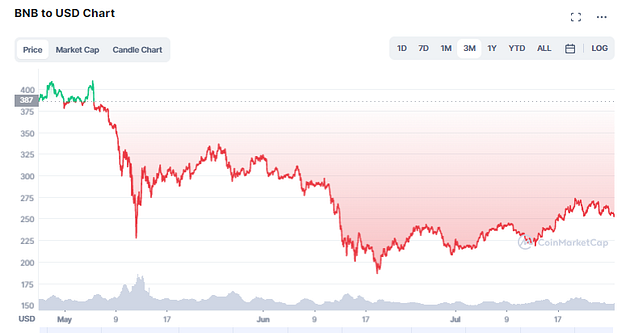
Honestly, I could go on with countless other platform/exchange tokens, but I think you can tell what I’m getting at — many tokens on exchanges have pretty much tanked with the rest of the market in the past few months. By comparison however, let’s take a look at $MIDAS’ last 3 month period:
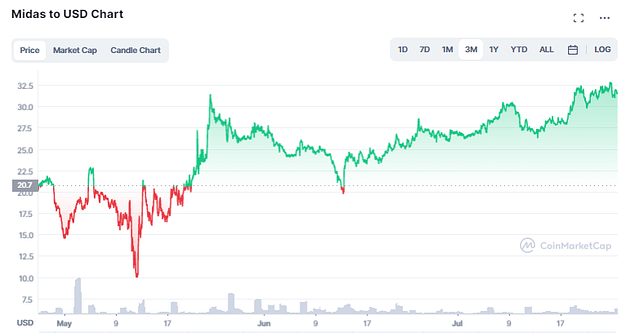
Despite the significant market-wide downturns that the cryptocurrency world have experienced, $MIDAS continues to outperform the rest of the market while hitting new all-time high’s.
What makes $MIDAS different?
First let’s break down essentially what the $MIDAS token is. As I’ve covered in previous articles, essentially investing in $MIDAS is investing in the platform itself. If Midas earns more money than expected, the extra value is transferred to the Midas liquidity pool, which in turn ads more value to $MIDAS tokens. And within Midas, the token’s value is essentially circulated from Midas boosts, to liquidity pools, and then back to Midas boosts. In late February, they reported that the current emission rate of the token is roughly 1600 tokens a day, and then to be capped at around 5 million which should be in the next 3–5 years, with 1.5 million staked on the Midas platform itself. To date, there’s around 2.86 million in circulation. There are several factors that I’ve identified that have made $MIDAS relatively unique:
The Midas platform is built like an OTC: Because of the way that the platform is setup, the wallet that holds individual users’ $MIDAS token (the core wallet), has essentially setup their own OTC marketplace for people who want to trade/buy/sell $MIDAS on their platform. In other words, by isolating a lot of $MIDAS movement on the platform itself, it’s not easily influenced by massive outside market buy or sell pressure because it’s essentially just moved around between user-to-user, or more specifically, just allocated differently between Midas’ own users accounts.
Resistant to market forces: As long as Midas has control of the lion’s share of $MIDAS tokens, they will continue to have a relatively controlled check on $MIDAS’ exposure to the market. If you look up $MIDAS on ftmscan.com to see where most tokens are held, to date more than 80% of $MIDAS tokens are either held directly by the platform, (with about 68% in the Midas’ core wallet, another 8% for platform swap purchases, and then roughly 6% in Midas’ treasury wallet.) totaling roughly 2.4 million tokens worth of $MIDAS. Alternatively if you look up $MIDAS’ exposure on dexscreener.com, there’s only a few pools available that have any significant amount of liquidity:
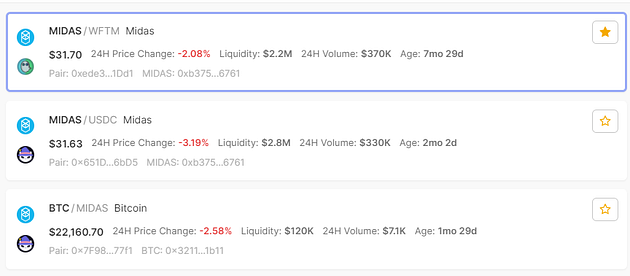
If you account for the TVL of all of these pools, this equates to roughly $5.1 million dollars. This $5.1 million dollars worth of $MIDAS in liquidity pools only composes total of roughly 160k worth of $MIDAS tokens, which pales in comparison with Midas’ 2.4 million. In other words, for better or worse, because the majority of tokens are actually held by Midas themselves, above all others they themselves have the greatest ability to manipulate the price if they wanted to. Speaking of price manipulation, this leads me to my next item…
Payout Split Buybacks: Probably the biggest element of the price’s secret sauce are Midas’ Payout Split Buybacks. On a near weekly basis, Midas takes company earnings to perform $MIDAS buybacks on the open market, which is an equivalent of 10% for whatever the profits that were were paid out to the Midas community of users. Currently through the split buybacks, half of the tokens are designated towards Midas’ growth fund, and the other half is designated for the Midas APY boosts. (To note, there is a reserved 3rd option to burn tokens, but it appears that since they are still in the “launch phase” of the Payout Split Buybacks so this option hasn’t been exercised as of yet.)
To date the latest payout split buyback was for 1,786 $MIDAS on July 20th, which means assuming the approximately $31 dollar spot price for $MIDAS for that week equates to around $55k dollars worth of $MIDAS that was bought back by Midas itself. Zooming out a bit further, you can see the overall trajectory of the $MIDAS’ average price in comparison with the buybacks:
Taking for example the month of April, Midas bought back 15,795 tokens at an average price of $24.38, totaling approximately $385,126.59 dollars worth of $MIDAS. This immense buying pressure, if it were to occur today when only roughly $5.1 million are available on open-market LP’s, would constitute roughly a 7% TVL. If that doesn’t seem like a whole lot to you, if we did the same comparison off of $ETH’s largest 30 LP’s totaling roughly $237 million dollars, a buyback of around 7% would be worth approximately $16.6 million dollars. This comparison highlights something I’d like to bring up in my next section:
Risks, or at least things to be wary of
$MIDAS has a small marketcap: Although it has been growing quickly, according to Coinmarketcap, the Midas token barely cracks the top 3000 in total marketcap. What this usually means is that the token is (or at least should be) subject to higher volatility and ultimately a higher chance of price manipulation. Going back to my comparison with $ETH, a $16.6 million dollar buy or sell would be much harder to pull off than a $385k buy or sell, therefore making $MIDAS more prone to a whale attack.
Don’t some people say buybacks are bad?: Elizabeth Warren certainly says they are. And to be completely honest, I would agree with her when she describes buybacks when they “do nothing to improve the quality of a business or the goods and services it produces.” However in Midas’ case, besides going to users’ APY boosts, half of the buybacks are attributed to a “Growth Fund,” which according to their wiki page, can fun multiple options such as:
providing liquidity to new or existing liquidity pools to provide strength to markets and open opportunities on new platforms.
providing opening liquidity on new farming or staking options for users, which increases the outside awareness of Midas.
marketing opportunities, be that internal or external activity which we have assessed open new opportunities for growth.
In Midas’ case, the intent of the growth fund is basically to further the development of the platform and $MIDAS token itself. From the most recent update I have seen, the growth funds are sitting “idle until we have any need to apply them.” My take is that it seems that if liquidity for $MIDAS LPs get low, that they will able to use their excess growth funds to bolster the liquidity thereby in turn minimizing price impacts. But seeing as it’s only been barely half a year since they’ve been doing the payout split buybacks, I don’t expect them to be moving any mountains, at least not yet.
Greater consolidation gives a larger threat of a rug pull: In any situation where you have a platform holding roughly 80% of the total marketcap of a token, there is usually always a larger threat of a rug pull. How much you gauge the risk of of this threat should be based on how much trust you give tp the Midas platform and its owners to not sell off the token and run. My personal opinion is that if there was to be a rug pull, it would have happened years ago. Midas itself has been around for more than 4 years now surviving multiple bear markets, and the team has maintained consistent and open communication through multiple channels including Youtube, Reddit, Telegram, and Discord. What really personally sold me on Midas? In the past Midas Investments did experience a hack, but Midas users never felt the impact because the company absorbed the losses themselves. The fact that they took a hit financial hit before passing on the costs to their users, shows Midas’ integrity and has solidified my trust in how much they care about the community and the investments towards what they’re trying to create. That all being said, as we’ve now seen what was behind the curtain with the likes of 3AC and Celsius, I imagine that we all need to continue to have a healthy degree of skepticism, especially when there’s not 100% transparency of what’s being done with funds. This leads me to my next and final risk factor:
Transparency is Key when It’s “Not your Keys”: Midas is a custodial platform in which you send your funds over your funds, giving up your custody and entrusting them basically not to lose your funds. Midas itself is also not insured, even through all of their assets are placed on Fireblocks, which IS insured.
If you read through any criticism of Midas, perhaps the number one repeated criticism is that they are not 100% transparent about their methods and how they obtain market-leading yields. If you want a deeper dive on the information that they do provide, I invite you to read a review of my latest research, but perhaps the clearest explanation for why they can’t be that transparent about their methods that I’ve found was from a reddit post from their COO, Dan Carson:
We try to be as transparent as we can be
I'll address this further. We do not publish exact strategies for several good reasons:
i) this is what gives Midas our competitive edge. As I alluded to before, we have a team of analysts who constantly monitor the defi space to build strategies that can allow us to support strong yield opportunities on the lower end of the risk spectrum with a sizeable amount of liquidity. A combination of these three criteria is a difficult goal to achieve. Whilst we are not concerned about our users copying these strategies directly, it is clear publishing our strategies in the public domain would be detrimental to the USP that Midas offer. We are now of a size that competitors and potential competitors will be following our news and updates and we would simply be opening the doors to an increase in competitors.ii) Strategies change on a regular basis. What we post this week may be irrelevant next week. Whilst the broad outline of our strategies will remain constant, the actual strategies within them change constantly.
iii) It would be impossible to please everyone with the information provided. Some want more risk, some less. Some will want us to explore other opportunities. Crypto is full of opinions and opinions are often divisive. We have strong belief in our Defi team. They build our strategies taking in to account optimised yield potential with a strong element of risk management and they deliver the yields we pay out to our users without outside influence/pressure to take our strategies in a particular direction.
In a nutshell, any potential user of Midas has to weigh their ability (or inability) to give trust to a platform in order to realize the gains that they are able to accrue. We have seen many company leaders such as CEO Alex Mashinsky do a 180-degree turnaround in a couple of days, so if all the FUD and contagion over the past month tells us anything — do not be willing to invest more than you can lose, and make sure you try to weigh all the risks versus the benefits before doing so.
Conclusion
Although I’m usually quite timid in general about putting anything into altcoins during a bear market, following what the Midas team is doing, it’s starting to feel a bit silly to continue to sit on the sidelines while the $MIDAS token has been beating out nearly the entire cryptocurrency market.
Can number go up forever? Personally I don’t think so, because as Midas continues to grow, I think it will be more challenging for the team to continue to produce the yields that it does as it has more AUM, meaning that eventually the price of the $MIDAS token has to stabilize somewhere. However, being that it’s only currently 3000th in marketcap, I do think that there’s still a great deal of room for the the platform to grow, and as long as it keeps providing the yields as it does, and I greatly expect that the price of $MIDAS will continue to rise accordingly.
And lastly, I think one of the best things that Midas community has going for them are it’s community members. If you take a casual read through their discord, you’ll notice a lot of members talking about $MIDAS as if they were Bitcoin maxi’s talking about $BTC. If you have any more questions, I highly recommend that you either start there or check out the last AMA that was conducted via reddit with Trevor, Midas’ CEO in mid-July. Here, he also answers in depth the many things we can expect for Midas’ future.
Thanks again for reading, and if you haven’t tried out Midas yet but are interested, please consider supporting my blog and using my affiliate link: https://midas.investments?p=0191. Also, be sure to get all my latest updates by following me on twitter: https://twitter.com/CryptosWith
Disclaimer: And as a final reminder, this is not financial advice and this is for educational and entertainment purposes only. Please as always, do your own research and find what investments are best for you. Cheers everyone!





