
Introduction
Geopolitical instability all over the world came to a climax in the war between Russia and Ukraine which caused energy crisis in Europe. Now, we see Israel - Hamas conflict. On top of political risks, there are significant economic and financial risks. High inflation rate all over the globe lead to interest rate hikes. As a result, economic activity declines which can be yet another sign of a global recession.
All these factors impact financial markets causing large swings in almost all asset classes. Volatility across all markets is surging creating a lot of opportunities. In light of this, I decided to write an article on long volatility strategies in the crypto market.
What is a long volatility strategy?
Long volatility strategies seek to benefit from high volatility in the markets. Long vol strategies don’t bet on the market direction; instead, they benefit from a surge in volatility which means they perform well when there are large price moves.
The main advantage of these strategies for investors is that they have a negative correlation with equities. That is, long vol strategies tend to perform well when the stock market goes down. Their overperformance in an adverse market environment makes long vol strategies a perfect addition to the traditional portfolio. Since they typically involve buying options, they have a limited downside and an unlimited upside.
Long vol in DeFi
Now that we understand long vol strategies, we can ask: what are long vol strategies in the crypto market? One of the simplest of these strategies may be buying out-of-money put options on Bitcoin. If the market crashes, we’ll benefit from it by holding put options. We can also consider buying out-of-money call options but for those who hold Bitcoin it should be unnecessary.
We can directly go long volatility too. Developed by the COTI team, CVI (Crypto Volatility Index) allows us to do so; if the volatility in the crypto market goes up, the token appreciates. CVI Index measures the expected volatility of the crypto market based on the cryptocurrency option prices. It is calculated based on 30-day prices of options traded on exchanges.
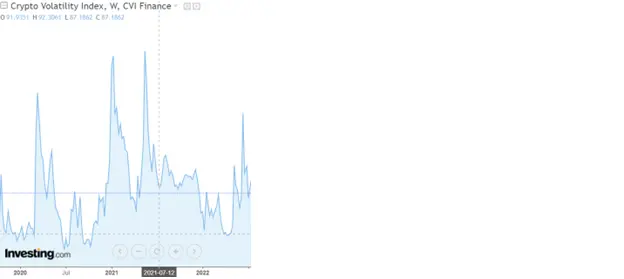
CVI index can be traded for hedging purposes especially if one expects big moves in the market. During such events the crypto market can be highly volatile. The sharp spikes on the chart below support the notion that sometimes crypto traders may experience wild swings which is what happened in the beginning of Coronavirus crash. The highest value of CVI was 158.4 on 17 May 2021 when Tesla CEO Elon Musk tweeted that the carmaker company may stop taking Bitcoin as payment due to environmental concerns. As a result, Bitcoin lost 27% of its value in that week which drove the whole crypto market down.
Another trading style benefiting from the high volatility is momentum trading. Momentum trading is buying assets overperforming in the lookback period and shorting underperforming assets. When volatility increases, both winner and loser assets tend to continue their recent performance; therefore, buying recent winners and shorting recent losers make sense.
When researchers backtest momentum strategy in equity, bond or commodity markets, they usually look back to 3-12 last months’ performance dropping the last month (because the last month tends to exhibit a reversal). And the holding period (how long you’ll hold an asset) is typically 3-6 months.
However, DeFi is more dynamic, fast-paced and volatile than traditional asset classes. Therefore, I modified parameters as following: 49 days of lookback window (how many last days’ data we will look at) ignoring last 14 days data and holding period of 7 days. Even this simple strategy delivers 44% annual return.
When there’s a surge in the volatility in the crypto market, it is likely that some DeFi protocols will underperform. Another way of benefiting from increasing volatility is buying an insurance coverage on DeFi protocols on decentralized insurance protocols, such as InsurAce. You can think of this strategy as purchasing a CDS (credit default swap) in traditional credit markets. You make regular payments to the seller for hedging credit risk. Your counterparty will have to pay to you if an issuer (borrower) on which you bought CDS defaults.
Shorting DOV protocol tokens would also be a profitable long vol strategy. Decentralized option vaults are an option selling strategy; they collect deposits from investors and sell options which means they are essentially short volatility strategies. When volatility in the crypto market spikes, it’s reasonable to expect that short volatility strategies will suffer huge losses. I don’t know how to directly bet against the DOV strategies in high-volatility market environment; that’s why I suggest shorting the tokens of token protocols, such as RBN which is the governance token of the Ribbon Finance, the largest crypto structured products protocol on Ethereum.
Yet another strategy capitalizing on surging volatility in DeFi could be shorting stablecoin perpetuals swaps. Perpetuals, or perps are similar to futures in traditional finance that allow you to bet on the direction of the asset price. If you go long aluminum futures, you’ll make money if aluminum price increases. Otherwise, you’ll lose money.
Stablecoins are generally perceived to be a safe haven in the crypto market. But in turbulent periods stablecoins, or at least some of them, tend to depeg, that is to lose their peg to US dollar (or any fiat currency). For example, during Coronavirus crash almost all large stablecoins experienced deviation from their peg trading at a premium to $1.
But sometimes stablecoins fail spectacularly showing that they are not stable at all. The infamous UST, a native stablecoin of the Terra ecosystem, fell to 0.1 USDT losing 90% of its value.
So, holding a stable coin is like a short volatility strategy – most of the time nothing extraordinary happens and the coin keeps its peg. But in the hard times it will depeg leading to large losses for investors. Shorting a stablecoin perp is exactly the opposite of this, hence it’s a long vol strategy: most of the time you’ll lose small being on the wrong of the trade, but when a disaster happens, you’ll win big.






