Blockchain world has been struggling to keep up with scalability solutions for a long time. The most popular blockchain networks, Bitcoin and Ethereum, have been accused of being “slow” and not scalable enough to support mainstream financial transactions and applications.
Since 2017, there have been many crypto startups created just to solve this scalability problem. Zilliqa is one of them. Using its own unique sharding technology, Zilliqa believes it can finally solve the scalability problem that has prevented many mainstream or traditional companies from testing the water with blockchain technology.
So, how does Zilliqa work, and is it worth it to invest in Zilliqa’s native cryptocurrency (ZIL) in the long-term? Let’s find out together!
Background And Scalability Problems
Blockchain has been called “revolutionary” by many financial experts and politicians. As everybody knows, the biggest problem with our traditional monetary system is that everything is simply too centralized in the hands of the few.
With the technology of blockchain, we can remove that need for trust. Everybody has the same copy of the ledger. The “trust” is decentralized to hundreds or even thousands of different nodes.
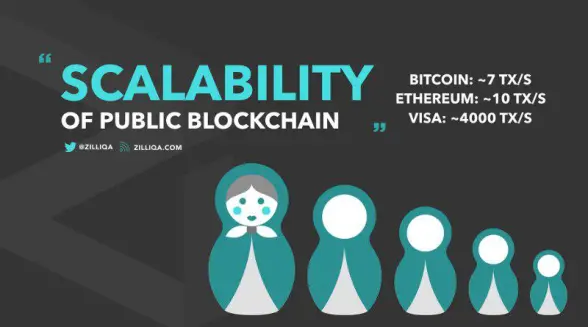
That being said, the blockchain or distributed ledger technology (DLT) introduced one big problem in the industry itself. That problem is about scalability. In a simple way, the blockchain network needs to achieve consensus among all the participating nodes.
So, in order to verify one transaction, the participating nodes have to agree that it’s indeed a valid transaction. That’s why it’s called “decentralization,” so no one centralized power can just say something, and everybody else is forced to believe it.
The bigger the network is, the harder it is to achieve consensus. The analogy is like when you are with four family members VS if you are with hundreds of other people. It will be easy to achieve an agreement with your family members, isn’t it? But, imagine if the same agreement has to be made among hundreds of people. Obviously, it would be much harder.
The same with blockchain technology. When there are only 5-6 nodes, it will be easier and faster to confirm something. When there are hundreds or thousands of participants, it will be harder.
And this was the exact problem with Bitcoin and Ethereum. During the peak popularity of cryptocurrencies (late 2017 to early 2018), both Bitcoin and Ethereum networks were often clogged due to the huge amount of transactions at the time.
Ethereum, especially, got much slower (and its transaction fees got much higher) when CryptoKittes became extremely popular. For your information, CryptoKitties was a very popular game that was built on top of Ethereum, and all the transactions were done directly on the blockchain.
Many newer blockchain platforms tried to solve scalability problems by introducing different consensus algorithms, especially Delegated Proof of Stake (DPoS). With DPoS, they use the concept of limited representatives, where the community has to put their trust on these representatives (and they do it by staking the coins or tokens).
Then, these representatives will verify all the transactions in the blockchain (in other words, they are the only nodes in the blockchain network). They can be voted in or voted out depends on the community’s trust in them. The problem with this consensus algorithm is that it basically sacrifices a certain amount of decentralization.
Zilliqa - Summary
And then, there’s Zillqa. The core team of Zilliqa understood this exact problem with blockchain scalability. And of course, they don’t want a simple fix like using DPoS consensus and ignore the core of the scalability problem itself.
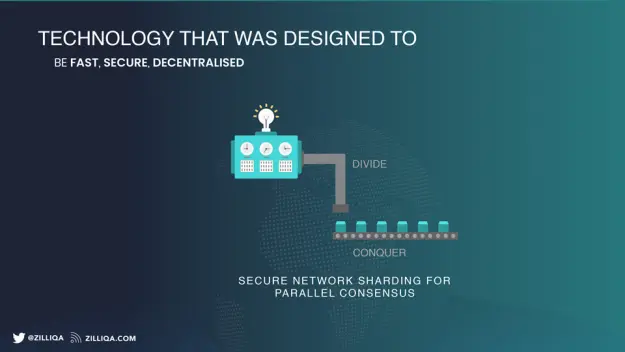
Zilliqa’s idea is to use sharding technology. The concept of Zilliqa’s sharding is to break down the nodes every 600 nodes. This breaking down process is called “sharding.” So, when there are 1200 nodes, we get two shards. When there are 1800 nodes, we get three shards. And so on.
Each shard will have to process a certain part of the blockchain transactions. To give you an idea of how it is going to work, I will give you an example. Imagine when there are six shards in total. Each of these shards will have to process one-sixth of the blockchain transactions in the form of “microblocks”.
When all of these shards have successfully finished their jobs in processing these microblocks, they will be mixed back into one single full block. This process is named DS epoch.
On top of the sharding and DS epoch processes, Zilliqa also combines the concept of Byzantine Fault Tolerance (BFT) and the standard mining algorithm Proof of Work (PoW). So, in order for a node to prove its identity in the Zilliqa blockchain, it has to use Proof of Work. But, when the same node enters a sharding process, it will use BFT consensus.
This solution sounds great, although, in practice, it can encounter some potential issues. In the not-so-distant future, when Zilliqa will have millions of nodes, the assigned shards might encounter issues due to the increasing amount of microblocks as well. However, as long as Zilliqa is not as mainstream as it wants to be, this “millions of nodes” problem is still far from reality.
Zilliqa’s Native Cryptocurrency (ZIL)
So, when it comes to investing in a cryptocurrency, it’s not enough to know about the project’s technology. We also need to know what is the token is being used for. After all, we invest in the token, isn’t it?
So, how about Zilliqa’s native cryptocurrency, ZIL coin? Well, ZIL’s use case in the Zilliqa blockchain is more or less the same as how ETH is being used in the Ethereum network. It acts as an incentive to pay for transaction fees as well as for contract execution. On top of that, the ZIL coin also acts as an incentive to pay the miners.
Analyzing Zilliqa Team

Cryptocurrency investing is also about having faith in the core team’s ability to deliver their promises. After all, more often than not, we invest in one specific altcoin because we believe it can be used for more mainstream purposes in the future.
So, how about the Zilliqa core team? Well, the Zilliqa team is based in Singapore, one of the most blockchain-friendly capitals in Asia. The project was co-founded by Amrit Kumar, Max Kantelia, Yaoqi Jia, and Xinshu Dong. In the first quarter of 2018, the Zilliqa team managed to collect $22 million from its initial coin offering.
The President & Chief Scientific Officer of Zilliqa is Amrit Kumar. He used to work for the National University of Singapore as Research Fellow. He also spent four months at the University of Calgary. In June 2017, he co-founded Zilliqa and now becomes an integral part of the team.
The other co-founder, Max Kantelia, is the CEO of Anquan, part of the board at Aqilliz, and Chairman of the board at Anqlave. His various experience with multiple successful projects is an enormous contribution to the team.
The third co-founder is Yaoqi Jia, who is the Head of Engineering at Parity Technologies, and a Research Fellow at the National University of Singapore. He was also the Chief Technology Officer (CTO) of Zilliqa until August 2019.
The last co-founder is Xinshu Dong, but his profile cannot be found on the Zilliqa team page.
The core team itself (outside the co-founders) has many decent names with strong background. The Head of Growth & Strategy, Kenneth Bok, used to be the Lead Organizer at De/Centralize and Director at Blocks.
Then, we have Han Wen Chua, who used to be the Design Engineer at ST Engineering. The same guy was also responsible for design engineering at Dyson.
Another important figure is Arthur Cheong, the Vice President of Zilliqa. He is responsible for Growth and Strategy. Prior to his time with Zilliqa, he used to be the Trading Development Programme at BP. He also spent four months as Crypto Trading Strategist at JST Capital.
All of these names are legit, and they look capable of building a good project. From my analysis, the Zilliqa team is highly commendable.
Zilliqa Future And Potential Roadblocks
Zilliqa has a competent team, and it is trying to solve one of the biggest issues in the blockchain industry, which is about scalability. However, it is not the only project that tries to solve this exact problem. Almost all newer gen of blockchain platforms promise the same thing.
While Zilliqa’s sharding technology is unique, but it is still very new and not really proven yet with a real and serious amount of transactions. There is a chance that somewhere in the future, most crypto enthusiasts will just forget about Zilliqa and move on to the next project that will also promise the same thing (about solving scalability issues).
Unfortunately, the blockchain industry is pretty unpredictable. Sometimes having better technology alone is not enough. You also need to be well-adopted by corporations, different partners, and you need strong fanbase as well.
While Zilliqa is on the right path in terms of technology, but it has a big challenge ahead of itself in other means (business-wise, fanbase-wise, and marketing-wise). The biggest risk in Zilliqa’s future is its competition trying to solve the exact same problem and use-case.
Another potential problem is Zilliqa’s policy to use its own programming language that is called Scilla. Just like Ethereum and its Solidity, many mainstream developers might not want to spend their time to learn Scilla.
Many people said that Zilliqa should have adopted more mainstream programming languages to attract all these developers.
External Factor And ZIL Price
So, we have learned about all the essential things regarding Zilliqa. But, is it enough to make a decision whether to invest in ZIL coin? Unfortunately, not. In the world of crypto, there’s one big external factor that can decide the entire fate of altcoins. That factor is called Bitcoin price.
Everybody who has been trading for a while knows that Bitcoin price, basically, controls the entire market. When Bitcoin price pumps, the entire market goes up. When Bitcoin price dumps, the entire market goes down. Zilliqa coin won’t be an exception. It will be hugely affected by the Bitcoin market trend.
And this is where things get tricky. Many people say that Bitcoin price will go up significantly in 2020 following the Bitcoin mining reward halving event somewhere in the middle of the year. In that scenario, ZIL price will also go up significantly.
However, some other analysts predict that Bitcoin price will actually go down because the community’s reaction to halving event was already “priced in” earlier this year when BTC went up from below $4000 to above $12000.
Either way, it’s quite important to pay attention to Bitcoin price. Even if you truly believe in Zilliqa’s future, it’s possible that ZIL price will still go down when BTC itself goes down.
Conclusion
Zilliqa is a decent project that tries to solve scalability problems by introducing a unique and complicated sharding process. The team looks capable of achieving their promises, and their achievements would be important for the entirety of the blockchain space.
Overall, investing in ZIL is not a bad idea. It’s definitely a decent idea. However, always trade with caution, as there are several risks involved, as I have written above.






