
The cryptocurrency technology has long been known for its ability to “surpass” the traditional banking system to send money across the border. From the very first years of Bitcoin, many crypto enthusiasts have been bragging about how cheap and fast sending money from country A to country B by using cryptocurrencies (as opposed to traditional cross-border solutions).
Request Network aims to make this goal even easier. The promise is that people can easily “request” payment and create an invoice on the blockchain, and they will get paid in local currency without the need to go through all the hassles (such as going to cryptocurrency off-ramps).
Not only that, but Request Network also has a vision to be utilized in multiple use-cases, including business-to-business (B2B), online purchases, and IoT-based payments.
Can Request Network achieve its goals? Can REQ (Request Network’s native crypto token) become a valuable long-term investment for crypto enthusiasts? Let’s find out together.
Request Network - Summary
The idea of Request Network, in its beginning, was to simplify all the complex processes that had been plaguing the crypto world for a very long time. Many merchants have resisted adopting cryptocurrencies for the exact same two reasons, complexity and price volatility.
For example, if someone wants to hire a freelancer from another country, the freelancer wants to have the ability to auto-convert the crypto he receives to a local fiat currency. However, this problem is much more complicated than it seems.
When the freelancer receives Bitcoin or Ethereum, he needs to find a crypto-to-fiat exchange before he can “enjoy” the liquid money he deserves. And yes, most merchants need liquid fiat money because they always need to do something with the money (for example, to pay rent. or if the merchant sells physical items, he needs to re-stock his item supply).
But, when the same merchant receives the payment in cryptocurrencies, it becomes complicated, because he needs to login to his crypto-to-fiat exchange first, and sometimes it requires more time to withdraw the fiat money to the bank account.
Request Network’s primary idea was to simplify this whole process. The idea was for merchants to be able to “invoice” the buyers directly, and while the buyers can pay with crypto, the merchants will be able to receive the money directly in their local fiat currencies.
The idea was well-received in the beginning. By October 2017, Request Network’s Initial Coin Offering (ICO) received $33.6 million from the participants. Request Network promises something that is even simpler than PayPal, but it’s Ethereum-based payment system where everybody can easily “request” blockchain-based payment and get the money in their local currency.
The step is fairly simple. The money requester or invoicer “broadcasts” the request to the money owner by using the blockchain. The money owner, then, detect the request through an application that he has. And within just one click or one touch, the recipient will be able to get the money in the local currency.
Not only this, but Request Network can also track and record all the transactions for auditing and transparency purposes. They are hoping the project can eventually replace inefficient centralized systems like PayPal or traditional escrow systems to connect freelancers and buyers.
In the middle of these processes, Request Network utilizes its own native cryptocurrency that they named as REQ. Basically, you need to use REQ token if you want to enter the ecosystem of the Request Network. For example, when you want to create advanced invoices, you need to have some REQ tokens.
And with the new Request v2, the charged fees become flexible, depends on the size of data of each request. $0.10 fixed fees will be applied for the first 10 kiloBytes of data in the request. It will go up $0.03 for each extra 10kiloBytes. The core team has repeatedly said they might adjust the fees in the future, which means it won’t be forever $0.1 for the first 10kiloBytes and $0.03 for each extra 10 kiloBytes.
Analyzing Request Network Team

Kyber Network and Request Network in Singapore - image source
Before we judge whether it’s a good idea or not to invest in a certain crypto token, first we need to know who’s the brain behind the project. This is important because investing in a cryptocurrency often means investing in the team’s promises as well.
So, how about the Request Network team? The project was co-founded by Christophe Lassuyt and Etienne Tatur. At Request Network, Christophe acts as the Chief Financial Officer while Etienne is the Chief Technology Officer.
Before his time with Request, Christophe Lassuyt focused his time on Moneytis for almost two years, the company that he co-founded together with Etienne.
Meanwhile, Etienne Tatur himself was the Chief Technology Officer and co-founder at Moneytis, and he was also the Lead Developer at QOBUZ.
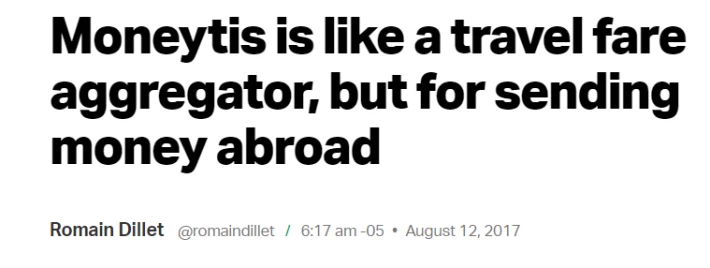
You might be wondering what is Moneytis, exactly? Well, according to an article on Techcrunch, Moneytis is similar to a travel fare aggregator, but it is specialized for sending money abroad. Imagine like Booking.com but for international transfers. That’s how Moneytis works. Etienne and Christophe’s experience with Moneytis is the reason why they decide to create Request Network.
Beside the two co-founders, the core team of Request Network also has Laura Girod, who acts as the Data Analyst at Request since May 2017. Before his time with Request, Laura was the Data Analyst at Moneytis. Apparently, Etienne and Christopher brought the best employee that they had at Moneytis to Request Network.
A good Data Analyst is always a very valuable addition to a crypto startup team, especially a team like Request that specializes in cross-border payments and invoicing.
There isn’t much information about the other core team members. It looks like Request Network does not want to share too much info about the other members of the core team, either for privacy or other reasons. According to their LinkedIn pages, Request is officially registered in Singapore. However, from the Request team page, apparently, the core team operates from Amsterdam.
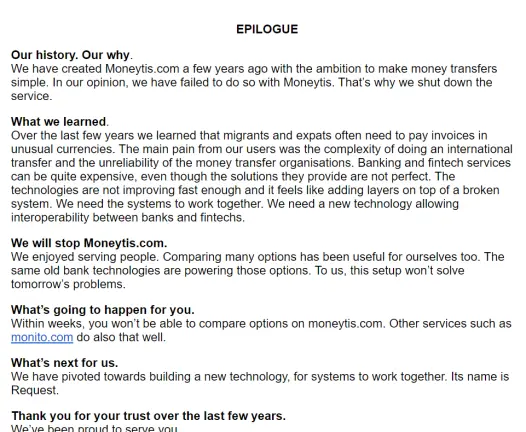
Based on the things I wrote above, I believe the main individuals behind the project are mostly experienced with Moneytis. It’s fair to judge the team’s ability based on how successful Moneytis was. Well, it looks like Moneytis itself is shutting down. Below is the screenshot from Moneytis.com homepage.
I must say I am not very impressed with the background of this team. I don’t mean they are bad, just that they are not very good. There are other altcoin projects with stronger core team members.
Request Network Future And Potential Roadblocks
To be honest, the idea of Request Network was not so bad in mid 2017. However, things have changed so much in the past one and a half years. Nowadays, it’s already a lot easier to buy and sell cryptocurrencies in many developed countries. Not only that, Request Network itself has made very slow progress with their promises.
I can’t fully blame Request Network for their slow progress. After all, there are tons of regulatory problems in many countries when you want to convert cryptocurrencies to fiat automatically. It’s never easy. And besides, liquidity has always been an issue.
The concept of “automatically convert your cryptocurrencies to local fiat currencies” is a good dream but not that easy to achieve in the real world. Connecting people from different countries for that same dream requires a lot of hard work and lobbying.
And apparently, this project has been questioned multiple times even by its own supporters. There were concerns about the lack of progress on Reddit, as you can see from this thread.

It looks like the Request team does not even know how to answer such concerns appropriately. Every time a new concern about such lack of progress showed up, their answer has always been “we are working hard.” In other words, they miscommunicate a lot with their own supporters (and they do it intentionally).
If the Request core team does not change their PR strategies, they can become irrelevant soon. Not only that, but they also need to have certain unique selling points. At the moment, trying to “simplify the process of selling crypto to fiat” is not a unique idea anymore, because even the biggest altcoin projects are trying to solve that exact same problem.
While I might be wrong but at this point, Request Network does not seem like a strong project with a strong future.
And the potential problem here is not only about the core team’s capabilities to make progress, but also about its competition. As mentioned before, even the biggest altcoin projects are trying to solve the same problem.
For example, Ripple’s RippleNet and IBM Blockchain World Wire, both utilize cryptocurrencies in cross-border transactions. However, the users of those services will be able to accept the money in their local fiat currencies or CBDC (central bank digital currencies).
If Ripple or Stellar achieve success with their projects, it would be even harder for Request to compete. And yes, Ripple and Stellar are not the only projects trying to “automatically convert cryptocurrencies to stable currencies,” there are also other altcoin projects that try to do the same thing. Far too many, actually.
External Factor And REQ Price
So, we have learned all the fundamentals about the Request Network and even the background of its core team. But is it enough to make a decision? Unfortunately not. When it comes to an altcoin price, we need to understand that there’s one big external factor. That factor is called Bitcoin price.
Yes, since the beginning of cryptocurrencies, Bitcoin price has been controlling altcoin prices. It means altcoin prices go up when Bitcoin price goes up, and they go down when Bitcoin goes down as well.
So, what to look from Bitcoin price? Well, there are some dividing opinions. Some analysts predict Bitcoin will keep going up in 2020 following the next Bitcoin’s mining reward halving event. If 2020’s halving repeats the same price action from 2016’s halving, it looks like Bitcoin might go up and eventually break its all-time high (ATH).
However, some other analysts predict the exact opposite. They believe next year’s halving won’t do much to Bitcoin price because everybody already expected the same thing in the beginning to mid of this year (when Bitcoin unexpectedly pumped from below $4000 to above $12000). Therefore, Bitcoin price won’t go up anymore.
Which prediction is more accurate? Nobody knows. Either way, you need to pay close attention to Bitcoin price action if you decide to invest in REQ token. Whether you like it or not, the price of REQ token will be affected by Bitcoin price action.
Conclusion
Request Network used to be one of the most promising projects that try to solve the biggest problems in the cryptocurrency world. However, it does not look that promising anymore nowadays, due to lack of progress and heavy competition from much bigger altcoin projects.
If there’s one thing to learn from the cryptocurrency world, everything is unpredictable. However, there are always better altcoins to invest compared to REQ. Your choice.






