
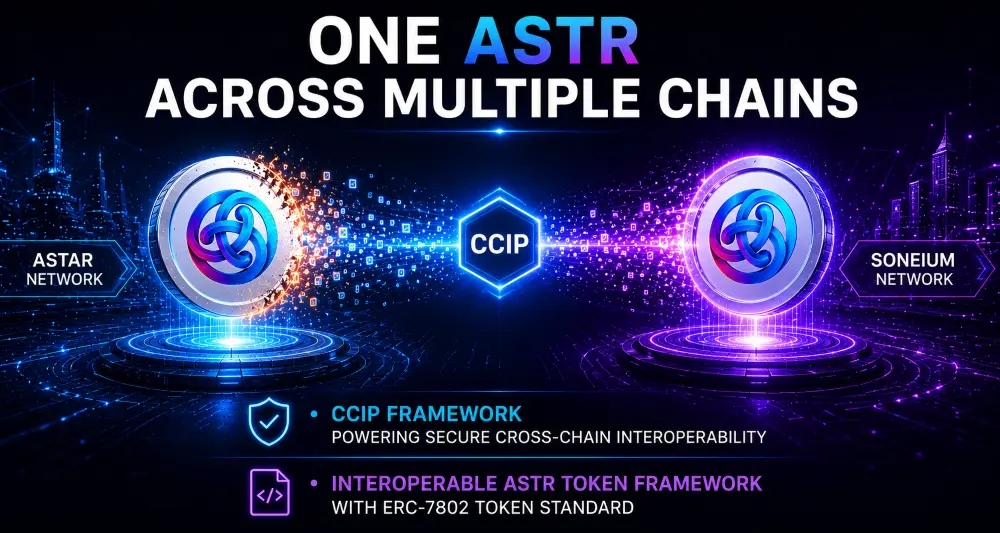
ChatGPT generated image. CCIP bridges unified ASTR across chains. ERC-7802 makes ASTR interoperable by design.
New-Age Web3 Interoperability: One Unified Token Across Heterogeneous Chains
In today’s Web3 era, executing cross-chain token transfers no longer requires relying on fragmented "wrapped" token models. Instead, a native token can exist as a single, unified version across completely different, heterogeneous blockchains.
Interoperability frameworks like Chainlink’s Cross-Chain Interoperability Protocol (CCIP) make this seamless portability a reality.
Beyond the underlying transport networks, tokens themselves can now be programmed to be natively interoperable by adopting cutting-edge asset standards like Optimism’s SuperchainERC20 (ERC-7802).
The ASTR token serves as a premier real-world case study of this hybrid architecture.
By leveraging Chainlink CCIP, ASTR moves securely as a unified asset from its native Polkadot Layer 1 environment over to Sony’s Ethereum Layer 2 network, Soneium.
Furthermore, because the ASTR token contract was upgraded to conform to the ERC-7802 standard, it gains seamless, native mobility across the broader Optimism OP Stack Superchain ecosystem, utilizing the official Superchain Token Bridge to power intra-ecosystem transfers.
Under the Hood: How CCIP powers ASTR’s interoperability from Astar to Soneium
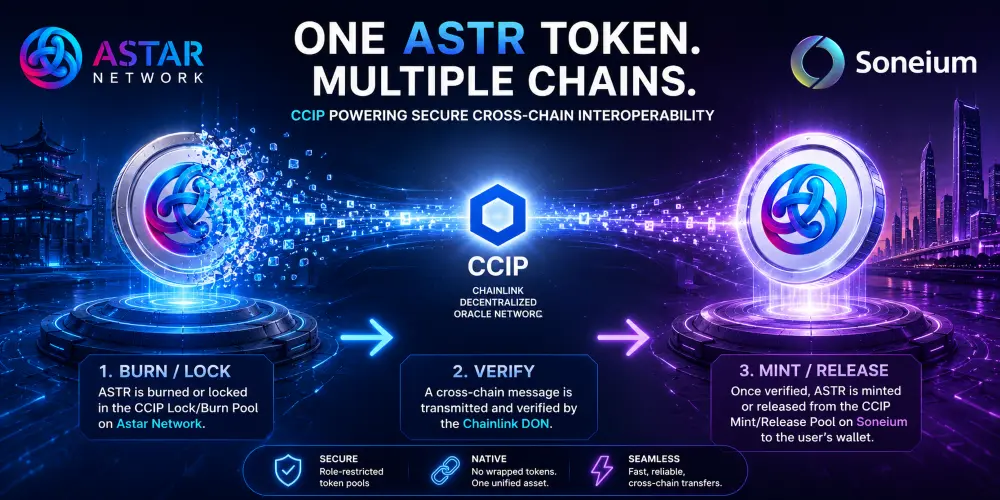
CCIP interoperability Mechanism driving cross-chain ASTR portability from Astar to Soneium
Integrating Chainlink CCIP into the Astar ecosystem requires configuring specialized network infrastructure components known as Token Pool contracts across all connected chains.
This architecture introduces strict role-based access control to ensure comprehensive security. These CCIP Token Pools are embedded with highly restricted Minter and Burner roles, meaning operational access is granted exclusively to the authorized CCIP bridge infrastructure. No other third-party bridge can interact with these pools, and no unapproved smart contract can alter the token supply.
For a cross-chain transfer of ASTR from the Astar Network to Soneium, the execution path follows a clear, secure lifecycle:
1. Locking of ASTR in Astar side CCIP Pool Contract
The user's ASTR token is safely locked inside the designated CCIP Pool contract on the source Astar chain.
2. Verification of Transaction
All CCIP powered transactions is verified by Chainlink Decentralized Oracle Network (DON).
3. Minting ASTR in Soneium
DON signals corresponding CCIP Pool contract on Soneium to Mint ASTR.
Efficient Interoperability with Tokens Designed for Cross-Chain Execution
Because Astar modified its token contract to support the ERC-7802 standard, the asset inherently carries its own portable cross-chain framework. This allows it to interact directly with the unified infrastructure powering the OP Stack ecosystem: the Superchain Token Bridge.
The upgraded ASTR token contract is equipped to natively burn and mint tokens across different chains via two explicit functions: crosschainBurn(address to, uint256 amount) and crosschainMint(address to, uint256 amount).
ASTR is truly interoperable by design. When these functions are called by the Superchain Token Bridge, the asset automatically burns on the source chain and instantly mints at the exact same wallet address on the destination chain.
The advantage of this native alignment is unparalleled efficiency: users experience friction-free movement inside the Optimism OP Stack ecosystem, achieving near-instant transfers with 1-block finality and zero slippage.
ASTR’s burn/mint events can be tracked on-chain as well.
Smart Interoperability Frameworks Combining Cross-Chain Bridging and Interoperable Token Standards
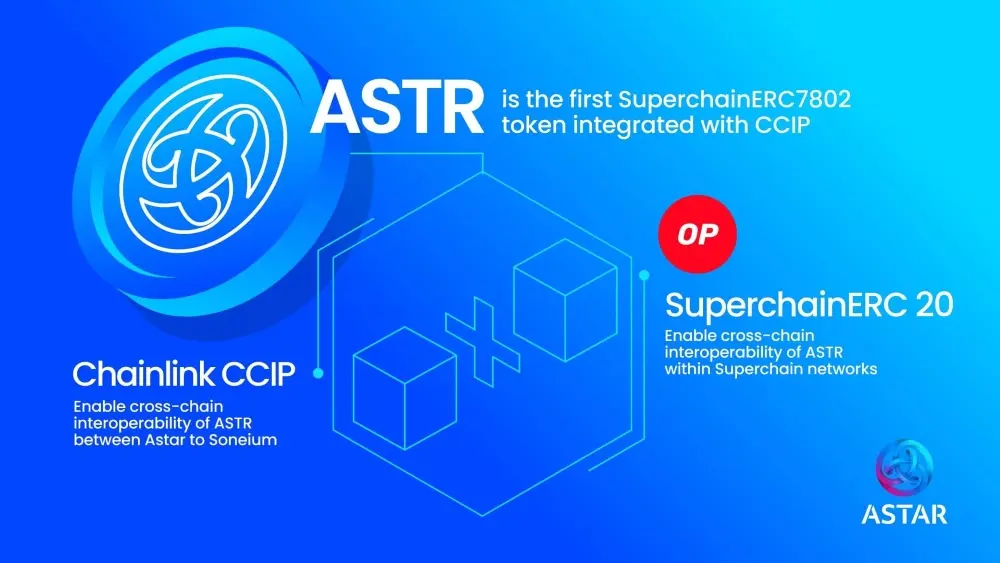
Taken from Astar Blog. Combining Cross-Chain Bridging and Interoperable Token Standards for Unified Liquidity
ASTR’s case has shown an efficient model of interoperability –
Where liquidity is unified, as token is transferred cross-chain as one unified token.
Secure interoperability frameworks where access control is limited to authorized Bridge operating with its component Pool Contracts to mint/burn tokens.
Interoperable Tokens with token contracts that mint and burn Token in chains when functions are called by authorised Bridge.
These are positive developments upgrading the Web3 space that simplify operations for users.
This article is based on Astar Network's blog explaining ASTR's cross-chain interoperability architecture, powered by Chainlink CCIP and the ERC-7802 (SuperchainERC20) token standard framework.
Implementation of ASTR on Soneium with Chainlink CCIP & ERC-7802 compatibility
My article can also be found in these platforms I post my content on-:
Hive — https://ecency.com/hive-150329/@mintymilecan
Publish0x — https://www.publish0x.com/@greenchic
Medium — https://medium.com/@kikctikcy
t2World — https://app.t2.world





