
Building a computer network is a very difficult task, which is almost impossible to cope with. To solve such a problem, decomposition is used, that is, one complex task is divided into several simpler tasks.
To build a large, large network, its decomposition into levels is used. But here a few questions arise:
- How many layers should the network have?
- What levels should be in the network?
- What functions should be carried out and at what level?
These questions are answered by the architecture of the network. Network architecture is a set of layers and protocols of a network. A protocol is an agreed-upon way of exchanging data on a network.
There are many network architectures, but we will consider two reference architectural networks - the OSI model and the TCP/IP model.
The OSI network model (open systems interconnection basic reference model) is a hierarchical model consisting of seven levels, formed depending on the functions performed by the protocols.
This model has a good theoretical study, but is not used in practice. This model is necessary so that different network devices can interact with each other. That is why understanding this model helps to understand how data is transmitted on the network.
The OSI model has seven layers and each of these layers performs specific functions.
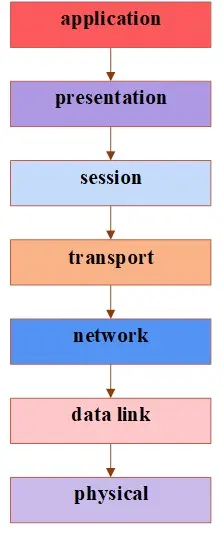
The seventh layer is the application layer. Or it is also called the application layer - at this level, the means are provided for user access to network resources.
The sixth level is the presentation level. At this level, the received data is converted into a format that is easy to read at the application level. Security features are also implemented.
The fifth level is the session level. This layer maintains a communication session, allowing applications to interact with each other. The layer controls the creation of a connection and the correct termination of the session, as well as the exchange of information.
The fourth layer is the transport layer. It is necessary to ensure reliable data transmission from the sender to the recipient.
The third layer is the network layer. At this level, data is routed in physical networks. At the same level, the data streams are split into smaller parts. It is at this level that routers operate. A router is a network device that connects computing devices and networks to other networks.
The second layer is the data link leyer. This is where an addressing scheme is provided to refer to physical devices.
The first level is the physical level. This layer handles the actual physical devices that are used to establish the connection.
Initially, data transmission over the network begins at the application level of the transmitting system. Data passes from top to bottom through all layers of the OSI model until it reaches the physical layer, which is the point from where data is sent from the transmitting system to the receiving one.
And the receiving system receives data at its physical layer, from where the data passes from bottom to top through all layers of the OSI model, eventually reaching the application layer.
As data passes through the sending levels, a header is added to the data at each level. The data together with the header form a protocol data block. And when the information passes to the receiving side and begins to pass levels there, then this header is taken away when passing the mirror level on the receiving side. This way of communication between protocols is called data encapsulation.
The TCP/IP model is the de facto standard for networking based on the TCP/IP protocol stack.
A protocol stack is a hierarchically organized set of protocols sufficient to organize communication over a network.
The TCP / IP model is similar to OSI, only there are four layers.
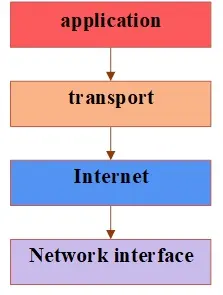
Application layer - corresponds to the top three layers of the OSI model. Includes protocols that process user data and control the transfer of data between applications.
Transport layer - corresponds to the transport layer of the OSI model. Includes protocols that control the integrity of transmitted data, the establishment and termination of connections.
Internet layer - corresponds to the network layer of the OSI model. It uses protocols designed to route transmitted data.
Network interface layer - corresponds to the data link and physical layers of the OSI model. And it contains protocols designed for the physical transfer of data between network devices.
The following figure will show a diagram of the TCP/IP protocol stack.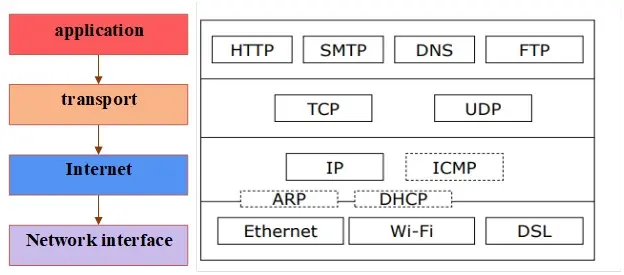
In the next article, we will look at these protocols.






