
In this post we're going to talk about the letter to Francesco Vettori, a missive, dated December 10, 1513, sent by Niccolò Machiavelli to his friend Francesco, Florentine ambassador to Pope Leo X in Rome.
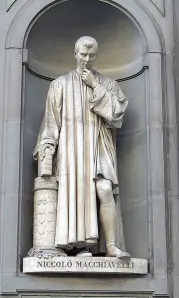
Image from Wikipedia - licensed under the terms of the Creative Commons Attribution 3.0 Unported license.
The letter was written during the time he spent in his country house, the Albergaccio, in Sant'Andrea in Percussina, near San Casciano in Val di Pesa; here he was spending a forced stay, to which he was forced because he was suspected by the Medici family of having participated in a conspiracy against them.
According to scholar William J. Connell, Machiavelli was not really in exile, but was serving a sort of residence obligation, although he could return to Florence, according to some documents recently discovered in the Florence State Archives, but that is not the topic of this post.
... I behave miserably all day long ...
In the letter to Vettori, the author recounts his own day to his friend: let us focus immediately on two paragraphs that make up the central - and most interesting - part of the letter. Machiavelli writes:
Mangiato che ho, ritorno nell'hosteria: quivi è l'hoste, per l'ordinario, un beccaio, un mugnaio, dua fornaciai. Con questi io m'ingaglioffo per tutto dí giuocando a cricca, a trich-trach, e poi dove nascono mille contese e infiniti dispetti di parole iniuriose; e il più delle volte si combatte un quattrino, e siamo sentiti non di manco gridare da San Casciano. Cosí, rinvolto in tra questi pidocchi, traggo el cervello di muffa, e sfogo questa malignità di questa mia sorta, sendo contento mi calpesti per questa via, per vedere se la se ne vergognassi.
Translation and paraphrase:
After eating, I return to the tavern: where there are usually the innkeeper, a butcher, a miller, and two bakers. Together with them I behave miserably all day long, playing cricca (a game with cards), trich-trach (a game with dice and pawns), and a thousand quarrels and endless insults arise; most of the time we fight over a penny, and they hear us screaming all the way to San Casciano. Thus, in the midst of these lice, I pull my brain out of the mold, and vent anger at my fate, that, pleased to see me trampled on in this way, it should be ashamed [to persecute me].
... I strip off that robe soiled with mud and muck, and put on the clothes worthy of a curia and a king...
At last, after bitterly describing the less than honorable daily occupations, Machiavelli recovers his dignity as an intellectual:
Venuta la sera, mi ritorno a casa ed entro nel mio scrittoio; e in sull'uscio mi spoglio quella veste cotidiana, piena di fango e di loto, e mi metto panni reali e curiali; e rivestito condecentemente, entro nelle antique corti delli antiqui huomini, dove, da loro ricevuto amorevolmente, mi pasco di quel cibo che solum è mio e ch’io nacqui per lui; dove io non mi vergogno parlare con loro e domandarli della ragione delle loro azioni; e quelli per loro humanità mi rispondono; e non sento per quattro hore di tempo alcuna noia, sdimentico ogni affanno, non temo la povertà, non mi sbigottisce la morte: tutto mi transferisco in loro.
Translation and paraphrase:
When evening comes I leave home and go to my study; on the threshold I strip off that robe soiled with mud and muck, and put on the clothes worthy of a curia and a king; thus decently dressed I enter the lives of ancient men and, received with pleasure by them, I feed on that food which is for me alone and for which I am made; and I'm not ashamed to talk to them and ask the reason for their actions; and those, out of their courtesy, answer me; and for four hours I don't feel boredom, I forget worries, I'm not afraid of poverty and I'm not afraid of death: completely I move into them.
Machiavelli first describes his day, pointing out how it is spent between games of trich-trach (a late medieval game with pawns and dice, not too legal) and quarrels with fellow players such as butchers, millers or bakers, with individuals, in short, far removed from his intellectual status, soiled with metaphorical mud.
In the evening, he finally closes himself in his studies, for which he feels he was born, dressing, not only symbolically, in the shoes of the scholar, the intellectual.
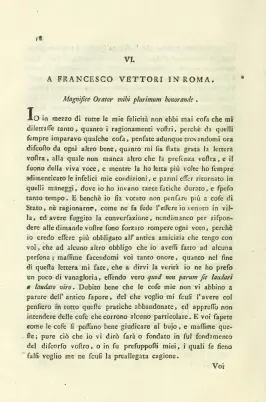
opening part of the letter,

Image from it.wikisource- licensed under the terms of the Creative Commons Attribution 3.0 Unported license.
When he wrote this letter, he was still working on The Prince, the treatise he would dedicate to the De Medici family, with the aim of returning to Florentine political life. The Prince is precisely the work that will earn him fame in the following centuries (and which we will discuss at greater length in a future article).
But what lessons can we learn from reading this letter?
Freud repeatedly reiterated that, for the common man, taking refuge in the world of fantasy is a way of repairing the traumas suffered; the artist is able to sublimate this propensity in the process of artistic creation.
A few centuries before Freud, through this letter, Machiavelli illustrates what the attitude of the artist, poet or man of letters is: when they create or compose, they carry out a process of reparation to what is the greatest trauma, the fear of death; this explains the afflatus to artistic creation, that romantic streben - philosophically theorized by Fichte - that compels the author to never stop, even when writing only for himself.
This letter is a kind of universal statement on what the attitude of the intellectual is, a message that is as valid yesterday as it is today, to shake off the muck and mire of everyday baseness, and elevate one's spirit in study and culture.






