
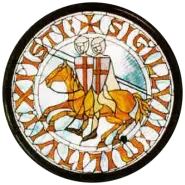
The production of historical texts related to the Templars, in their various aspects, is practically boundless. For this article we will refer to two texts in particular, "Vie et mort de l'ordre du temple," written by Alain Demurger in 1998, in the Italian edition of 2005, and the text by the Italian writer Barbara Frale "Il papato e il processo ai templari" (publisher Viella - 2003).
A google search for the terms "templar treasure" returns over 4 million results, proving how much, even today, the issue is felt.
There are at least sixty or so movies - from the 1960s to the present - that have been produced with the Knights Templar as their theme; in particular, more than half of them were made from the year 2003 onward. It cannot escape the circumstance that they were produced after the publication of the very famous "Da Vinci Code, by Dan Brown (November 2003), after which titles associating the Knights of the Temple with terms such as "treasure," "curse," and "mystery" have proliferated: one example for all, National Treasure, a 2004 movie starring Nicholas Cage (in italy: the mystery of the Templars), in which the hero discovers a gigantic storehouse of valuables.
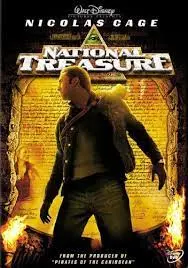
movie poster
In fact, that of the XX Century is a second "rediscovery" of the Templar vicissitudes; already in the Renaissance an "esoteric" reinterpretation was being made morbidly attentive to the secret rites and heretical aspects of the affair, as documented by Peter Partner, in his 1982 book "The murdered magicians."
Already the knights' own contemporaries were aware of the utilitarian nature of the trial and its purposes: even Dante, in Canto XX of Purgatory, condemns the destruction of the temple order, which took place out of self-interest.
While the most disparate theories, spread even by the so-called "mainstream" media, such as the History channel or Discovery channel (have you ever noticed how many self-styled experts are simply presented with the sole qualification of "writer" or "researcher"?), and we wait for some Templar artifacts to turn up from Oak Island - frankly, I hope so, but I don't believe it - here is what happened, really, to the Templar goods. Countless times we have come across, on the web, the fictitious transport of the mythical treasure, which took place thanks to "three wagons and eighteen ships," a revelation allegedly leaked from the interrogations of one of the captured and tortured Templars. The strangeness of a treasure being transported by only three wagons and then divided into eighteen ships is imaginatively resolved by writer Gerard de Sede, according to whom the expression "three wagons" is code for hiding the place where the treasure would be hidden ... and let's quote him, come on, thanks to Dan Brown's various predecessors or emulators, it would be somewhere near Rennes le Chateau (farther over 100 kilometers from the first useful port … never mind), or at the fortress of Gisors (and here the kilometers from the sea become about 150). Sometimes certain kinships are really forced, such as the Templar-Roxlyn chapel likeness drawn from a bas-relief, which actually depicts a knight flanked by an angel holding a cross.
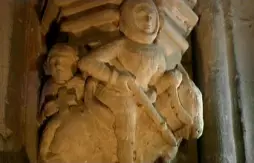
The Rosslyn knight
The arrests by Philip the Fair occurred on Oct. 13, 1307, while the papal bull Ad providam, by which Pope Clement V transferred Templar property to the Hospitallers of St. John of Jerusalem, was dated May 2, 1312. Almost five years in which the supposed treasure would have remained hidden somewhere? And where, if Fort Knox was built only in 1918?
The first question is: Where did the riches come from? From fabulous treasures discovered under the temple in Jerusalem? Not really, there is, very prosaically, extensive documentation of their provenance, as far back as 1133, when the lords of Douzen donated plots of land to the Templars, with all the productive activities insisting on them. From then on, for two centuries, a donation race was ignited in favor of the knights, which would feature bishops, nobles and royalty. After about thirty years, the Temple began to trade, acquiring additional properties and making them profitable, with a widespread system of exchanges, purchases or sales, as attested by cartulari and notarial records, and reported by Demurger.
Those who donate-or sell for a bargain-redeem their sins and save their souls, while the Temple increases its power exponentially, sometimes violently, as in 1298 when English temple master Brian de Jay forcibly seizes some funds in Esperton.
When we speak of "assets," we refer not so much to sound money, perhaps crammed into coffers, or gold artifacts, but, for the most part, to real estate: ships, land, mills, farms ... and related livestock, a "passive" role of accumulation, which is transformed into entrepreneurial finance activities. In less than two centuries, the Temple increased its financial economic power, while Christendom lost on the battlefield: by the time the arrests took place, in 1307, the last Christian stronghold, Acre, had already fallen to the Mamluks for sixteen years, and the Christian dream in the East had long since waned.
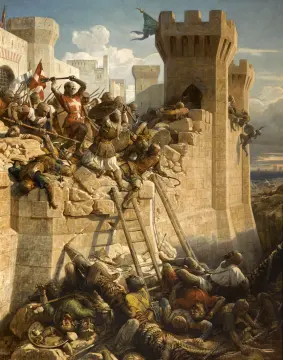
The Hospitalier Master Mathieu de Clermont defending the walls in 1291,
Dominique Papety - Collections de Versailles
As Frale points out, these were rents and properties not taxable by the rulers, by virtue of the specific privileges of ecclesiastical property; it is easy to see how all this infuriated the King of France, Philip IV, on whose lands was a large slice of Templar property, with which, in 1306 (a year before the arrests), he was heavily in debt.
In a memorial sent to the pope, de Molay explains the real reasons for the friction with the king of France, who had no intention of embarking on an enterprise to reconquer the Holy Land, but hoped for a merger of the Hospitaller and Templar orders under his leadership in an operation to conquer Armenia. King Philip, it should be remembered, did not exactly have a good relationship with the pope and ecclesiastics in general: in 1303 his emissaries had been the protagonists of the famous outrage of Anagni.
The Templars, moreover, are everywhere cited as the originators of the modern banking system, and of the "letter of exchange, or letter of credit," the traveler's cheque of our days (indeed, pre-internet days): a written title that allowed one to travel with the least amount of cash on one's person. In fact, the "letter of credit" was a gimmick devised by the Hospitaller order, but the Templars applied and spread it, having a larger and more moneyed clientele.
OK, we get it: properties, letters of exchange, loan contracts with European monarchs, all point to the distribution of wealth from Oporto to Jerusalem, not a concentration of gold in a handful of coffers perhaps buried near Rennes le Chateau.
Where is the treasure?
What happened to all this wealth after the convictions and dissolution of the order?
With the papal bull Ad providam of May 2, 1312, Templar assets were transferred from the Temple to the Hospitallers, while Templar assets in Portugal were merged into the Order of Christ, which was created on the ashes of the Templars to finance the naval fleet to counter the Moors, and which consolidated Portuguese economic power.
Similarly, in Spain, the military order of Our Lady of Montesa forfeited assets, and framed several Templars into its ranks.
In Germany it was the Teutonic Knights who forfeited their property, while Overseas, what was inherited from the order of Malta, was confiscated by Henry VIII: the greedy Philip also demanded a quid pro quo from the Maltese knights.
We have talked too much; we have come to a simple conclusion: the Templar treasury did not exist. Or rather, it existed in the form of assets, annuities and land scattered from Portugal to the Middle East, and even as for the cash, that is, the sound money, the gold coins, it was scattered and diffused among all the commanderies and chapters scattered throughout the Mediterranean.
That is why today, after 700 years, already as it was then, it would be vain to look for the so-called treasure, and hope to find it piled up in some cavern, wherever in the world we can imagine looking for it.






