
Did Dante really think the earth was spherical?
Let's find out ... in 5 minutes of reading.
It now seems to be well established that the question about round or flat earth is a more debated issue in our time than in the past, just go and check how bulky, and continually updated, the related wikipedia page is:
https://it.wikipedia.org/wiki/Terra_piatta
Popular feeling is driven to believe that this belief was so until the fateful year of the Lord 1,492, the voyage of Columbus in short, which would prove the error of such a belief, or, at least, such seems to be the belief of the so-called boomers, who grew up eating cartoons and TV dramas (and yes, we had electricity in the houses, but no computers or smartphones, and to get information one had to go to books. Paper!), and all too wild about sharing on social networks content that was at least dubious.
In fact, this belief is based on a completely erroneous assumption. In fact, both the good Genoese (or Spanish?) navigator and the commission appointed by the Spanish crown to assess the chances of success of his expedition (the so-called "sages of Salamanca"), shared the idea that the Earth was about spherical, and the dispute was based practically only on the distance the ships would have to cover, without any possibility of a stop-over (for the record, the sages were right, because Columbus - intentionally or not - vastly underestimated it, in the proportion of 1 to 4).
All of this has a definite culprit: Washington Irving, who, in his History of the Life and Travels of Christopher Columbus, written in 1828, crystallized the false belief of a Columbus fighting against the learned men of the Spanish court over the sphericity of the Earth; but after all, he was a writer, not a historian (he is the author of The Legend of Sleepy Hollow).
Let us avoid bothering the Bible (where, for example, in Isaiah 40:22 there is a term that can be translated as "globe," or "circle"), or the cosmography of ancient Greece, where as early as the sixth century B.C. Anaximander spoke of of a cylinder floating in space, or Eratosthenes who measured with fair approximation the diameter of the earth thanks to trigonometry, or the monk Bede, who spoke of "Earth round like a ball" in 700 A.D., to focus on the focus of the present article: the sphericity of the Earth, was it already taken for granted by intellectuals like Dante Alighieri? Perhaps so ... but where do we derive this thesis from?
The Poet did not leave us writings of a purely scientific nature, however, one must come to terms with the knowledge that, for the educated medieval man, the concept of "specialization" of culture, as we understand it today, did not exist, so references to scientific principles can be found in several of Dante's writings. Alighieri lived in a world in which the wise man was a learned man, able to juggle somewhat all branches of knowledge, following Aristotle's model, able to write as much about physics as about theater, at best the sectorization of knowledge was that codified by the division into:
- Trivium
- Grammar-essentially just the Latin grammar
- Rhetorics
- Dialectics - the equivalent of philosophy
- Quadrivium
- Arithmetics
- Geometry
- Astronomy
- Music
In short, like we do when we hastily distinguish "science" subjects from "classics" by generalizing.
Dante's output covers treatises related to politics, rhetoric, and poetics, as well as sonnets, rhymes and epistles, and, of course, the Divine Comedy, his most important work. We will refer precisely to some precise passages from the Comedy.
We are accustomed to thinking that Dante is "descending" to hell, when in fact, he is "ascending," rising from it to heaven, as if he were going deep, yes, but from the opposite side of the globe.
We should move from the typical funnel-shaped view of hell to a more complete overview of Dante's otherworld:
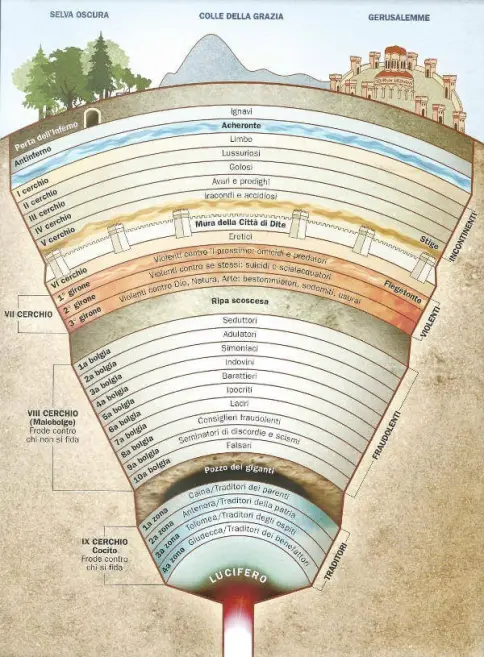
image from:
https://isoladiomero.com/2019/09/13/linferno-di-dante-alighieri-lincipit-del-viaggio-con-virgilio/
in which Dante and Virgil begin their journey, "upside down," as the inhabitants of the Asian Far East may be compared to Europe at this moment:
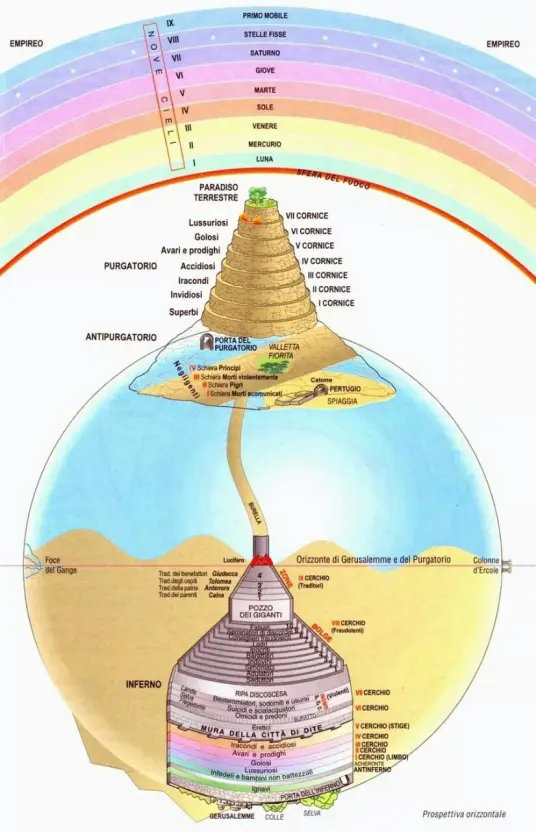
Image from:
https://www.thinglink.com/scene/886670295576870912 copyright to the author
The supreme poet wrote, in Canto XXXII of Hell, in verses 73 - 75 , walking - literally - over the heads of traitors immersed in the Cocite ice:
E mentre ch’andavamo inver’ lo mezzo
al quale ogne gravezza si rauna,
e io tremava ne l’etterno rezzo;
He was approaching the center of the Earth, the place toward which all weight (ogni gravezza) tends, hinting at how he had an awareness of a "center" of the planet on which bodies converge, drawn by their own weight.
Moreover, Ulysses says recalling his journey beyond the infamous Pillars of Hercules, to arrive "di retro al sol," del mondo sanza gente (without people because he was convinced that the southern hemisphere, in short, was uninhabited),
Tutte le stelle già de l’altro polo
vedea la notte e ‘l nostro tanto basso,
che non surgea fuor del marin suolo.
The sphericity of the Earth, however, is described by Dante admirably in the passage from hell to purgatory.
At the presence of Lucifer, immersed up to his waist in ice - and thus descending to the lowest point of hell - Dante sees Virgil, literally clinging to the body of the king of hell, and continuing his descent, to face the narrow tunnel known as the burella. The two then descend between his body and the ice, a prodigy happens:
quando noi fummo là dove la coscia
si volge, a punto sul grosso de l’anche,
lo duca, con fatica e angoscia,
volse la testa ov’elli avea le zanche,
e aggrappossi al pel com’om che sale,
sì che ‘n ferno i’ credea tornar anche.
Having arrived at Lucifer's hips, Virgil, with some effort, flips over and ... continues straight on until he sees the stars again. In essence, they have just passed the center of the Earth, and-in deference to Newton's thesis-they are not upside down at all, with their legs in the air, as the poet fears, but perfectly upright.
Clearly we are still in a context far from mechanistic physics: as well expressed in the Convivio, it is the love of God, the one true Logos, that moves the sun and the other stars, and that cannot be demonstrated scientifically, as well debated by Alistair Cameron Crombie in his Augustine to Galileo: the history of science, A. D. 400-1650.
Well, yes, we have the answer: Dante knew about the sphericity of the Earth, and, moreover, he gives evidence of how-and here is the reference to Canto XXXII-in the midst of the Middle Ages, the law of universal gravitation, which Newton would not codify until 1687, had already been intuited!
Note:
https://it.wikipedia.org/wiki/Anassimandro#Le_concezioni_astronomiche
https://it.wikipedia.org/wiki/Eratostene_di_Cirene






