
*Ethereum (ETH) 2.0 can solve Bitcoin's scalability problem
Gavin Andresen, founder of the Bitcoin Foundation and lead developer of the BTC network since 2010, identified three steps that can improve Bitcoin's scalability. Mr. Andresen assumes that the Bitcoins wrapped (wBTC) on the Ethereum (ETH) 2.0 network are the best instruments.
According to him, once the Proof of Stake (PoS) version of Ethereum (ETH) is implemented, Bitcoiners can start wrapping their assets in wBTC, which are ERC-20 tokens. Eventually, all Bitcoin (BTC) transactions can be transferred to the Ethereum (ETH) 2.0 blockchain.
Andresen admits that migrating from Ethereum (ETH) to its Proof of Stake in itself is not easy. Nor is it the process of wrapping all the Bitcoins (BTC) that are in circulation. However, in 1-3 years, this process will happen. In terms of quantity, wrapped Bitcoin (BTC) transactions can exceed Bitcoin (BTC) transfers on the main chain.
Despite the fact that wBTC is not a novelty in the blockchain segment, it is one of the first proposals to scale the Bitcoin (BTC) network.

*The father of the JOBS Act believes there will be no demand for the Chinese digital currency.
On May 28, Digital Dollar released its white paper, a 30-page document detailing the possible applications of a CBDC. This document continues the work of the new expert group to drive the development of a digital dollar.
The document details certain basic principles of what you consider a digital dollar and what will drive the initiative.
The Digital Dollar Project was founded by former leaders of the Commodity Futures Trading Commission (CFTC) and professional services firm Accenture.
The new document expresses interest
to operate alongside traditional financial authorities and existing payment mechanisms, including money and technology from the Automated Clearing House.
The article presents an impressive range of applications for the digital dollar, for example, the colossal remittance corridor between the United States and Mexico. It is also looking forward to future pilot programs to test these uses as separate components.
Centralization and privacy
In line with the project's desire to work within existing regulatory limits, it explicitly does not seek to change the current US monetary system. Several times he mentions maintaining the currency format that flows from the Federal Reserve (Fed) to financial institutions and then to the public.
Although some recent laws have required direct consumer access to Fed accounts, One of these founders Daniel Gorfine explained the structure proposed by the digital dollar project as part of a decentralization effort:
Relying primarily on the private sector and regulated banks and money transmitters seems to be a much better approach. Public solutions would only make sense if there were still gaps and problems to be solved. [...] If you think about how the Fed developed, it was trying to decentralize the federal banking system and policy-related decision making. "
"This is a very important area. Ultimately, these are political decisions that the government must make, ”Gorfine said of privacy. "I think what we call a 'white paper' is a model anchored and based on physical money."

*Banks burn as unrest grows
On June 12, Reuters reported that Lebanon's central bank will begin to inject funds into its currency market in a bid to stem the rapid devaluation that has intensified local tensions and unrest.
The report notes that some currency traders have already responded to the central bank's move, lowering prices to around £ 4,500 per dollar, government officials have also pledged to take steps to reduce its value to around £ 3,000 per every dollar.
However, recent attempts by politicians to quell the deepening economic crisis within the country have been unsuccessful, and protesters have erupted in multiple protests, throwing stones at banks and even setting them on fire in recent months, while Lebanese officials piled up record debts.
Bitcoin grows in popularity as local currency collapses
Amid turmoil, an increasing number of Lebanese citizens are turning to Bitcoin and cryptocurrencies in general

*Cryptocurrency exchange KuCoin announced through its official blog that it is adding support to buy cryptocurrencies with a credit card in 17 countries, of which seven are from Latin America.
The Argentine peso (ARS), Colombian peso (COL), Costa Rican colon (CRC), Dominican peso (DOP), Peruvian sol (SOL), Uruguayan peso (UYU) and the Chilean peso (CLP) of Argentina, Colombia, Costa Rica , Dominican Republic, Peru, Uruguay and Chile respectively, are the lucky countries where users will be able to acquire cryptocurrencies using their native currencies.
The service will be accessible within the exchange through the Simplex platform, one of the fiduciary channels introduced by the company for its global expansion.
In addition, with this option, the natives of countries such as the Philippines, India, Azerbaijan, Georgia, along with six other countries, will also be able to access the crypto-fiat ramp proposed by KuCoin.
In the official statement KuCoin points out that in addition to Simplex it has introduced two additional fiduciary channels, to support more than 50 fiat currencies such as the USD, EUR and AUD to buy cryptocurrencies
* Takeshi Fujimaki, a former adviser to George Soros, said it was "not a surprise" to hear Paul Tudor Jones' revelation, given the current state of central bank-led monetary inflation.
Fujimaki is a former Japanese legislator
Takeshi Fujimaki, former adviser to George Soros, said
"Louis Bacon, George Soros, Paul Tudor, Julian Rovertson ... I often spoke to them on the phone, met them in person and discussed many things, these people have a similar mindset. They look long term and capture a great trend Paul Tudor Joining the world of crypto assets means that you take global inflation concerns seriously and believe that crypto assets thrive in such circumstances. "
Fujimaki explains that when central banks flood the market with new money, there is a question of where everything will go. He added "I think it is quite natural to move money to cryptocurrencies and bitcoins, 'digital gold'."
PTJ, the founder of Tudor Investment Corporation, revealed that Bitcoin was part of his portfolio last month. He noted "The Great Money Inflation" as the reason to buy Bitcoin and argued that Bitcoin could be a protection against inflation. "Bitcoin reminds me of gold when I entered the business in 1976," he added.

*One of the most notable improvements observed by Ethereum this year has been regarding the utilization of its network.
Evolution of the value in Ethereum
In May, the value transferred on Ethereum exceeded the value transferred via Bitcoin for a short period. This was largely due to the increased issuance of stablecoins on the ETH blockchain, but it is a perfect example of the fact that the type of value moving in space has evolved over time.
ERC-20 tokens now only store 50 percent of the value in Ethereum, which was 100 percent in January 2017. Using ETH in DeFi also helps solidify Ethereum's primary value store.
And now Ethereum 2.0
There are no prizes to guess, as the impact of Ethereum 2.0 on improving network utilization is evident. The beacon test chain has been fervently active with more than 40,000 validators underway.
ETH 2.0 Phase Zero will be released soon. Along with this update and the enhancement of its core properties, its futures market credentials have also been positive, with Grayscale's ETHE market share in sales close to 1000 percent in premiums.
Therefore, the current use of the Ethereum network is a complete amalgam of key events that have taken place over the years, all of which have contributed to building an improved blockchain for the future.
Ryan Watkins, an analyst at Messari, said:
“The great part of Ethereum's programmability is that it allows Ethereum to quickly adapt and find the right product for the market. The successes of these experiments have directly translated into increased use of the Ethereum blockchain, which has also put upward pressure on rates. "
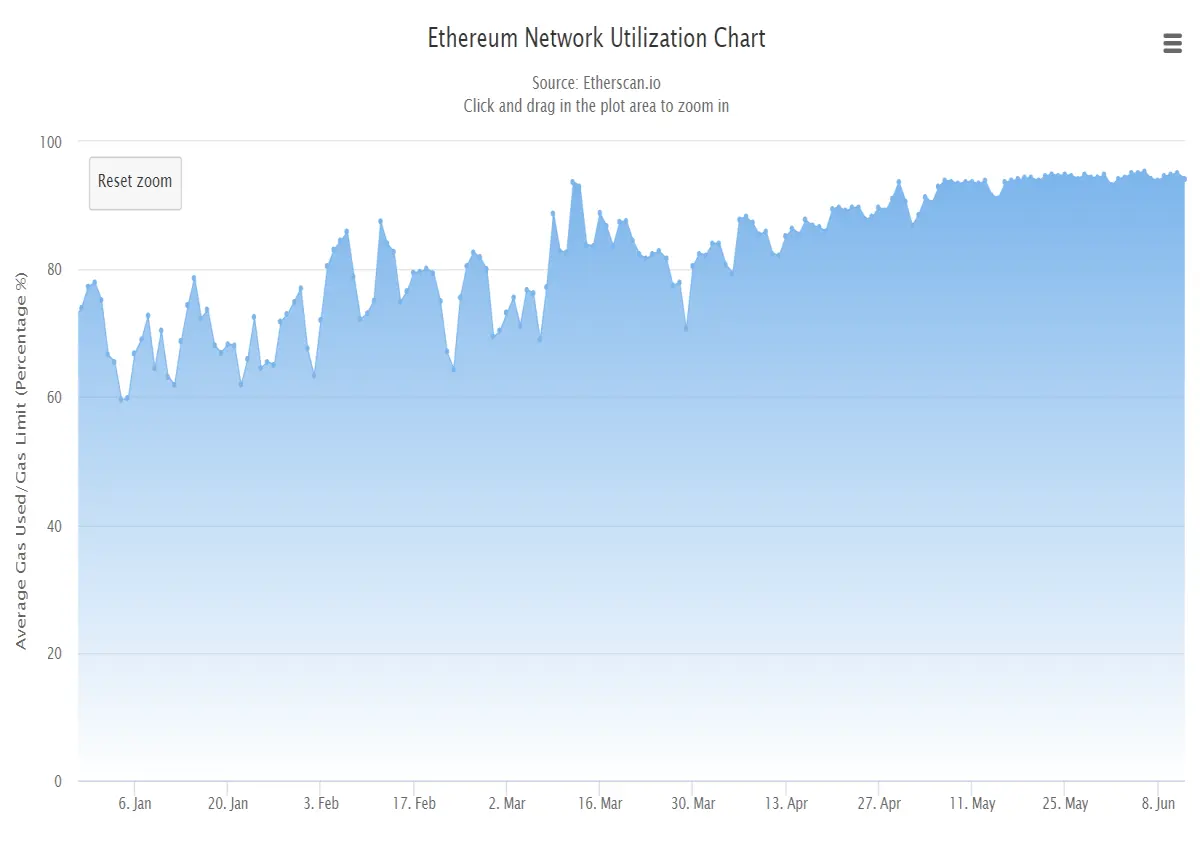
As can be seen in the table below, since the beginning of January, the utilization rate of the ETH network has grown steadily and, despite the market drop in March, the utilization percentage has continued to increase. In fact, over the last month alone, the utilization rate has consistently been around 95 percent.
thanks for reading have a great day 🤗
if you want valuable information only in Publish0x
Subscribe for more 🥳
SOURCES:
https://eng.ambcrypto.com
https://www.ccn.com
https://es.cointelegraph.com
https://www.diariobitcoin.com
https://cryptodaily.co.uk
https://crypto.u.today/ethereum
https://cryptorank.io/news






