
Hello everyone, do you remember the days when AI was not as powerful and smart as of right now? Well from that point we have been reaching new highs every single day because every one have understood that bigger GPU and CPU means better performance and that results in other countries investing more and more into AI and the big dream was one huge model that would do anything in a short amount of time within high quality .
One Big AI Handling It All :
Consider how things used to be. The early big language models, like the first GPTs or BERT, were constructed as massive unified systems. They’d have billions or trillions of parameters all rolled into one, as well as tons of data. The upside? You could ask it something, and it’d pull from everything it knew and provide you an answer. It powered chat apps and suggestion systems, performed wonderfully, and proved useful for broad tasks.
But these giants had their downsides. They mess up sometimes on specific stuff because they’re trying to be good at everything, not amazing at one thing. They suck up a ridiculous amount of power to build and use. And growing them means piling on more tech, which gets expensive and wasteful quick. That’s where the new approach comes in. Also this one big brain AI had lots of debuging problems.
The Mini AI's: Experts That Team Up
A new approach to solving multifaceted issues is to split these challenges to be tackled by various ‘mini’ AIs each specializing in a particular aspect of the problem. These ‘mini’ AIs work in tandem, as if they are in a highly coordinated meeting, each member with their respective specialization, and offer solutions that are far more sophisticated than any individual member can offer alone.
This approach is based on the concept of multi agent systems in AI, which is now gaining traction due to advancements in technology. Each agent within a multi agent system is autonomous and responsible for perception, decision making, and interaction with other agents. They can share the workload within a collaborative system and even negotiate as needed. Autonomous agents are capable of continuous and dynamic communication and system integration to achieve a common goal.
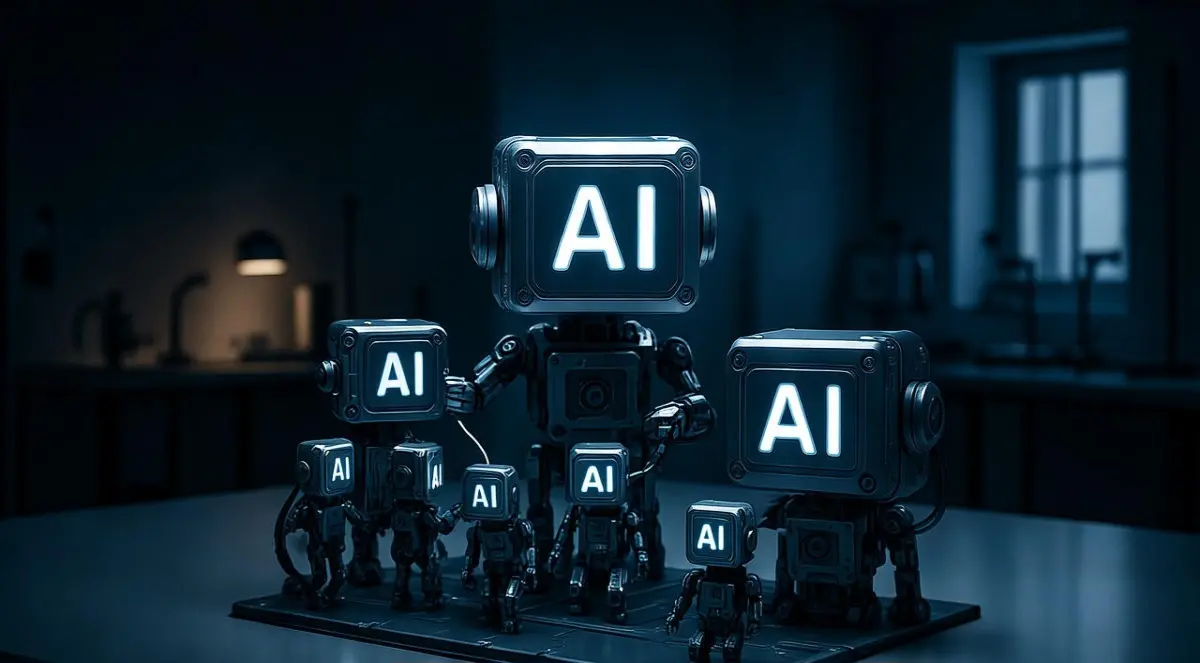
But Why small teams win ?
- More Efficient Resource Management: Smaller models are cheaper to build and operate. Because they function on basic hardware, AI can easily be integrated into phones and other smart devices. You can scale by adding more agents rather than rebuilding the entire system.
- Greater Precision Results in Less Errors: Each can be fine-tuned to focus on one area, such as a health AI specialized for X-rays, allowing for deeper, undistracted work.
- Hardier and More Adaptable: If one glitches or is out for repairs, the others continue to operate. They teach and adapt to one another during the task, like in a beehive, where they share the burden and accomplish complex goals.
- Ignites More Creativity: Collaboration encourages co-creation. In more creative tasks, one person generates ideas, another challenges the ideas, and a third refines the ideas. The end result is often more creative.
- Stronger Privacy Safeguards: You can design smaller models and systems with privacy concerns in mind, preventing the information from being disseminated like in large models.
Going from one AI setup to a bunch of minis is what we call to AI maturation. It’s like upgrading from a one person band to a full choir. There is so much more to control. The more complex these systems get, the more the challenge of ensuring the collaboration works for us.
Whether you’re programming your own agents or simply using more advanced applications, a more interactive AI ecosystem awaits you. When you next speak to an AI, a whole team may be working to make the interaction seamless.
Perhaps maybe this is what AI will look in the future small particles that will form something special and we should be ready for it.






