
At the time of writing, the total crypto market cap sits just under the 2 trillion dollar threshold (1,847T). In that ecosystem, the staking-supported protocols constitute only 10.7% of that value. (198,9B) These values have already risen since October 2020, when the numbers were 326,7B and 21,1B respectively. The ratio was 6.7% one-and-a-half years ago. So, the main point I want to address is that the staking ecosystem has shown better performance when compared collaboratively. We welcomed Solana, Ethereum 2.0, and many others since the beginning of 2020 in addition such networks have already implemented PoS to their features including Cosmos and Algorand.
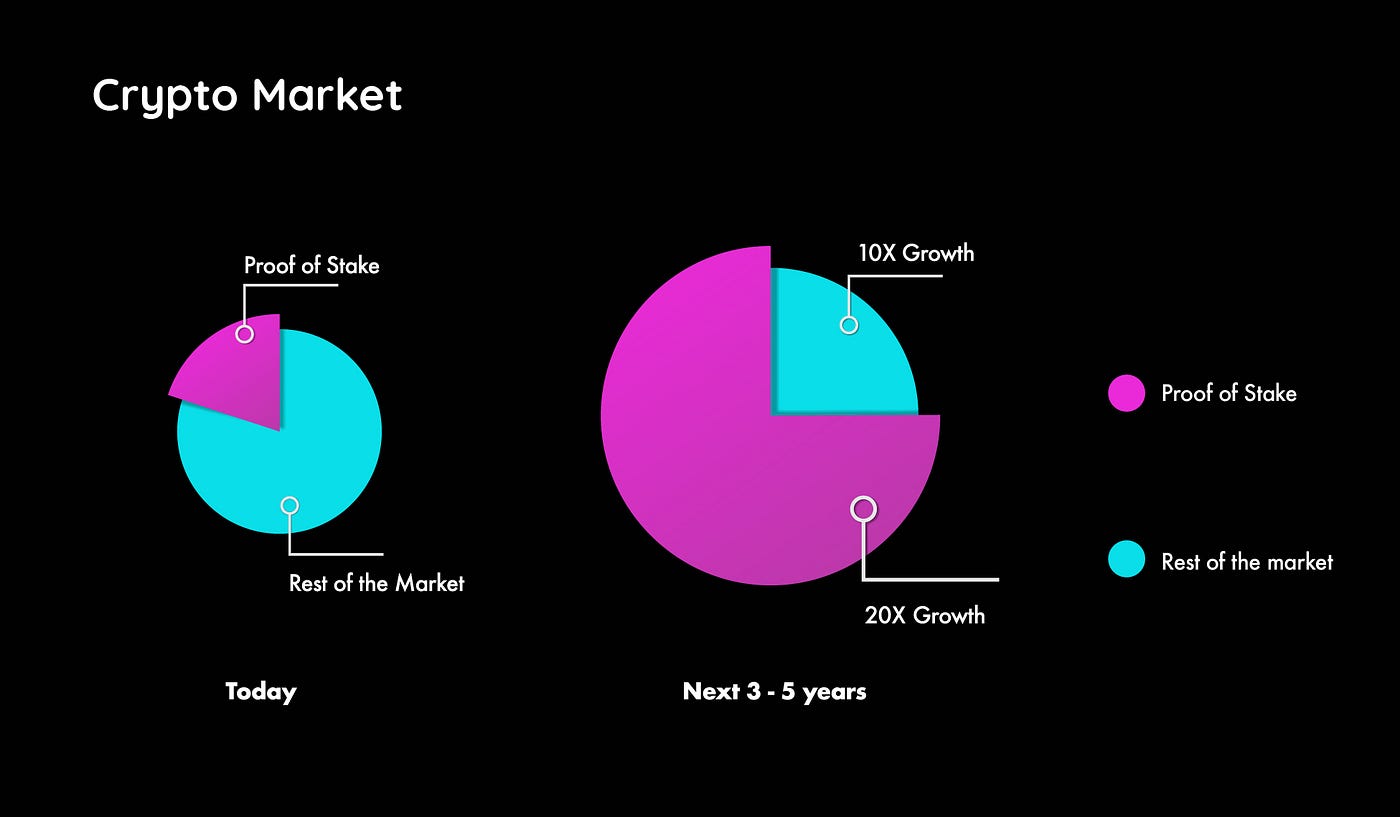
Like every single one on the cryptosphere, you already know that the price or market capitalization is not everything. So, the better performance over the last didn’t make the PoS part blue-chips of the entire ecosystem. Most of them started their journey with the idea of ”being the real Ethereum killer” but none of them could succeed so far. Ethereum has many vulnerabilities that make people discover & use different solutions on it, PoS systems have also. In that article, I will talk about the current status of the staking ecosystem, the problems to be overcome, and how StaderLabs aims to achieve such goals through the implementation of the ”liquid staking” method instead of native staking ways.
What is PoS (Proof-of-Staking) and Its Problems?
PoS is the algorithm behind the networks using the staking feature on the relevant chains. It enables token holders to lock their assets, help the chain run, and get rewarded in return. Starting from Bitcoin (BTC), most of the crypto assets are created on the networks supporting PoW (Proof-of-Work) algorithm. PoW can be visualized as a cryptographic puzzle to be solved. The solver gets the reward. By doing so, the challengers consume electricity & the newest technology to solve the puzzle faster. Nowadays, both consumed tools become unsustainable.
To overcome the basic ”the most technologic one wins” theory and to achieve more decentralization, PoS has emerged and evolved over many years. It could be visualized as a more collective approach to running the underlying network. It doesn’t heavily rely on the power like PoW, but on the other hand, it brings the complexity of trusting the Nodes for staking the ecosystem tokens. Here are the major challenges that bring the StaderLabs team onboarded:
- Deeply centralized staking (and voting) power among top shareholders
- The complexity of manual managing of staking
- Limited awareness of metrics regarding staking & Validators
- Non-automated delegation process that consumes daily effort
Shortly, none of the PoS platforms is excellent. All of them have some vulnerable aspects. But StaderLabs is here to bring the most widely used solution for everyone. Now, let’s start with the basic information to get ready for a deep dive into the platform.
What is StaderLabs?
StaderLabs is a cryptocurrency staking management platform. It was founded in April 2021 with the superior aim of being the long-term infrastructure provider for multiple chains. For now, the platform supports 3 different networks: Terra, Hedera, and the Polygon chain. To realize the aim of being the multi-chain supported staking platform, StaderLabs offers a new way to staking economy: Liquid Staking
In conventional staking methods, users have to lock their assets in a specialized smart contract for a certain amount of time and get rewarded for that action in return. The APY (or reward ratio) ranges from as low as 0.1% for major crypto assets to four-digit APYs in more volatile assets. The ROI is dependent on the number of circulating tokens staked currently on the smart contracts. The shareholders will get ”symbolic” assets in their wallets. For example, receiving pPOOL for staking POOL on the Polygon network or bBED after staking the BED index token on the Beta Finance platform. There are no utilities for such tokens at the moment and this is another major challenge for stakers to be solved. But, by utilizing the StaderLabs staking program users will be able to both receive the incurring staking rewards and continue to live in the DeFi ecosystem thanks to the productive assets they get in return for staking: LunaX for staking Luna, for example.
What is LunaX and How do Users Utilise It?
As I stated above, LunaX is the token representing your shareholdings in the smart contract for $LUNA staking on the StaderLabs platform. In addition to that, it’s not a non-tradeable non-transferrable token like many other common staking tokens. You can easily deposit some LunaX to other DeFi platforms to gain access to the huge DeFi environment: it’s tradeable against other currencies, it’s not static only in your wallet, and those make LunaX productive. I used the term ”productive” especially. Because LunaX stands for 2 different meanings: Firstly, it symbolizes an unstoppable upwards trend of $LUNA. And the second meaning represents the countless possibilities for both Terra ecosystem & StaderLabs in the near future.
LunaX provides users an additional instant liquidity option which means anyone can join and/or exit to/from the staking pool anytime. There is no lock-up time to receive rewards. Any incurring asset will be available anytime to withdraw on the smart contracts. Shortly, Luna users will experience the following benefits by using LunaX:
- Auto-compounding Luna and stablecoins (after conversion to Luna)
- Continue to earn airdrops (based on weekly snap-shots taken randomly)
- Instant liquidity and yield-enhancing opportunities
Of course, the list is not limited to those above, please make sure you follow their Twitter account to get updated & join the Discord server to spend time with the community.
The Native Token: $SD
Like all the other platforms, StaderLabs has launched a native token, named $SD. It was launched on the 11th of March 2022 with a total supply of 150 million tokens. When you dive deep into the distribution of $SD, the below scheme can be obtained from the Litepaper itself.
- 21% for sales
- 36% for rewards
- 26% to funds
- 17% for team & advisors
There are four main utilities for the $SD token: Slashing Insurance, Discounts, Governance, and Developmental Access. The StaderLabs has published a series of tweets explaining the utilizing points for $SD recently. You can see the tweet here.
Who Is Behind StaderLabs?
In recent months, some of the DApp developers chose to stay anonymous and didn’t reveal any information about the background of their team. On the other hand, we know the core StaderLabs team. According to the StaderLabs Litepaper, the core team consists of 5 members. The details are as follows:
- Amitej, CEO and Co-founder: 10+ years with Strategy consulting and Start-up management | Ex Swiggy, ATKearney | IIT & IIM Alumnus.
- Sidhartha, CTO and Co-founder: Deep expertise in crypto mining | 10+ years building and scaling tech applications | Columbia and IIT Alumnus.
- Dheeraj, Protocol Lead and Co-founder: 10+ years of engineering in silicon Valley | Ex LinkedIn, Blend, PayPal | UT Austin and IIT Alumnus.
- Vijay, Head of Product: 10+ years across product management and operations | Ex Booking.com. IIT and NIT Alumnus.
- Gautam, Incoming Head of Strategy & Expansion: 10+ years across i-banking, consulting, and investing | Ex Kearney, Deutsche Bank, and JP Morgan | IIT and IIM Alumnus.
What to Expect From StaderLabs For the Upcoming Weeks/Months?

StaderLabs has completed the third chain integration for staking, $MATIC. Now, it’s time to increase both the user count and TVL. As stated in the LunaX Litepaper (not the StaderLabs), the team expects multi-chain growth for Stader. Let’s check the details below together:
- Leveraged Staking
- Simple Leverage
- Future & Options Markets on Luna
- Cross-chain Compatibility
- Anchor Integration
*This article is created to spread the awareness of StaderLabs, LunaX, and its features by utilizing my own experiences, the StaderLabs Medium Blog, the StaderLabs Litepaper, the LunaX Litepaper, and the 2021 Staking Ecosystem Overview Report. None of the words above contain any kind of investment advice! Please DYOR (Do Your Research) before investing.
*Originally posted on Loop Finance.





