
Want to get paid to read Publish0x articles right in your inbox? Sign up for my email newsletter.
In many ways, it seems like one of the primary stories of the 2020s will be governments either coming to terms with Bitcoin and Crypto or trying to ban them outright. We’ve certainly had strong examples of both recently:
-
El Salvador embraced Bitcoin back in the summer of 2021, rolling it out as legal tender around the country and then doubling down by buying dips, mining with geothermal energy from volcanoes, announcing a sovereign Bitcoin bond, and more.
-
China rebuffed Bitcoin and Crypto by banning any activity related to the industry, including trading, mining, or making payments with cryptocurrencies. Granted, China has imposed various bans in the past with limited success and the current ban may also fall by the wayside in the coming years.
But the process of reconciliation or aggression for most countries is still in the early stages, with many jumping from one approach to another quite rapidly. The country of India certainly seems to find itself in this group. The Reserve Bank of India rattled cryptocurrency markets worldwide late last year when it recommended that citizens be banned from interacting with all private cryptocurrencies. On the surface, that recommendation seemed to be an attempt to clear the way for the Central Bank to release its own CBDC (Central Bank Digital Currency), and the government still has plans to do just that in the coming months.
Bad news aside, their latest move may turn out to be a win overall, with India’s finance minister, Nirmala Sitharaman, having announced earlier this week that the government intends to begin taxing income on “virtual digital assets”, namely cryptocurrencies and NFTs (Non-Fungible Tokens), at a 30% rate. While many in the space chafe at such a hefty tax rate, others interpret the move as giving legitimacy to digital assets, since it’s highly uncommon for governments to tax illegal activities. In other words, most commentators now believe that the previously proposed cryptocurrency ban is off the table in India.
To Tax or Not to Tax
There are a variety of different viewpoints when it comes to taxation, and participants in the crypto space are likely to encounter all of them at some point. I’d like to share two of the most common mindsets that I’ve heard, and perhaps they’ll sound familiar to you or one of them will resonate with you:
Taxation is Theft
It has often been said that “time is money”. However, to a large degree the inverse is also true: money is stored time, in the sense that the majority of us acquire money by exchanging our time through jobs, entrepreneurship, and investing.
The idea that “taxation is theft” thus stems from the idea that governments extract the only finite resource we have, our time, and that they do it by forced taxation. In other words, if you don’t sacrifice part of your time to enrich the government by paying taxes, they’ll take your property and throw you in prison. For most people around the world, paying taxes isn’t a choice. It’s an ultimatum.
Taxation brings Benefits
A close acquaintance of mine once conveyed to me his belief that taxation is the cost we pay to receive services, like infrastructure, protection, and governance, from the government. On top of that, he opined that those of us who live in democracies have a hand, to some degree, in our own taxation, since we voted to elect many of the political leaders driving decisions related to taxation.
The reality is that any perceived benefits of government are up for debate. Each of us will have to make our own decision as to how much we value each of the “services” provided by our respective governments.
The Governments’ Case for Taxation
At least for certain digital assets, governments’ planned taxation is in line with what they extract for other similar assets:
-
Many crypto tokens are, for all intents and purposes, comparable to corporate stocks in that they monetize a company’s current and future earnings so that the company can raise funds from supporters on the open market. In fact, this was the primary reason that many regulators around the world reacted harshly to the Initial Coin Offering (ICO) craze that occurred in 2017 and 2018.
-
While digital art and in-game items are far from the only use case for NFTs, they are the biggest recipient of outsider attention these days. In their current form, they are extremely similar to assets regulators identify as “property”, like art and other collectibles. If you make money trading your NFTs, you can bet the government will want a cut.
Whether or not you support taxation by governments, it’s not likely to go away any time soon. India’s government will seek to collect the portion of your income from digital assets that it believes you owe, and other countries either already have or soon will follow suit.
Like what you see, but not a subscriber yet?
Consider subscribing for:
📧Two weekly emails on the topics of cryptocurrency and blockchain
💰Subscriber giveaways for Bitcoin, Crypto Bestseller Books, Non-Fungible Tokens (NFTs), and more
🗣Real-time community discussions on the latest news within Crypto
Can’t Get Enough Crypto In Your Life?
Consider joining my:
🐥Twitter. Where I share live news and thoughts about the goings on of the crypto-verse.
📸 Instagram. Where I share bytes of crypto knowledge about more topics than we can cover in a twice-weekly newsletter.
📚Facebook. Where I share my latest content and engage the community on the world’s biggest social network.
Support The HiFi Crypto Letters
Bitcoin is my passion and my mission is to give as many people as possible the chance to learn how it can change their lives for the better. If you feel like supporting that mission, a donation of any size is possible and greatly appreciated:
Blockchain Word of the Day
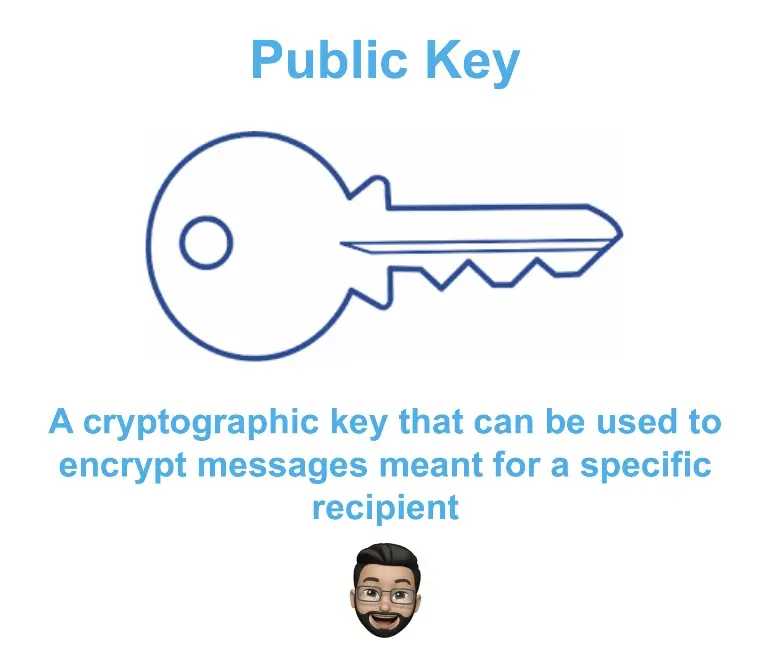
Learn more about Public/Private keys by reading Bitcoin and the FBI Hack That Never Was
Want to learn more Blockchain words?
If you enjoyed the above article, please consider supporting me by providing a small tip at no cost to you and by subscribing to my free newsletter.
You can also take this 3-question survey to tell me how I can improve the newsletter for you.
This is not financial advice. This newsletter and related content are for informational purposes only. Cryptocurrencies, stocks, and similar assets can be risky. Always do your own research before making any sort of investment.






