
Cycling is a sport that still lives on a rhetoric made up of hard work, sacrifice, pain, catharsis, and stoicism-.
"Cycling is not a game," people say, mocking colleagues in other sports who throw themselves to the ground to simulate foul contact....
Where does this rhetoric come from? It comes from the pioneer years, from the early 1900s. At that time, cycling was not a gentleman's sport, like aristocratic tennis or football, let alone athletics. Cycling was like a job, a kind of cruel circus show, in which people with uncommon physical abilities often escaped from poverty or low-level jobs to go and risk, literally, their lives on the track in velodromes or in the mountains, on unpaved roads, with bikes with wooden rims and brakes that were more like "slow motion".
It is in this context that the culture of "chemical aid" was probably born.
Today doping is rightly considered a scam and a symbol of unsportsmanship, but in the days of our pioneers it was often just a way to stay alive and the use of such substances was not considered ethically unsound.
"Nous marchons à la dynamite" is the famous phrase of Francis Pelissier before a stage of the Tour de France 1924, released to a journalist who asked him about the famous "substances".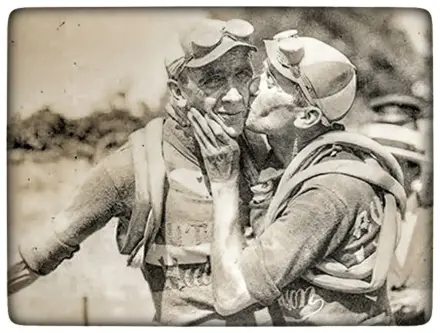
Photo Francis Pelisier kiss his brother Henri
Pellissier did not limit himself to this sentence, but from the pockets of his jersey he showed all the dynamite: "cocaine eye drops for the eyes (used as a local anesthetic), chloroform for the gums, ointments for the knees", and three boxes of pills: amphetamines of course. All stuff that was used to survive the unpaved roads where you had to eat dust, literally, for 10-12 hours in a row, with eyes full of blood. Amphetamines were needed to stay awake and lucid in 400km stages, to resist the cold of stages run in the rain without capes or raincoats, to climb alpine passes practically on foot (see thumbnail photo where Scieur climbs the Galibier on foot) wearing heavy woolen sweaters.
A sport that brought thousands of people onto the roads or into the velodromes, that sold thousands of copies to the newspapers that wrote about it (and organized the races), for which the cyclists were poorly paid heroes, who did not become rich, but simply came out of poverty. A cruel "sport," not a game.
EPILOGUE AND THE BEGINNING OF THE FIGHT AGAINST DOPING
As a matter of fact, all those substances did not have a great impact on sports performance, but they were still used until the late 60's, despite the fact that the road conditions were better than at the beginning of the century and the routes were much more "human".
Perhaps out of habit, perhaps there was a culture of the pill... I don't know, the fact is that the knots were coming to the comb. Many were the victims of those practices, both in the race (1886 the first known death for doping: Arthur Linton after taking strychnine in Paris-Bordeaux) and at the end of his career (see Major Taylor, who died young of heart failure). But the event that stirred public opinion to start fighting the phenomenon was the tragedy of Tom Simpson who was killed by a cocktail of amphetamines and alcohol at the Tour de France. From that day on anti-doping controls became regular.
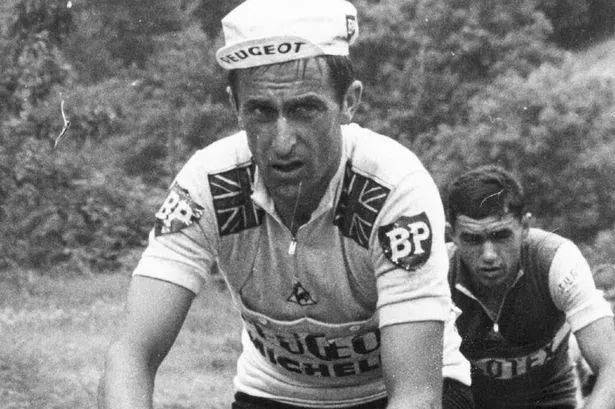
T. Simpson, Tour 1967
You can find beautiful photos and curiosities on our instagram and facebook.
To support the project follow our blog here on Publish0x and our Telegram channel.






