
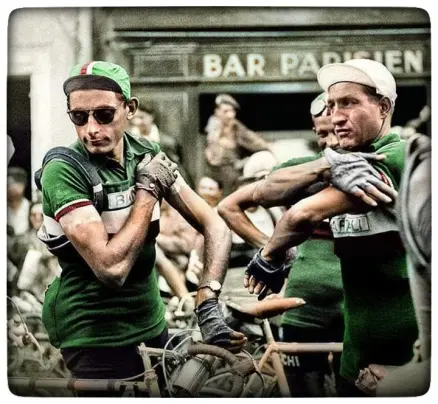
In the collective imagination Coppi and Bartali were enemies and even opposites. United by a catalyst that is the bicycle: one was the North Pole, the other the South Pole. Bartali was the Catholic, Coppi the communist. One was virtue, the other sin. Bartali saved the Jews, carrying the documents for the expatriation in the column tube of the bicycle, and dedicated the victory to Virgin Mary and St. Therese of the Baby Jesus.
Coppi gave scandal, leaving his wife Bruna for the “Dama Bianca”. It mattered little that other famous people and Italian politicians of the time had done the same.
But were Coppi and Bartali really enemies? Is the idea of their rivalry that has been handed down to us faithful to reality? Or is it just a stereotype to romanticize their exploits?
The analysis of Coppi and Bartali's life reveals important similarities. Both had humble origins and the bicycle was the instrument that allowed them to open up to great opportunities, a glimmer of light in the jungle of their lives. Both have known an identical tragedy, the loss in a bicycle accident of a brother: Giulio for Bartali and Serse for Coppi.

Serse and Fausto coppi @ Paris - Roubaix
We forget that Coppi, five years younger, was established in Legnano, Bartali's team. Fausto was the last of Gino's wingmen when he won in Modena, after a flight of one hundred kilometers, and took the pink jersey. His captain Bartali did not stop him, did not attack him, rather he waited for him on the Pordoi and helped him win that Giro d'Italia.
After the Second World War, the Coppi-Bartali rivalry really heated up. At the base, however, there was industrial competition: Bianchi was trying to undermine Legnano, which had dominated cycling for twenty years. And this ignited and took the sporting rivalry to the extreme.
Someone has recklessly written that the two hated each other. On the famous photo of the "exchange of the water bottle", which was mistakenly considered a rare event, it was discussed a lot: Bartali gave it to Coppi, or not Coppi gave it to Bartali. Meanwhile, it was not a water aluminium bottle, but a plastic bottle of mineral water. A woman along the road - probably in cahoots with the lurking photographer - wanted to give it to Coppi. But Bartali passed by her - while Fausto was in the middle of the road - took the bottle and gave it to Coppi, to whom it was destined.
This was not the only exchange of water bottle between Bartali and Coppi. "We passed it to each other dozens and dozens of times, when we were representing Italy at the Tour and the World Championships," Bartali told us. "Not only that, we also exchanged wheels many times. Fausto was very fair in the race."
Beyond the sporting rivalry, which was proud, Bartali and Coppi respected each other. The greatest proof of this came when Serse Coppi died. Mamma Angiolina was devastated. And Fausto, fearing her collapse, asked Gino to stay close to his mother. This episode erased any suspicion about the quality of the relationship between Bartali and Coppi. They were loyal rivals who respected each other.
If you liked the article let me know by leaving feedback.
For updates on the Heroes on Bike project follow the TELEGRAM channel. before the end of the summer there will be some good news.
To enjoy images and short stories of historical cycling follow HoB on INSTAGRAM






