Introduction
- Sri Lanka has a free and universal healthcare system.
- It scores higher than the regional average in healthcare having a high Life expectancy and a lower maternal and infant death rate than its neighbors.
- It is known for having one of the world's earliest known healthcare systems and has its own indigenous medicine system.


History
According to the Mahawamsa (The ancient chronicle of Sinhalese royalty);
- King Pandukabhaya had lying-in-homes and hospitals (Sivikasotthi-Sala) built in various parts of the country after having fortified his capital at Anuradhapura in the 4th century BC.
- Ruins of a hospital in Mihintale which was built by King Sena II (851-885 A.C.) that dates back to the 9th century has been discovered and it is considered as one of the world’s oldest hospitals

- King Buddhadasa (340–368 AC) was said to be adept in general medicine, surgery, midwifery and veterinary medicine and he is known for the surgical operation on an outcaste (Chandala) woman in order to deliver her child and the surgical removal of a lump in the belly of a snake.
- "Sarartha Sangraha", a comprehensive medical treatise in Sanskrit, is also attributed to King Buddhadasa.
- King Aggabodhi VII (766–772 A.C.) is known for his medical research and according to the Chulavamsa, the king "studied the medicinal plants over the entire island of Lanka to ascertain whether they were wholesome or harmful to the sick.”
- Excavations of the ruins of Ancient hospitals have uncovered several surgical instruments like Forceps, Scalpels and Scissors as well as spoons that are believed to be used to mix or administer medicine.

- The hospitals in ancient Sri Lanka had toilets and baths that were attached to the living quarters.
- The hospitals had been designed for ventilation and free circulation of air due to two open courts in addition to the windows which indicates that psychological aspects of therapeutics were understood by Medical practitioners.
Overview
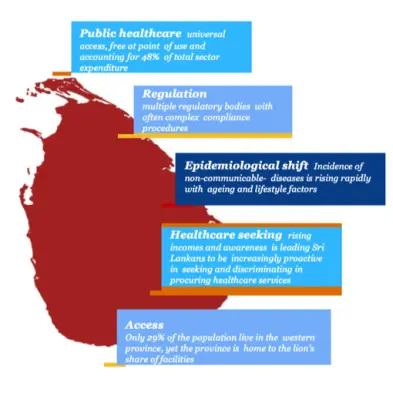
- Sri Lanka has a universal health care system that extends free healthcare to all citizens, which has been a national priority.
- OPD facilities are readily available in public (general) hospitals situated in major towns and cities, with laboratory and radiology facilities common in most.
- All doctors and nurses in the government hospitals are qualified and trained, with some of the most experienced staff working at the teaching hospitals.
- For emergencies, especially accidents, it is highly recommended to go directly to general hospital accident services as they are equipped with the staff and facilities to handle emergencies

The Current Health care system
- The MoH - a central government function - is responsible for the provision of comprehensive health services which include services for preventive, curative and rehabilitative care
- The SLMC is the statutory body established for the purpose of protecting healthcare seekers by ensuring the maintenance of academic and professional standards, discipline and ethical practice by health professionals who are registered with it.
- The PGIM is the only institute in Sri Lanka that is responsible for the post graduate specialist training of medical doctors
- CDDA is based on Canadian legislation and covers registration, manufacture, importation, transportation, Sale (retail and wholesale), labelling, advertising, distribution of drug samples, testing and disposal of outdated or spoilt drugs
- PHSRC is a council established to exercise, perform and discharge its powers, duties and functions under the Private Medical Institutions. The council is represented by the professional bodies such as SLMC, Independent Medical Practitioners Association and Dental Association and is headed by the Director General of Health Services
- Provincial and District Councils- In addition to MoH, the structure is further broken down to 9 provincial ministries with an equal number of Provincial Directors of Health Services responsible for planning, implementation and monitoring of all health programs including public health programs within the provinces.
Recognized Councils
- Sri Lankan traditional medicine
- (Western) medicine
- Sri Lanka Ayuruvedic Council
- Traditional Sinhala medicine
- Ayuruveda
- Siddha
- Unani
- Sri Lanka Homeopathy Council
- Homeopathy
Hospitals
- There are 555 government hospitals in Sri Lanka, in addition to several other government hospitals treating according to the Ayurvedic System.
- A large number of private hospitals have appeared in Sri Lanka, due to the rising income of people and demand for private healthcare services.
- The public sector accounted for 73% of the hospitals and 93% of the available bed capacity in Sri Lanka, while handling over 90% of the total patient admissions and outpatient visits to hospitals in the private sector.
- The top five players the Dr Neville Fernando Teaching Hospital (NFTH), Asiri, Nawaloka Hospitals PLC (Nawaloka), Durdans Hospitals (Durdans) and The Lanka Hospitals – accounted for nearly 45% of the private-sector bed capacity, with NFTH the market leader with 1,002 beds
Fun Fact:
Sri Lanka is one of the biggest donors of human eyes to the world, with a supply of approximately 3,000 corneas per year.
 Key Demand factors
- Sri Lanka's rapidly ageing population is expected to change the profile of healthcare services required
- With the increase in prevalence of non-communicable diseases (NCD) in Sri Lanka, the need for related NCD based medical care is likely to increase significantly.
- In addition to demographic and epidemiological shifts, changes in health seeking behavior, lifestyles, increased purchasing power and weather patterns have increased utilization of healthcare.
- Childbirth, injuries, asthma, ischemic heart disease and viral fever were leading causes of admissions in Sri Lanka.
Challenges in Sri Lankas health sector
Expected real growth in healthcare expenditure
- Key issues facing healthcare providers include addressing the epidemiological shift primarily driven by demographic and socioeconomic factors, the role of the state and the nature of its evolving partnership with the private sector, human capital constraints, improving access to specialized care and the promotion of appropriate, affordable health insurance across all segments of
- Navigating these complex and dynamic challenges will be key to establishing and sustaining a successful engagement with the Sri Lankan healthcare sector.
- However, irrespective of these considerations, one fact is certain:
Sri Lankans are increasingly demanding more and better healthcare and are willing to direct their growing disposable income towards it.
Health capacity planning and cooperation between the private enterprise and the state
- Ensuring that the healthcare system is structured and aligned with current and future demands of the population is a particularly relevant challenge for Sri Lanka.
- Currently private sector healthcare delivery is heavily concentrated in the diagnostic and outpatient space and receives c.54% of total national healthcare expenditure.
Health capacity planning and cooperation between the private enterprise and the state
- However, rapid population ageing, increased incidence of non-communicable diseases and related morbidity, increasingly high patient expectations and constrained public resources are factors that are likely to transform in the coming years, particularly in relation to the provision of inpatient and specialized care.
- Ultimately however, we expect that the nature and intensity of cooperation and competition within and between the private and public sectors will be critical in addressing the healthcare needs of a market which we expect to more than double to USD 4.5bn by 2020.
Operating within an evolving policy and regulatory environment
- Consequently, while we expect the private sector market opportunity to top $2.1bn by 2020, we also believe there to be substantial risks and costs of compliance.
- Navigating the complex landscape of agencies and regulations whilst planning for the future adoption of global best practice regulations and standards can be challenging.
Healthcare provider operations will need to adapt to transitioning nature of demand
- Ironically, thanks to the historical success of universal healthcare delivery and steadily increasing prosperity, Sri Lankans are living longer, albeit with more sedentary and unhealthy lives. Illness related to alcohol, tobacco, obesity, diabetes etc. are all on the rise: 80% of morbidity and 65% of all mortality is related to non- communicable disease.
- Simultaneously, increasing levels of disposable income and education are forcing providers to serve a higher and more informed demand with high quality and value for money healthcare products and services.
Healthcare provider operations will need to adapt to transitioning nature of demand
- Competing on price alone is an increasingly difficult proposition; competition has driven service commoditization with oftentimes sub-par healthcare outcomes.
- To succeed in the long-run, providers will increasingly have to make strategic decisions with respect to how to deliver quality services with acceptable returns based on optimization of operating performance, establishing the right geographic footprint, rationalizing services all with respect to the overall patient care pathway.