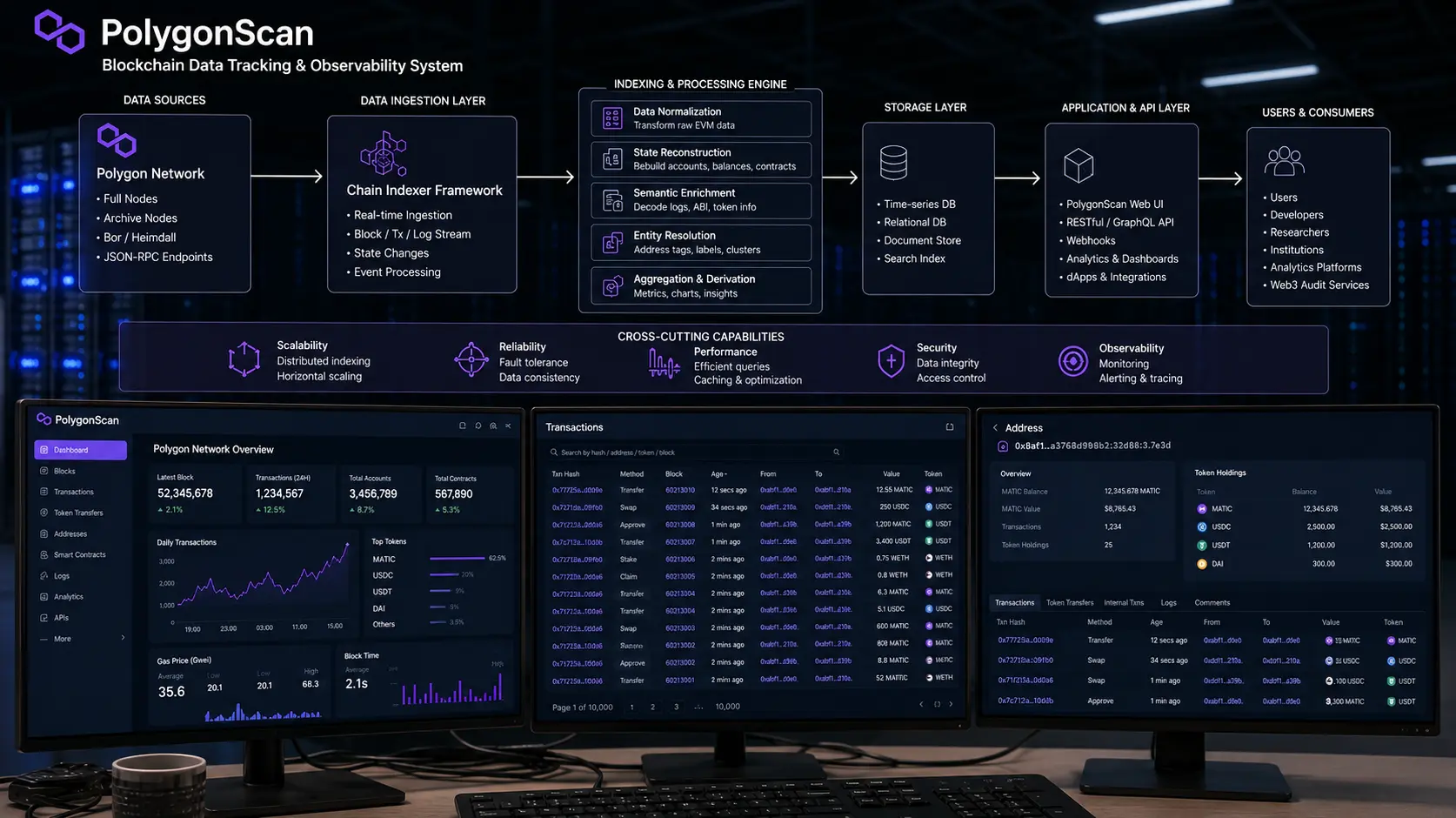
Polygon block explorers such as Polygonscan and open-source alternatives like Blockscout are best understood not as simple web applications, but as distributed blockchain data-tracking systems, blockchain data-analyses systems, blockchain data-processing systems and thus they are to also be called structered blockchain data-showcasing systems and platforms. Their primary function is to transform raw, append-only blockchain state transitions into structured, queryable, human-readable information that can be consumed by users, applications, researchers, institutions, and analytics platform.
To understand PolygonScan at a truly technical level, one must stop thinking of it as a "block explorer" —by terminological synergies an terminological consesus and terminological reference— and instead view it as respectively to what it is: a large-scale distributed blockchain observability and state-reconstruction system, and as a tracking system that displaying for the public is indeed one of the things that it offers; but the practical usages of all of that are in greater numbers.
The actual technological achievement lies in the indexing engine that continuously transforms raw blockchain consensus data into structured, queryable, semantically enriched information. This is precisely the problem that Polygon's Chain Indexer Framework was created to address: organizing vast quantities of EVM blockchain data into forms that can be efficiently, more orderly and more productively: searched, identified and consumed by applications, systems, web3 audit services —for better verification—, dAPPs, and also the Poligon Netwowork's oganization to better improve its and upon its services.
Elabprations regarding blockchains so thus to better understand blockchains
1.A blockchain is, in its most fundamental computational form, sort-of essentialy: an append-only, cryptographically secured, distributed state-transition machine whose primary purpose is to achieve deterministic consensus regarding the validity and ordering of state changes across a certain decentralized network. Sort of in essence in general any "blockchain"'s internal architecture is therefore optimized for security, immutability, fault tolerance, verifiability, and consensus formation rather than for analytical retrieval, exploratory querying, or large-scale information discovery. Every transaction, smart-contract execution, token transfer, event emission, and state modification is permanently recorded within a structure designed to guarantee the integrity and systemic integrity of historical, systemic and actual computation, but this structure is inherently inefficient for answering complex informational questions.
1.a. Increasing scalability tends to require greater computational, networking, and storage resources from participants. As these resource requirements increase, the number of individuals and organizations capable of independently validating the blockchain tends to decrease. The reduction in the number of validators and participants consequently reduces decentralization, since participation becomes concentrated among a smaller group of actors. Efforts to restore or preserve decentralization by lowering participation barriers often result in lower transaction throughput, higher latency, or weaker security guarantees. According to the paper, this interdependence reflects a fundamental trade-off among scalability, decentralization, and security rather than a limitation of any particular blockchain implementation.
Poem Section.
At least 1-2 poems respectiv to this topic:
Polygon's PolygonScan: Using PolygonScan's APIs:
(This poem is still being revised)
Oh, thar thar wast created
For blochain data explorarion and data proccesing,
And many of clusters of important web3 data and information this blockchain explorer
Everyday into its severs and databases comprehended,
Data streams create trafic on the blockchain highways
Like bullet trains going through realms
But more like high-speed hyper-cars
But with encrypted data and information
And so thus there they flow in this great web
And thus thar they flow in this great Polygon web
And there also like cyber-winds they flow
And thar also like cyber-winds they flow
And the internet highways also as cyber-winds they blow,
And Polygon's blockscans Polygon Blockchain activity they show;
Oh, POL's price goeth up and goeth down
Oh, POL's price goeth up and goeth down
Oh, POL's price goeth high and goeth low
Oh, POL's price goeth above and goeth bellow
But when the users buy and sell Polygon's blockscan those transactons show
But whanne the users buy and sell Polygon's blockscan those transactons show
But when the users transfer POL Polygon's blocksans those transactions show
But whanne the users transfer POL Polygon's blocksans those transactions show
To be continued today ... ...