
This news is based on official reports from the Ministry of the Interior of France, as well as analytics from Chainalysis. They indicate a widespread rise in violent crimes - such as kidnappings, torture, and threats - aimed at seizing the victims' cryptocurrencies.
According to official data from the French Ministry of the Interior, 90 cases of kidnapping, physical harm, or robbery related to cryptocurrencies were recorded between January and August. If you calculate the average number of such cases, it turns out to be approximately one attack every 2.5 days.
According to data from Gart.io, France has overtaken the United States and the United Kingdom, where 66 and 27 attacks on crypto investors were recorded, respectively.

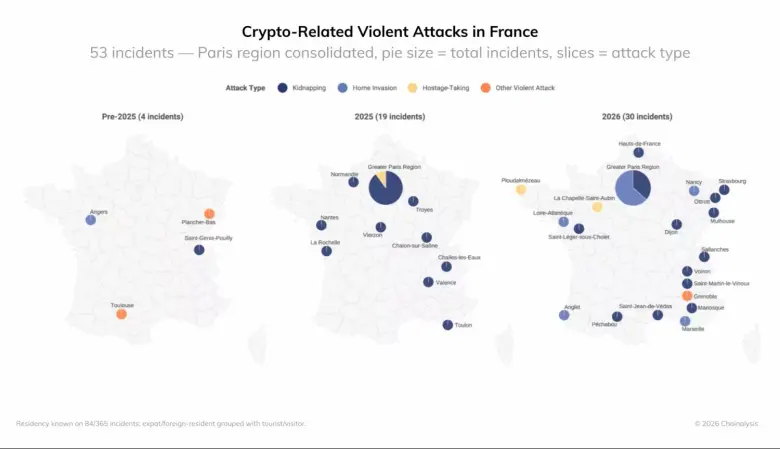
Analysts at Chainalysis recorded at least 30 publicly known cases of violence in France during the first half of the year. They also noted that the real number of such incidents is likely significantly higher than what is known to the public, as people often fear contacting the police. Total global losses from such attacks have exceeded $30 million.

How did it come to this?
There are several possible reasons that could have contributed to this situation.
- Data leak from the tax authority
According to reports, an employee of a tax office in Paris stole and sold dossiers of wealthy cryptocurrency owners on the darknet. The number of attacks rose sharply after this incident. - Leak of Waltio user data
Data from users of the popular service Waltio was stolen. The personal information of approximately 50,000 people was leaked online.
Although the leak reportedly covered email addresses, crypto balances, and tax report information - rather than wallet passwords - the risk of phishing still remains high. Knowing users' approximate balances, scammers can send fake emails on behalf of support services or tax authorities, attempting to trick them into giving up passwords or other confidential data.
While I do not quite understand how anyone could fall for this, let me emphasize separately: practically every service or platform warns that support will never ask for your account password. This is one of the most cliché phishing methods, but at the same time, such methods still remain effective for fraudsters.
Who is targeted most often?
It is also worth noting that criminals have certain criteria for selecting victims. Most often, they target local residents rather than tourists or visitors. According to Chainalysis, 93% of victims in France whose residency status was established were local residents.
Criminals can even come to people's homes.
According to Chainalysis, over 40% of attacks in France were targeted at relatives or close acquaintances of cryptocurrency owners, who were used as leverage against the investors themselves.

For example, there was an attempted kidnapping of the wife of Sébastien Borget, co-founder of the well-known platform The Sandbox, right outside their home.
Crime has also moved beyond Paris. Attacks have been recorded in Strasbourg, Marseille, Grenoble, Toulouse, and Nantes.
French authorities and law enforcement agencies are not sitting idly by: the police have already detained suspects involved in these crimes.
At the same time, the crypto community is actively criticizing the authorities and the new EU rules regarding the exchange of tax information. The main concern is that the state collects significant amounts of personal data in one place, which, in turn, creates risks to people's lives and property in the event of an information leak.
How to protect yourself?
I have already written an article on a similar topic, though a more generalized one publish0x.com.
Based on the data provided, I would personally recommend the following:
- Never brag about your profits or purchases of expensive things, especially on social media.
- Use a separate SIM card and email address for crypto exchanges and financial platforms. This will help separate your crypto accounts from your primary digital life.
- Consider using a hidden wallet. Some hardware wallets, including Ledger, support an additional passphrase linked to an alternative PIN code. Trezor also has a hidden wallet feature, though the setup depends on the model. It is important to understand how this feature works in advance and to back up your data correctly.
- Set up multi-layered protection for your funds. For significant amounts, you can consider a multi-signature wallet (multisig), which requires several independent confirmations to execute a transfer.
- Do not keep all your funds in one place. Keep only a small amount on your phone or in a wallet for daily use. In the event of an armed attack, the most important thing is your life and health, not cryptocurrency. If a situation threatens your life, do not risk it to save your assets.
*The last point is just my security paranoia, but, just in case, keep it in mind anyway.
Stay safe and thank you for reading.






