
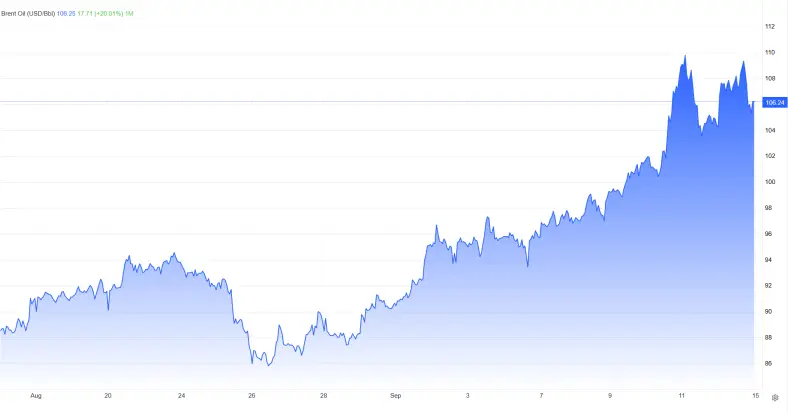
A major supply crisis is currently unfolding in the Brent crude oil market. The price has exceeded the $100–108 per barrel range. It has shown rapid growth, increasing by more than 20% over the past month and by more than 50% compared with the previous year.
For those who do not fully understand the significance of this problem, I will try to explain the potential consequences as well as the main causes behind it. Let us begin with the consequences. Almost all of us use personal vehicles or public transportation, and it is not difficult to understand that rising oil prices will quickly translate into higher gasoline and diesel prices.
Since diesel fuel is the primary energy source for trucks and railway transportation, any shortage is felt most severely in this sector. Bus operators will be forced to increase ticket prices in order to compensate for higher fuel costs.Airlines are also likely to face a significant increase in the cost of aviation fuel, which means passengers should expect higher air ticket prices.
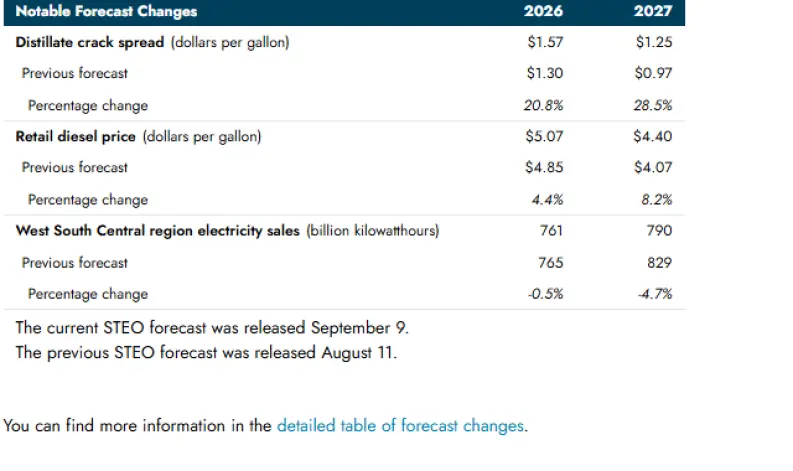
According to the latest EIA Short-Term Energy Outlook (STEO) released on September 9, 2026, the market is already experiencing a massive shock. The distillate crack spread forecast for 2026 has surged by 20.8% to $1.57 per gallon, reflecting global refinery strains. As a direct result, retail diesel prices are projected to climb to an painful $5.07 per gallon, driving up logistics costs and everyday inflation for consumers.
Every product we see in a supermarket, store, or shopping center must first be transported there. Logistics companies include higher fuel costs in their pricing, which automatically increases the final price of goods on store shelves.
Oil is important not only for buses, long-haul trucks, and aircraft — it is also essential for tractors and agricultural machinery used on farms. In addition, oil is a key raw material for producing nitrogen fertilizers and pesticides.
Expensive fertilizers mean higher production costs for future crops. As a result, this will lead to higher prices for bread products, cooking oil, and many other goods. The list of affected products is extremely long.
Synthetic fabrics such as polyester and nylon will also become more expensive. Plastic packaging, household chemicals, cosmetics, car tires, and even asphalt are all produced using petroleum-based products.There is no need to explain exactly which products will be affected. As the raw material becomes more expensive, the prices of thousands of everyday items that ordinary people use will inevitably rise.
In many countries around the world, thermal power plants and electricity stations still partially rely on fuel oil or gas, the price of which has historically been linked to oil prices. For Europeans and residents of other energy-dependent regions, this means a direct increase in heating and electricity bills.
Due to higher energy costs, companies begin cutting their budgets. This can lead to wage freezes, cancelled bonuses, and, in the worst-case scenario, business closures and job losses caused by the threat of recession.
Now that we have examined the consequences, we can move on to the causes.
Obviously, one of the main reasons is the escalation of tensions around Iran and the blockade of the Strait of Hormuz. The volume of oil passing through the Strait of Hormuz has fallen from 20 million barrels per day to critically low levels.
Any diplomatic attempts by the United States, Oman, and other countries to negotiate safe passage for vessels are constantly being disrupted or postponed.
Another major factor is the attacks on Saudi Arabia’s oil infrastructure. Yemeni Houthi forces, supported by Iran, carried out drone attacks on the East–West oil pipeline, which allowed Saudi Arabia to transport oil while bypassing the dangerous strait and reaching the Red Sea coastline.
Riyadh was forced to temporarily shut down this pipeline, immediately reducing the amount of crude oil available on the global market.
Control over the Bab el-Mandeb Strait has also played an important role. The Houthis have effectively controlled parts of Yemen’s Red Sea coastline, making the safe movement of oil tankers toward the Suez Canal much more difficult.
The cost of war-risk insurance for vessels has increased to extremely high levels — around 3–10% of the vessel’s total value.
The impact of the war between Ukraine and Russia cannot be ignored either. Successful Ukrainian strikes on Russian oil refineries have contributed to fuel shortages inside Russia, and through what is known as the domino effect, global prices for refined petroleum products — especially diesel fuel — have risen sharply.
I will not include specific figures here, as the article would become too long, and I do not want to overload you with excessive statistics on this topic. However, if we estimate the approximate contribution of each factor, the situation could be described as follows:
50–60% — the blockade of the Strait of Hormuz;
20–25% — attacks on the East–West oil pipeline;
10–15% — control over the Bab el-Mandeb Strait;
5–10% — refinery disruptions and other regional factors.
Looking at the current situation, it can be concluded that a significant decline in Brent crude prices should not be expected in the coming months. Any new escalation in the Persian Gulf could once again push prices significantly higher. The world will have to adapt to a new reality of expensive energy, or accelerate the transition toward alternative energy sources and the search for safer trade routes. By the way, South Korea has sent its first-ever commercial vessel through the Northern Sea Route, avoiding traditional routes affected by instability in the Middle East. For ordinary people like us, this means only one thing — the so-called “geopolitical tax” that each of us will pay at gas stations and in supermarkets.
I hope this article has helped you better understand the situation surrounding the Strait of Hormuz and where the global economy may be heading.
Thank you for reading until the end. I truly appreciate your time. Have a good and peaceful day.





