
According to Citadel Securities, retail investors have once again returned to aggressive buying. In just one week in October, net purchases of US equities on the Citadel platform reached $9.1 billion, marking the ninth-largest weekly figure of the year.
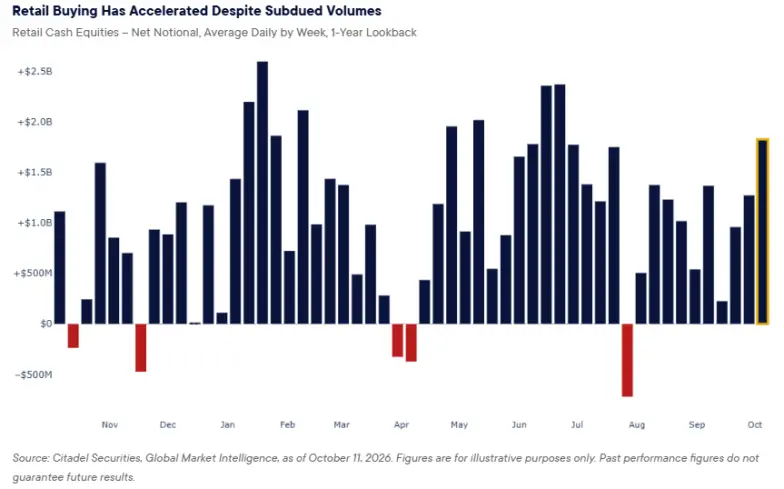
*Retail net cash equity inflows show an aggressive surge in October 2026. Source: Citadel Securities.
However, this trend is raising concerns among some analysts. The reason is that retail investors are buying assets that large institutional investors are actively selling.
It is also worth noting that most of this money is flowing into a single sector, AI.
Semiconductors have emerged as the most popular segment, attracting $2.6 billion in net inflows in a single week. In October, semiconductor buying has been running at three times the annual average.
AI infrastructure comes next, attracting another $2.4 billion for data centers and servers.
Then come neocloud providers, specialized cloud operators that provide computing power for AI training. This segment attracted $700 million, setting a record among Citadel clients.
There is another interesting detail. According to analysts, this aggressive buying is not driven by a general increase in trading volume, but rather by investors' conviction. Buying volume exceeded selling volume by 2.7%. In simple terms, retail investors continue to buy stocks aggressively despite market fluctuations. This could indicate confidence in the future growth of the technology sector.
Analysts at Goldman Sachs note that hedge funds, essentially investment funds managed by highly specialized financial professionals, are cutting their exposure to the US technology sector at the fastest pace on record, taking profits after a prolonged rally. Institutional investors are concerned that companies' massive capital expenditures on AI are not yet translating into corresponding revenue growth.
Data from JPMorgan confirms this divergence. While large funds are moving into defensive assets or diversifying their portfolios, retail investors are aggressively buying the dip in companies such as Nvidia, Micron, and Meta.
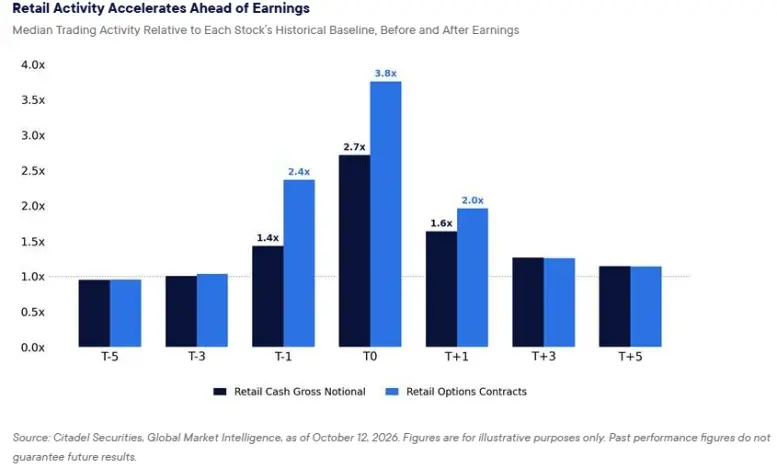
*Retail trading activity and options contracts volume significantly accelerate relative to historical baselines during earnings season (T0). Source: Citadel Securities.
However, historical observations from Citadel Securities suggest that during periods of high market volatility, retail investors may shift from buying the dip to aggressively reducing their positions. Such periods of capitulation have often been followed by positive market performance in the subsequent months. At the same time, this behavior alone does not mean that a market downturn will necessarily be prolonged.
The growth of the AI sector has a real economic foundation. However, this can also create a false sense of security. Investors believe in the future of the technology and buy stocks at almost any price, even when valuations may be excessively high.
According to analysts at Vanda Research, ordinary investors may already be starting to have doubts. They continue buying stocks out of fear of missing out, while also increasingly purchasing financial protection against a sudden market crash.
It is also worth mentioning Citadel founder Ken Griffin, who has pointed out that corporate America is seeing uneven success in extracting real value from its AI models. Bills from OpenAI and Anthropic continue to grow, but productivity gains do not always keep pace.
Based on these developments, retail investors' money continues to support the valuations of major technology companies, but the risk of a significant correction remains. The key is not to blindly chase charts that seem to be heading into the stratosphere, but to distinguish media hype from companies' actual ability to turn AI into net profits. This is a principle worth remembering whenever you decide where to invest your money.






