
🧠 Trader’s Psychology #1
Trade Without Emotion: 10 Questions to Ask Yourself Before Every Trade
💡 This article is part of the “Trader’s Psychology” series, focused on emotional control, risk mindset, and building a consistent trading strategy.
🎯 Why Use a Checklist Before You Trade?
Most trading mistakes don’t come from technical analysis failures — they come from emotional decisions: fear, greed, hesitation, or overconfidence. When emotions take over, we often break our own rules.
🟢 This 10-question checklist is your mental safety net. It helps ensure you're entering a trade based on logic, not impulse. Review it before every trade — over time, discipline becomes automatic.
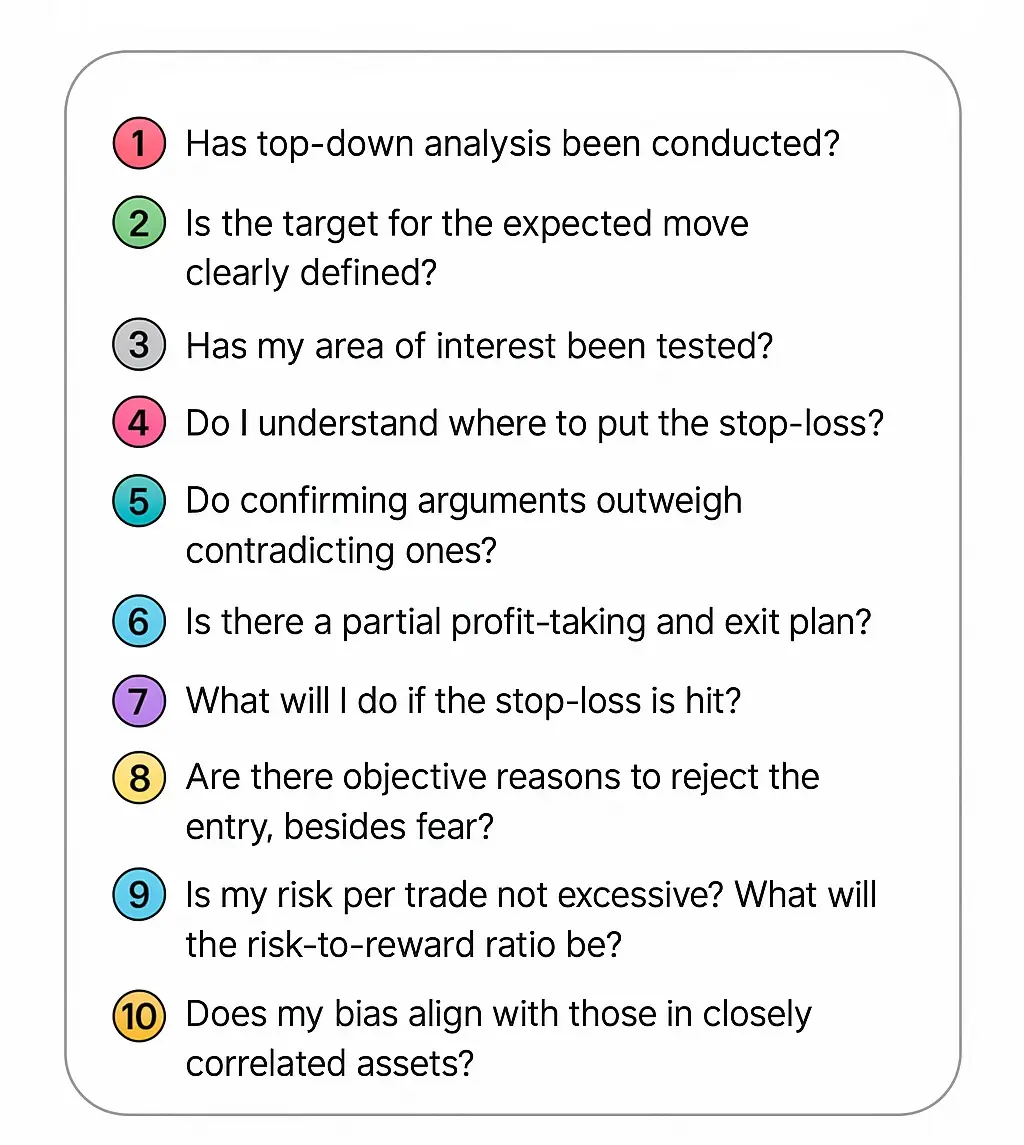
1. Has a top-down analysis (from higher to lower timeframes) been conducted?
Top-down analysis means reviewing the market from higher timeframes (monthly, weekly) down to the lower ones (daily, hourly). This gives a clear view of the overall trend and helps you avoid trading against the broader direction.
📌 Example: It may look like an uptrend on H, but it could just be a pullback in a larger downtrend on D.
2. Is the target for the expected move (take-profit) clearly defined?
Without a clear target, your trade becomes a guessing game: “maybe it’ll go higher.” Always define your take-profit levels based on logic — not greed.
3. Has the area of interest been tested?
The area of interest is a key price level where you expect a reaction. If the price hasn’t tested this zone yet, it might be better to wait for confirmation.
4. Do I understand exactly where to place my stop-loss?
Stop-losses aren’t just emergency breaks — they’re essential to capital preservation. Your stop should be based on structure and logic, not on how much you're “willing to lose emotionally.”
5. Do confirming arguments outweigh the contradicting ones?
Your trade idea should be supported by more confirming signals than opposing ones. If you're unsure or the cons outweigh the pros, it’s often better to stay out.
6. Is there a plan for partial profit-taking and a full exit?
Exit planning isn’t just about final targets. Partial profit-taking helps lock in gains and reduces emotional pressure during volatile moves.
7. What will I do if the stop-loss gets hit?
Mentally preparing for a loss is a sign of maturity. Know your next steps ahead of time: will you re-enter, wait for a new setup, or sit out?
8. Are there any objective reasons to avoid the trade — other than fear?
Your decision to pass on a trade should be based on facts, not on feelings. If you can’t find a clear reason to skip it, other than “it just feels wrong,” it might be worth reassessing.
9. Is my risk per trade reasonable? What’s the risk-to-reward (R:R) ratio?
Even the best setups don’t justify excessive risk. Make sure your potential reward outweighs the risk — ideally, an R:R of at least 1:2.
10. Does my bias align with related, correlated assets?
Example: If you're looking to long NASDAQ, but S&P 500 and Dow Jones are both dropping, something’s off. Correlation helps confirm your bias.
🧠 Conclusion
This checklist won’t guarantee profits — but it will protect you from one of the biggest threats in trading: your own emotions. Stability, structure, and preparation for all outcomes are what separate beginners from professionals.
📌 Pro tip: Save this checklist or print it. Go through it every time before you place a trade.
📅 Next Article in the “Trader’s Psychology” Series
#2 – Why Traders Hold Onto Losing Positions (and How to Stop)
Follow to get notified when it drops.
💬 What About You?
Do you already use a checklist?
Would you add anything to the list? Let’s discuss in the comments!
Support This Blog
This blog has no sponsors. If you enjoy the content and want to support future posts, you can donate to any of the following addresses:
USDT (TRC20): TXtiESEbRDcUAe61SoRVdam1hVkrZxzFqM
BTC: 12GUAVVWxp6X64B6Gx5fjmoTJfaQjYTZmA
ETH (ERC20) 0x2fff48354c36a3b58c45df8e0f73b8c954508d99
Thank you for your support! ❤️






