
Your Wallet Has Been Talking Behind Your Back
Most people look at a crypto wallet address and see nothing but a random jumble of letters and numbers. No name. No face. No phone number. There is absolutely nothing linking those chaotic characters to a living, breathing human being.
It creates a highly comforting, but dangerous, illusion of anonymity.
But here is the catch:
Your wallet has a flawless memory.
Because many major blockchains use public ledgers, you leave a digital breadcrumb trail every time you interact with the network. Anyone with an internet connection can examine your public address and see where funds have moved, which addresses it has interacted with, when transactions occurred, and the assets visible in that wallet.
Sure, a casual observer won't automatically learn your real name from that data.
But professional scammers don't necessarily need your legal identity.
They only need your habits.
Think about how you move your funds. If you're like many crypto users, you may regularly shuffle assets between the same places—perhaps moving crypto from a centralized exchange to your favorite self-custody wallet, or repeatedly sending funds to another address you control.
After doing it dozens of times, something dangerous can happen.
You become comfortable.
Instead of carefully checking every single character of the destination address, you start skimming. You recognize an address by its beginning and ending. You might even copy a past destination directly from your wallet's transaction history.
Scammers know people do this.
And that human habit is exactly what address poisoning is engineered to exploit.
An attacker can generate a malicious address that looks extremely similar to one you frequently interact with. The beginning and ending can be made to look familiar. The attacker then creates a tiny or effectively worthless transaction designed to place that look-alike address into your transaction history.
Your funds haven't been touched.
Your password hasn't necessarily been compromised.
Your seed phrase hasn't necessarily been exposed.
Everything looks normal.
The trap is simply sitting in your history, waiting for you to trip over it.
Days later, you make another transfer.
You open your history. You see what looks like the familiar address. The beginning looks right. The ending looks right.
You copy it.
You press Send.
And just like that, an irreversible cryptocurrency transaction is heading directly toward a criminal's wallet.
The $68 Million Mistake
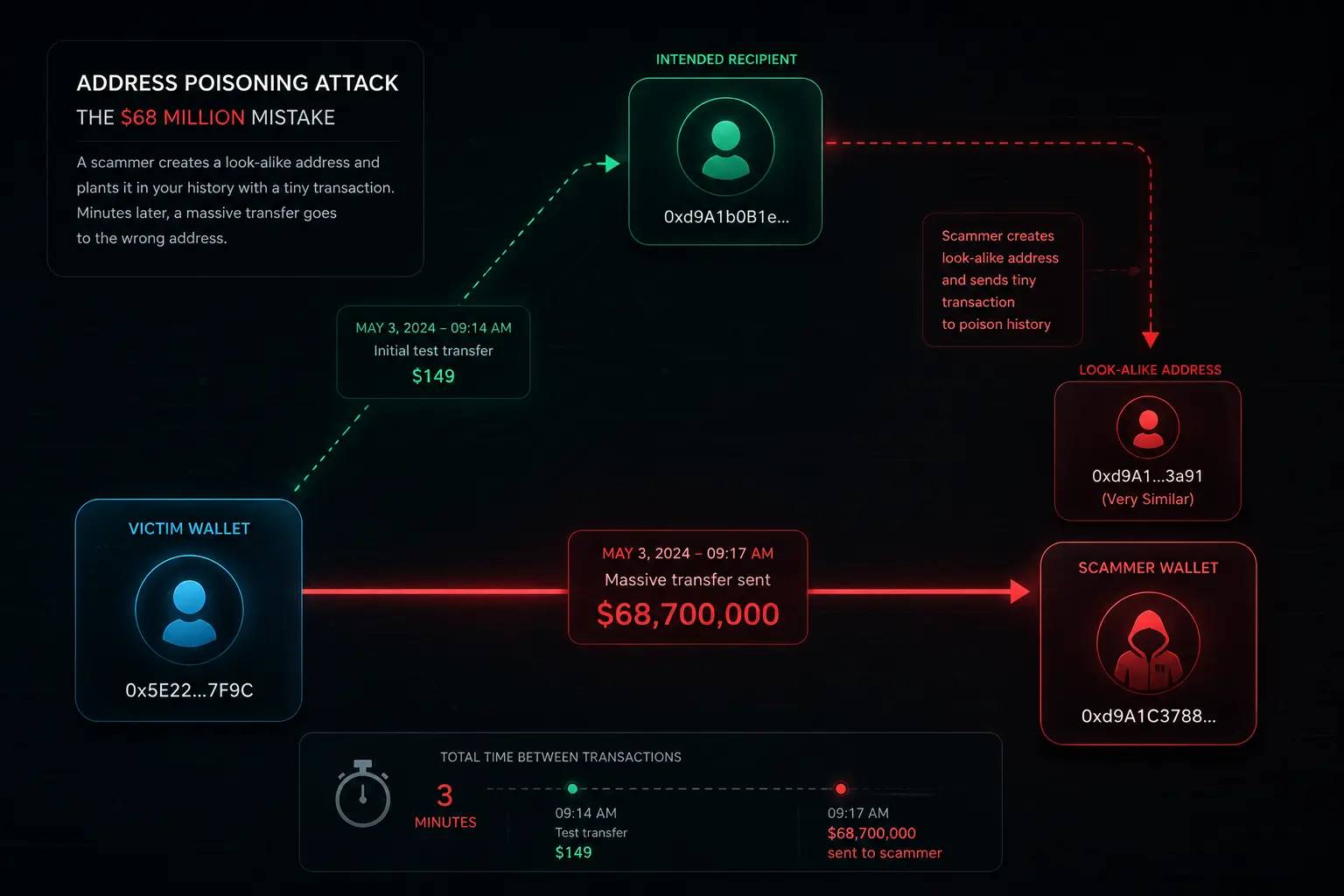
If that sounds like a hypothetical horror story, look at what happened on May 3, 2024.
A crypto holder fell victim to an address-poisoning attack and accidentally transferred approximately $68 million worth of wrapped Bitcoin to a poisoned look-alike address.
The victim had first made a legitimate small transfer to the real destination. Minutes later, when making the much larger transfer, the funds instead went to the attacker's similar-looking address.
And this wasn't simply one attacker manually creating one clever address.
When investigators mapped the wider infrastructure, they identified eight seeder wallets and an astonishing 82,031 potential look-alike addresses associated with the campaign.
Most didn't need to succeed.
One human mistake was worth $68 million.
The victim began sending messages to the attacker through blockchain transactions, warning that the stolen funds could be traced and that the attacker could eventually be identified.
Six days later, something extraordinary happened.
The attacker returned the original $68 million.
This victim was extraordinarily fortunate.
Others weren't.
Chainalysis calculated that even after those $68 million were returned, the wider address-poisoning campaign still netted approximately $1.49 million.
But perhaps the most disturbing part of this story is what didn't happen.
The blockchain wasn't cracked.
Its encryption didn't suddenly collapse.
The victim didn't necessarily hand somebody a seed phrase or password.
The attacker exploited something much older than cryptocurrency:
Human trust. Human habit. And one moment of inattention.
Which brings us to an even darker question.
If a blockchain address doesn't have your real name written across it...
how does a scammer begin connecting that wallet to YOU?
How Scammers Connect Your Wallet to YOU
Your blockchain address might not have your legal name stamped across it, but the rest of your digital footprint can leave breadcrumbs everywhere you go.
This is where the attack can shift from automated blockchain scanning into something much more personal.
Put yourself in the shoes of a predator.
Imagine a scammer has identified a high-value wallet worth targeting. Using public blockchain data, they can examine the on-chain activity visible for that address. They may see that it handles significant amounts of crypto, interacts repeatedly with certain addresses, or follows recognizable transaction patterns.
But the thief still faces a brick wall:
They don't necessarily know who is sitting on the other side of the screen.
To break through that wall, they need a bridge between the blockchain and the person behind it.
And sometimes, we build that bridge for them.
Think about your own online habits.
Maybe you once posted your public wallet address in a forum to receive a payment, enter a giveaway, showcase an NFT, accept donations, or participate in a crypto community.
Maybe the same pseudonym you use in a Web3 community also appears on X, Telegram, Discord or Reddit.
Maybe you celebrated a profitable trade publicly.
Or perhaps you uploaded a screenshot of your portfolio without noticing the balances, account details or other clues visible around the edges.
One tiny clue might tell an attacker almost nothing.
But combine enough clues and something dangerous can begin to emerge:
A target profile.
And that's when the attack can become personal.
A message suddenly appears.
Maybe it looks like an automated security warning from an exchange you actually use:
- “⚠️ Urgent: Suspicious account activity detected.”
- “Your trading access has been temporarily restricted.”
- “Verify your account immediately to prevent further restrictions.”
Or perhaps fear isn't the weapon.
Greed is.
“🎉 Congratulations! Your wallet is eligible for an exclusive airdrop.”
The attacker doesn't necessarily need to break into your computer to make the first move.
They need something much easier.
They need you to click.
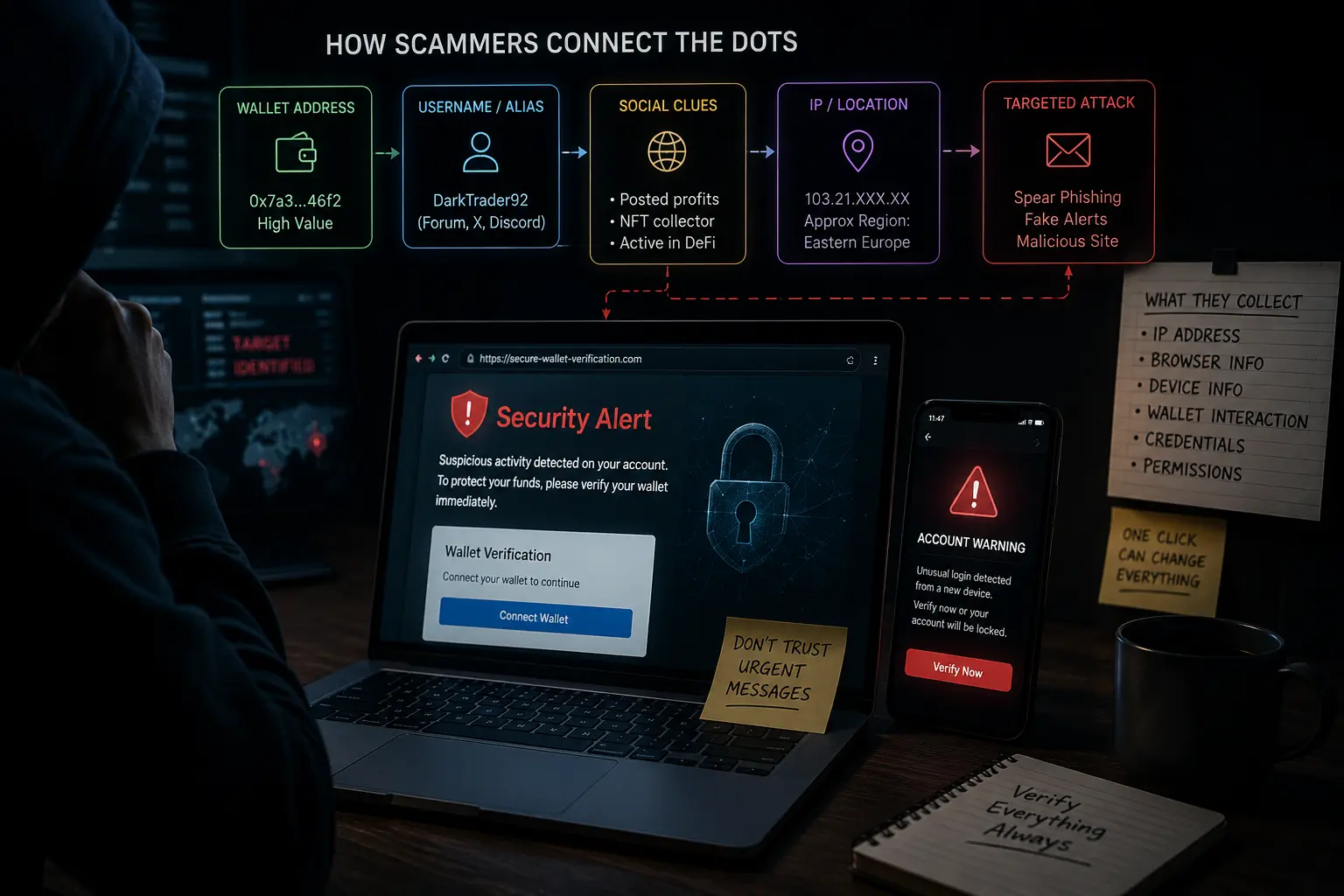
The moment you visit a website, its server normally receives technical information necessary to communicate with your device, including your public IP address. Websites can also obtain various information about your browser and device characteristics.
But this is where internet paranoia often gets ahead of reality.
Your IP address is not a magical skeleton key to your crypto fortune.
Knowing someone's public IP address does not automatically reveal their seed phrase, private keys, exchange password, precise home address, or give an attacker control of their cryptocurrency.
What it can provide is another clue.
An IP address can often indicate an approximate geographic region and internet service provider. That information isn't always precise. But combined with information gathered from social media, leaked data, usernames, phishing interactions or other sources, seemingly insignificant clues can help make an attack more convincing.
And a malicious website may be interested in much more than your IP address.
The real objective could be manipulating you into entering account credentials, downloading malware disguised as legitimate software, connecting a Web3 wallet, or approving a malicious transaction or token permission you don't fully understand.
And there's an important distinction:
Simply connecting a wallet to a website does not automatically give that website permission to empty it.
The danger becomes much greater when a victim is manipulated into signing something dangerous, granting permissions they don't understand, revealing secret credentials, or installing malicious software.
That's when a generic phishing message can turn into financial disaster.
Imagine staring at an urgent security warning that appears to come from a platform you trust.
The logo looks right.
The interface looks convincing.
The language sounds professional.
There's even a countdown telling you that your account will be frozen unless you act immediately.
So you rush.
You stop checking.
You start clicking.
You enter information or approve something because you genuinely believe you're protecting your money.
But there never was a security emergency.
The real emergency begins the exact moment you trust the criminal who invented one.
Once an attacker successfully connects enough information about a person with information about a valuable public wallet, they no longer need to cast the widest possible net and hope somebody bites.
Now they can build the scam around the victim.
They have something much more valuable than an IP address.
They have a target.
And that leads to the next question:
If they know who they want...
what happens when the next target is the computer or smartphone where you actually manage your crypto?
How to Make Yourself a Harder Target
Now that we have stripped away some of the internet mythology, we need to address the elephant in the room regarding your devices.
There is a common belief in the crypto space that smartphones are magically secure while desktop PCs are inherently virus-filled death traps.
That isn't how security works.
A phone isn't automatically bulletproof, and a PC isn't automatically compromised.
The bigger danger is managing high-value crypto on the same device you heavily expose to everyday internet risks.
Think about it. If the laptop or phone you use to manage valuable assets is also the device you use to install random browser extensions, click unfamiliar links, download untrusted software, or browse questionable websites, you are increasing the number of opportunities an attacker has to reach you.
Security isn't simply about choosing a phone over a computer.
It is about reducing exposure and protecting the environment where your money is managed.
So how do you make yourself a harder target without pretending any digital system is 100% safe?
You replace convenience with discipline.
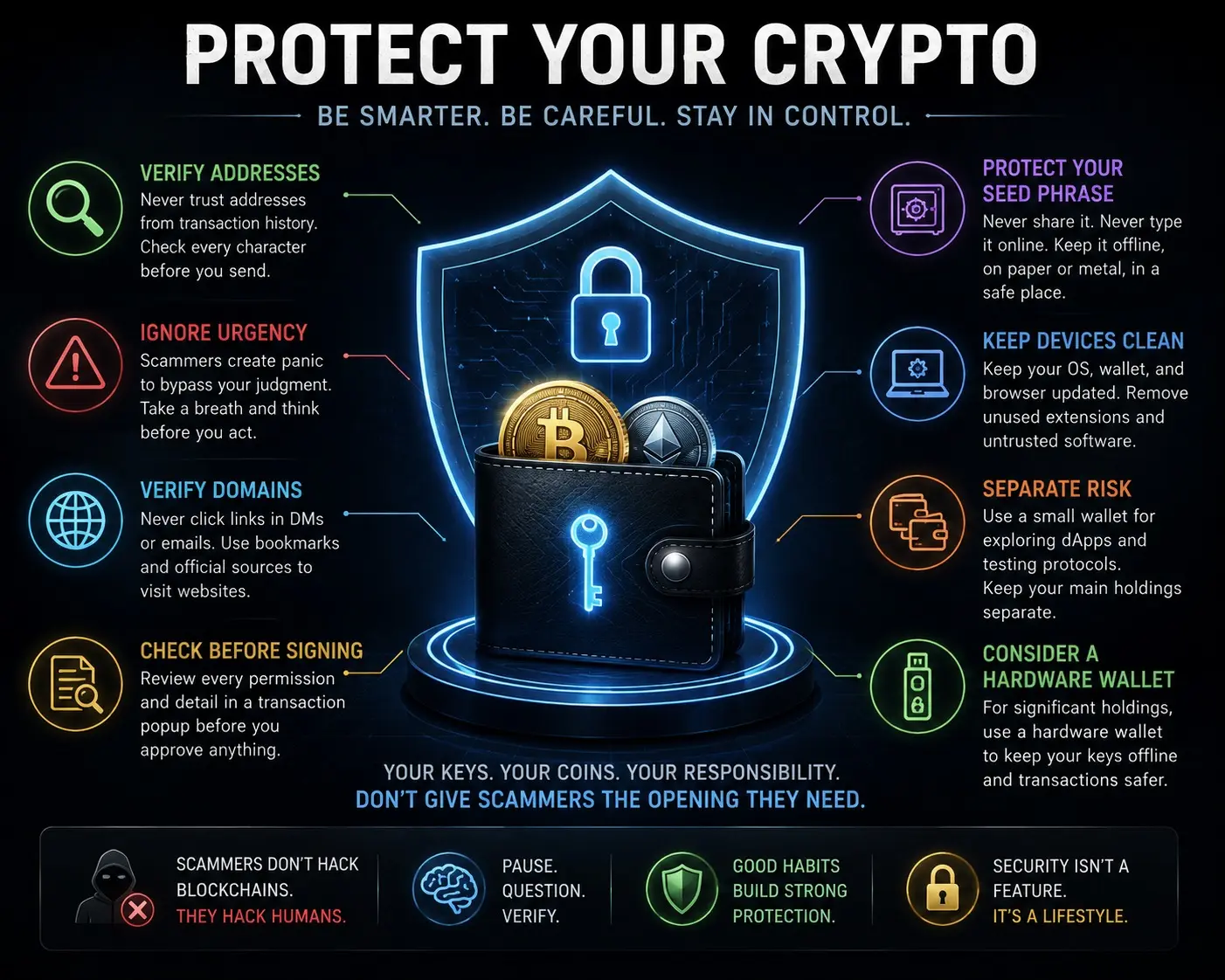
Verify the destination address. Never blindly trust an address simply because it appears in your transaction history. Address poisoning exists specifically to exploit that habit. For important transfers, carefully verify the destination address using a trusted source.
Treat unexpected urgency as a warning sign. A message claiming your funds are about to disappear, your account will immediately be frozen, or an incredible opportunity expires in minutes should make you more cautious—not less.
Verify websites independently. Be extremely cautious with links arriving through unsolicited emails, direct messages, advertisements, or social media. Use known official sources or bookmarks when possible, and inspect domains carefully before interacting with a wallet.
Understand what you are signing. Connecting a wallet and authorizing a transaction or token approval are not the same thing. Before confirming anything, examine exactly what the website is requesting. Dangerous permissions can potentially give a malicious application access to your tokens.
Keep your devices clean and updated. Install operating-system, browser, and wallet updates promptly. Avoid unnecessary browser extensions and untrusted software on devices used to manage important crypto.
Protect the keys to everything. Your recovery phrase and private keys can provide control over your assets. Never give them to someone claiming to be customer support, and never enter them into a random website. Avoid storing them in screenshots, ordinary cloud storage, or unprotected files. Keep recovery information securely offline.
Separate risk. Consider keeping a lower-value wallet for experimenting with unfamiliar dApps or protocols rather than exposing your primary holdings every time you interact with something new.
Consider a hardware wallet for significant holdings. If losing your cryptocurrency would seriously hurt you financially, a hardware wallet can add another layer of protection by keeping private-key operations isolated from an ordinary internet-connected device. It doesn't make you invincible—you can still authorize something malicious—but it can significantly change the attack surface.
At the end of the day, scammers don't always need to defeat the blockchain itself.
Sometimes they only need to defeat the person using it.
The strongest defense against address poisoning, phishing traps, malicious approvals, and social engineering isn't some secret piece of software.
It's the moment before you press Send.
The moment before you press Approve.
The moment when something feels urgent and you decide to check it one more time.
The blockchain may be secure.
Your private keys may still be secret.
Your wallet may appear completely untouched.
But the person holding it is still human.
And sometimes, that is the only vulnerability a scammer needs.
Found this valuable? Follow GhostKey for more crypto stories, investigations, and practical insights. 👻






