
I feel like I’m actually enjoying learning in this age of AI more than ever before. Not because everything is easier, but because everything feels more exposed. I can see how fast things are changing, and I can also see how dangerous it is to only stay at the surface of tools without understanding what is happening underneath.
One of the main reasons I think about this is because I don’t want to be someone who only knows how to use things without knowing how they actually work. Today it’s LLMs, tomorrow it will be something else entirely. If I don’t understand the foundations of how modern systems operate, how computers process information, how graphics pipelines work, or how generative systems are built, then I feel like I’ll be completely left behind in a few years.
It is not just about staying relevant. It is about not being dependent on tools I don’t understand. I often think about the future and how quickly things evolve. In ten years, I don’t want to be in a position where I only know how to interact with interfaces but have no idea what is happening behind them. I don’t want my understanding of technology to be limited to surface level prompts and outputs. I want to understand the structure underneath.
This is also something I think about when I imagine teaching future generations. If I have kids one day, I don’t just want them to learn how to use tools. I want them to understand how those tools are built, how systems behave, and how to think in terms of logic, structure, and experimentation rather than just consumption. That mindset is what keeps me interested in learning deeply instead of just using things passively.
The Difference Between Creating Effects and Creating Systems
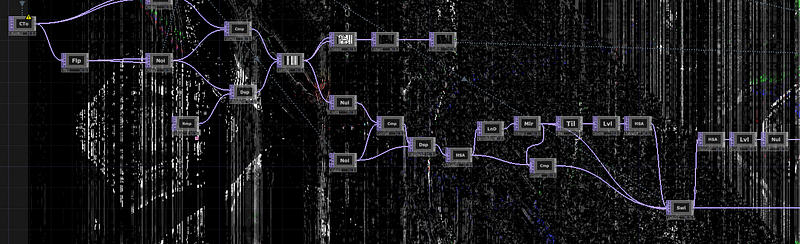
Right now most of my learning is happening inside TouchDesigner. It has become my main environment for understanding how systems actually behave in real time. At first it looks complicated, because you see a large network of nodes, operators, and connections that seem overwhelming. But once you spend time inside it, you start realizing it is not as complicated as it looks.
My workflow usually starts with simple ideas like audio reacting to visuals or a video being displaced in real time. In TouchDesigner, audio does not just stay as sound. It becomes data. That data flows through CHOPs where it can be analyzed, broken down, or remapped. From there it moves into TOPs where it becomes visual information. It can affect textures, colors, motion, or feedback systems. Sometimes it even gets passed into GLSL shaders where every pixel is calculated based on that data.
What makes it interesting is how everything is connected. CHOPs handle the motion and data side of things, TOPs handle images and textures, and SOPs handle geometry and structure. When these systems interact, you start building visual behavior instead of just images. Audio can influence motion, motion can influence feedback, and feedback can reshape the original input again. It becomes a loop rather than a straight line.
I will be showing visuals and screenshots throughout this post so you can see how these systems actually look inside the interface. Even though at first it might seem like a complicated mess of nodes, once you understand the flow, it becomes very logical. It is just data moving through different stages and being transformed step by step.
Alongside this, I will also be linking my YouTube and Patreon where I share full breakdowns, project files, and experiments. The goal is not just to show finished visuals, but to show the process behind them. How they are built, how they evolve, and how small changes inside a system can completely change the final output.
At the same time, I also feel a strong push to go deeper into coding itself. I want to properly understand Python, not just as a scripting tool but as a way of thinking about systems. I also want to understand GLSL shaders more deeply, because shaders are where a lot of modern visual systems actually live. That is where each pixel becomes a calculation and every frame becomes a dynamic process rather than a static image.
The more I learn, the more I realize that everything I am doing right now is connected. TouchDesigner, Python, GLSL, audio processing, generative systems, even AI models like LLMs all exist in the same space of thinking in systems rather than isolated tools. That is why I feel like learning in this era is actually exciting. Not because it is easy, but because it forces you to think in layers.
I don’t want to just use tools. I want to understand them. And more than that, I want to build my own way of working with them.
YouTube: https://www.youtube.com/@corpsekaizen
Patreon: https://www.patreon.com/corpsekaizen





