
Exploring vertex shaders, fragment shaders, and the foundations of computer graphics.
As I begin learning GLSL, I am starting to understand how shader programs are structured and what happens behind the visuals we see on screen. While shaders can seem intimidating at first, breaking them down into smaller pieces makes them much easier to understand.
A shader program is generally made up of two main parts: a vertex shader and a fragment shader. Each stage has its own purpose and each contains a void main() function, which acts as the entry point for execution. Although the main() function may initially appear almost empty, it is where the logic of each shader stage is written.
One of the first responsibilities of a vertex shader is to assign a value to gl_Position. This variable is of type vec4, a vector containing four values. Most people are familiar with the three spatial coordinates: x, y, and z, which describe a position in three-dimensional space. The fourth value, w, introduces the concept of homogeneous coordinates.
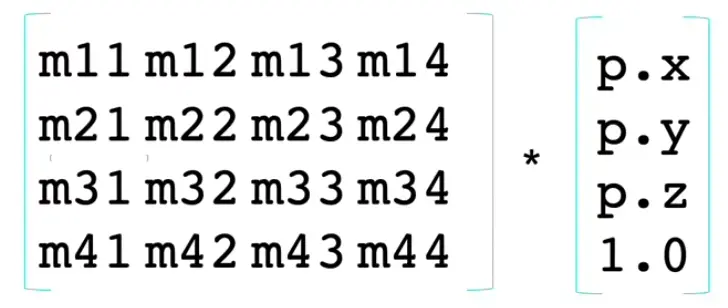
At first, the extra component can seem unnecessary, but it allows positions to be transformed using matrices. These matrix operations make it possible to perform translations, scaling, rotations, and perspective projections efficiently on the GPU. In other words, the fourth component is one of the reasons objects can be moved, rotated, and viewed from different angles in a graphics application.
The fragment shader comes after the vertex shader and is responsible for determining the final appearance of pixels on the screen. This is where colors, gradients, lighting calculations, and many visual effects are created.
What fascinates me most about learning GLSL is how much mathematics and computer graphics are hidden behind even the simplest lines of code. A single assignment to gl_Position is connected to an entire pipeline of transformations that eventually turns data into the images we see on our screens.
I am still at the beginning of my GLSL journey, but every concept I learn reveals another layer of how modern graphics work, making the process both challenging and rewarding.






